
Grapefruit Juice Interactions: Why Some Medications Are Affected
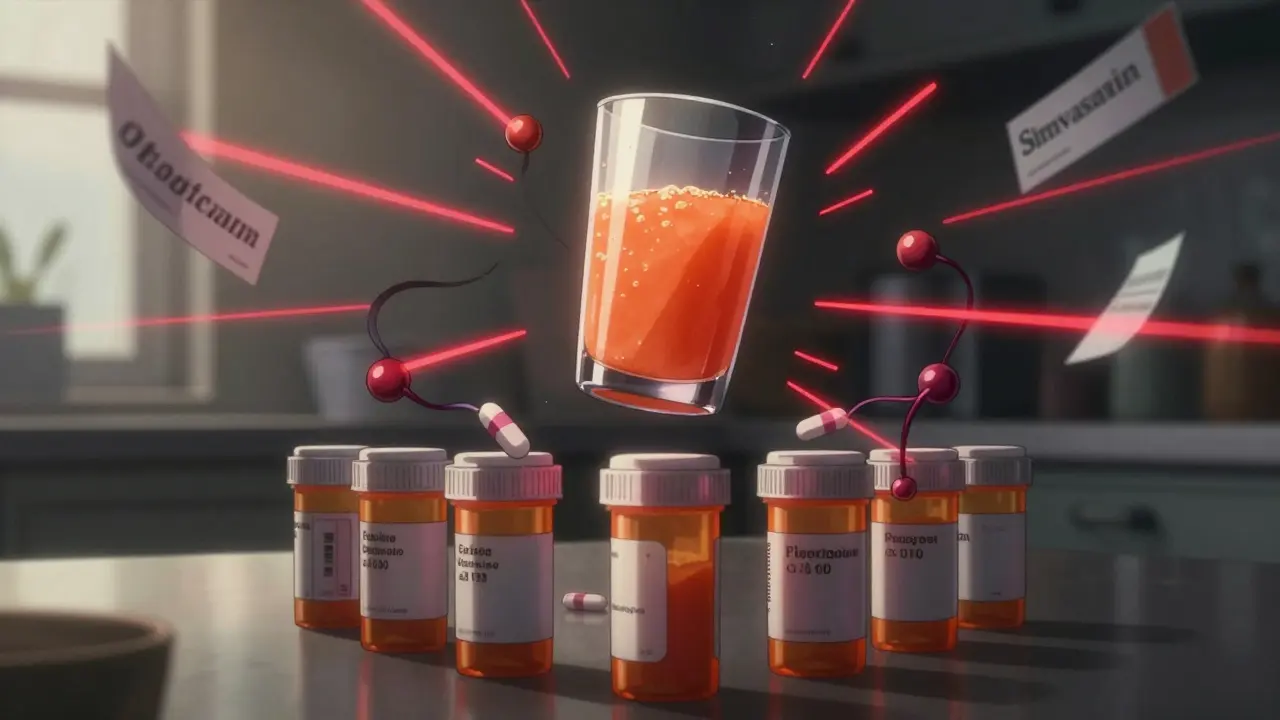
One glass of grapefruit juice in the morning might seem like a healthy choice-until it turns into a silent danger if you’re taking certain medications. This isn’t just a myth or a vague warning on a label. It’s a real, well-documented, and sometimes deadly interaction that affects more than 85 medications. And it doesn’t matter if you drink it fresh, frozen, or from concentrate. Just 200 milliliters-about a cup-can change how your body handles drugs in ways that doctors still don’t always catch.
How Grapefruit Juice Changes Your Medications
Grapefruit juice doesn’t just taste different from orange juice-it works differently inside your body. The problem lies in compounds called furanocoumarins, mainly bergamottin and 6',7'-dihydroxybergamottin. These aren’t sugars or vitamins. They’re chemicals that permanently disable a key enzyme in your gut called CYP3A4.
This enzyme normally breaks down many medications before they enter your bloodstream. Think of it like a security checkpoint. Without it, drugs pass through unchecked. That means more of the drug gets absorbed. For some medications, that can mean levels in your blood jump by 300% to 800%. That’s not a little extra-it’s a dangerous overdose waiting to happen.
It’s not just CYP3A4. Grapefruit juice also blocks OATP transporters, which help move certain drugs into your cells. When those are blocked, some drugs can’t get where they need to go. That’s why some medications become less effective, not more. The effect isn’t immediate either. Once the enzyme is shut down, your body needs about 72 hours to make new ones. So even if you drink grapefruit juice at breakfast and take your pill at night, you’re still at risk.
Which Medications Are Most at Risk?
Not all drugs are affected the same way. Some are barely touched. Others are completely transformed by grapefruit juice. The biggest red flags show up in a few key categories.
Statins-the cholesterol-lowering drugs-are among the most dangerous. Simvastatin and lovastatin can see their blood levels spike by over 300%. That raises the risk of rhabdomyolysis, a condition where muscle tissue breaks down and can cause kidney failure. Atorvastatin is also risky, though less so. But pravastatin, rosuvastatin, and fluvastatin? They’re safe. Why? Because they don’t rely on CYP3A4 to break down.
Calcium channel blockers like felodipine and nifedipine are next. Felodipine’s levels can jump 8-fold after just one glass. That can send blood pressure crashing too low, leading to dizziness, fainting, or even heart problems. Amlodipine, on the other hand, isn’t affected. The difference? It’s metabolized differently.
Benzodiazepines like midazolam and triazolam-used for anxiety and sleep-can become dangerously strong. Midazolam’s effect can increase by over 500%. That means sedation can last hours longer than expected, raising the risk of falls, confusion, or breathing issues, especially in older adults.
Other high-risk drugs include cyclosporine (used after transplants), some antiarrhythmics like amiodarone, and certain immunosuppressants. Even some psychiatric drugs like sertraline and buspirone can be affected, though the risk is lower.
And here’s the twist: some drugs become less effective. Theophylline (for asthma) and itraconazole (an antifungal) drop in concentration when taken with grapefruit juice. The reason isn’t fully understood, but it’s enough to make you think twice before assuming grapefruit is always a problem.

Who’s Most at Risk?
It’s not just about what you’re taking-it’s about who you are. Older adults are especially vulnerable. About 42% of people over 65 take five or more medications. That increases the chance one of them is affected. The American Geriatrics Society lists grapefruit interactions as a major concern for seniors in their 2023 Beers Criteria.
People with liver or kidney problems are also at higher risk. Their bodies are already slower at clearing drugs. Add grapefruit juice, and the burden skyrockets.
Genetics play a role too. Some people naturally have more CYP3A4 enzymes in their gut. Studies show those individuals see the biggest spikes in drug levels. A genetic variant called CYP3A4*22 has been linked to stronger interactions. That means two people taking the same drug and drinking the same amount of juice can have wildly different outcomes.
And here’s the scary part: most people don’t know they’re at risk. A 2021 study found only 28% of patients could correctly name which of their medications interacted with grapefruit-even after being told by a pharmacist.
What About Other Citrus Fruits?
Not all citrus is the same. Regular oranges, tangerines, and clementines? Safe. They don’t contain furanocoumarins.
But Seville oranges-used in marmalade-do. So do pomelos and some hybrid citrus fruits. If you’re on a high-risk medication, avoid anything that looks or tastes like a grapefruit, even if it’s not labeled as one.
Even grapefruit-flavored sodas, candies, or supplements can contain the same compounds. Always check the ingredient list for “grapefruit extract” or “natural citrus flavor.”

What Should You Do?
The safest advice is simple: if you’re on a medication that interacts with grapefruit, don’t consume it at all.
That means no juice, no fruit, no smoothies, no flavorings. The effect lasts for days, so timing doesn’t fix it. Waiting four hours between juice and pill? Doesn’t work for CYP3A4 drugs. You need to avoid it completely for 72 hours before and during treatment.
Check your prescription labels. The FDA now requires grapefruit warnings on 21 high-risk medications, including simvastatin, felodipine, and cyclosporine. But many others aren’t labeled. Ask your pharmacist. They’re trained to catch these interactions.
If you love grapefruit and can’t give it up, talk to your doctor about switching to a safer alternative. For statins, switch from simvastatin to rosuvastatin. For blood pressure meds, swap felodipine for amlodipine. These switches are common, safe, and often covered by insurance.
Pharmacies now have tools to flag these interactions. In 2023, over 128 grapefruit-related alerts were built into electronic health records. But those systems only work if your medication list is up to date. Make sure your pharmacist knows every pill, supplement, and herb you take.
The Bigger Picture
This isn’t just about one fruit. It’s about how little we know about what we put in our bodies alongside our meds. Grapefruit juice interactions account for 1.3% of all reported drug adverse events globally. That’s not a small number. In the EU alone, grapefruit-related reactions led to 12 deaths between 2000 and 2019.
Drug manufacturers are responding. Some have reformulated medications to reduce the interaction. The extended-release version of felodipine, for example, causes a smaller spike than the regular kind. Researchers are even working on CRISPR-edited grapefruit that removes furanocoumarins-still in trials, but promising.
But until those alternatives are widely available, the rule stays the same: if your medication warns you about grapefruit, treat it like poison. Don’t test it. Don’t assume it’s okay in small amounts. Don’t rely on memory. Keep a list of your meds and review it with your pharmacist every time you refill a prescription.
Medication safety isn’t just about the pill. It’s about everything that goes with it-including your breakfast.
Can I drink grapefruit juice if I take my medication at night?
No. Grapefruit juice disables enzymes in your gut that take 72 hours to regenerate. Even if you take your medication at night and drink juice in the morning, the enzyme inhibition is still active. The timing doesn’t matter-only complete avoidance does.
Is fresh grapefruit worse than juice?
No. Fresh fruit, juice, frozen concentrate, and even grapefruit-flavored products all contain the same active compounds. The amount of furanocoumarins in one whole grapefruit is enough to cause an interaction. You don’t need to drink a full glass-just 200 mL of juice or one fruit is enough.
What if I only have grapefruit juice once a week?
Even occasional use is risky. The enzyme inhibition lasts for days, and repeated exposure can keep CYP3A4 levels suppressed. For high-risk medications like simvastatin or felodipine, there’s no safe frequency. Complete avoidance is the only recommended approach.
Are there any safe citrus alternatives?
Yes. Regular oranges, tangerines, and clementines do not contain furanocoumarins and are safe to consume with all medications. Seville oranges (used in marmalade) and pomelos are not safe-they have the same harmful compounds as grapefruit.
Why don’t all medications have grapefruit warnings on the label?
The FDA only requires warnings for drugs with proven, clinically significant interactions. But many medications with moderate or emerging risks aren’t labeled yet. Over 85 drugs are known to interact, but only 21 are currently required to carry warnings. Always ask your pharmacist-even if the label doesn’t say anything.




Comments
Angel Tiestos lopez
January 13, 2026 AT 10:06bro i just drank grapefruit juice with my statin and now i’m kinda panicking 😅 i thought it was just a myth like ‘don’t mix alcohol and antibiotics’ but now i’m reading this and i feel like my liver is screaming at me 🍊💀
Alan Lin
January 13, 2026 AT 11:07This is a meticulously researched and clinically significant piece. The biochemical mechanisms underlying CYP3A4 inhibition are not merely academic-they are life-altering. I urge all healthcare providers to institutionalize grapefruit interaction screening as a standard of care, particularly in polypharmacy populations. The data is unequivocal.
Adam Vella
January 14, 2026 AT 20:23One must consider the epistemological framework of pharmaceutical regulation. The FDA's requirement for labeling is not a reflection of biological truth, but of bureaucratic pragmatism. To assume that only 21 drugs are dangerous is to confuse administrative convenience with physiological reality. The system is designed to minimize liability, not to maximize patient safety.
Nelly Oruko
January 15, 2026 AT 04:44I didn’t know grapefruit could do this. I’ve been drinking it with my blood pressure med for years. 😳 I just called my pharmacist-she said switch to amlodipine. Thank you for this. I’m sharing it with my mom.
vishnu priyanka
January 17, 2026 AT 01:46in india we don't really drink grapefruit juice but i heard from my cousin in texas he got hospitalized after mixing it with his heart med. wild how something so 'healthy' can be a silent killer 🤯
Trevor Whipple
January 17, 2026 AT 03:25soooo… you’re telling me i can’t have my morning grapefruit with my simvastatin? bro i’ve been doin’ it for 5 years. you’re just mad ‘cause you don’t like citrus. it’s fine. i’m fine. my liver’s fine. 🤷♂️
Lethabo Phalafala
January 18, 2026 AT 22:53I just cried reading this. My aunt died from rhabdomyolysis after drinking grapefruit juice with her statin. No one warned her. The pharmacist didn’t say a word. This isn’t just info-it’s a memorial. If you take meds, talk to your pharmacist. Don’t wait until it’s too late.
Lance Nickie
January 19, 2026 AT 07:53Actually, orange juice does the same thing. They just don’t tell you because it’s less profitable. Grapefruit is the scapegoat.
Milla Masliy
January 21, 2026 AT 03:17I love this post. I’m a nurse and I’ve seen too many people ignore these warnings. I always hand out little cards with their meds and the grapefruit thing written in big letters. It’s crazy how many people think ‘natural’ means ‘safe’.
Damario Brown
January 22, 2026 AT 01:24You people are missing the point. This isn’t about grapefruit. It’s about the pharmaceutical-industrial complex exploiting metabolic pathways for profit. They design drugs to be metabolized by CYP3A4 because it allows them to control bioavailability and patent life cycles. The grapefruit interaction? A side effect of systemic greed.
sam abas
January 23, 2026 AT 10:13I read the entire thing. Honestly? It’s overkill. Most of these interactions are theoretical. I’ve been taking felodipine with grapefruit juice for 8 years. I’m 63. My BP is perfect. My kidneys are fine. I’ve never had a single issue. The study you cited? Small sample size. Confounding variables. And you didn’t even mention that the effect is dose-dependent. I mean, come on. This is fearmongering dressed up as science. I’m not stopping my juice.
John Pope
January 23, 2026 AT 23:19The real tragedy here isn’t grapefruit-it’s that we’ve outsourced our health to corporations who profit from our ignorance. We’re told to take pills for everything, then punished for eating fruit. It’s a dystopian joke. They’ll CRISPR-edit grapefruit before they fix the broken pharmacovigilance system. We’re not patients-we’re revenue streams.
Clay .Haeber
January 25, 2026 AT 10:27Ah yes, the classic ‘avoid grapefruit’ lecture. How quaint. I’m sure next you’ll tell me to stop breathing near air pollution or not to drink water after taking aspirin. You’re all just scared of flavor. I’ll take my 800% spike in simvastatin and enjoy my breakfast, thank you very much. 🍊👑
Priyanka Kumari
January 25, 2026 AT 15:04This is so important! I teach nutrition to seniors in my community and I always emphasize this. Many think ‘if it’s fruit, it’s fine.’ I show them the list of safe citrus and even make a printable chart. Knowledge is power-and it saves lives.
Avneet Singh
January 26, 2026 AT 18:05The 1.3% adverse event statistic is statistically insignificant when normalized against polypharmacy prevalence. This article is an example of confirmation bias amplified by media sensationalism. The real issue is inadequate pharmacogenomic screening-not grapefruit.