
Unexpected Side Effects from Generic Medications: When to Seek Help
Switching to a generic medication can save you money-sometimes hundreds of dollars a month. But for some people, that switch isn’t just a cost-saving move. It can trigger strange, unsettling, or even dangerous side effects that weren’t there before. If you’ve noticed something off after your pharmacist handed you a different pill, you’re not imagining it. And you’re not alone.
Why a Generic Isn’t Always the Same
Generic drugs are required to contain the same active ingredient as the brand-name version. That part is straightforward. But what’s not talked about much? The rest of the pill. The fillers, dyes, coatings, and preservatives-called excipients-are not regulated to be identical. One manufacturer might use lactose as a binder. Another might use cornstarch. One might color a tablet red with FD&C Red 40; another leaves it white. For most people, this doesn’t matter. But if you’re sensitive to gluten, dye, or even a specific preservative, these tiny differences can cause big problems.Take thyroid medication, like levothyroxine. A 2023 GoodRx analysis of 15,000 patient reviews found that 23.7% of people switching to generic versions reported new symptoms-fatigue, heart palpitations, weight changes-within days. Why? Because even small shifts in how the active ingredient is absorbed can throw off your entire hormone balance. The FDA considers levothyroxine a narrow therapeutic index drug, meaning a tiny change in blood levels can mean your body is under- or over-treated. A 2020 JAMA Internal Medicine study showed 14.7% of patients on generic levothyroxine had unexpected side effects after switching manufacturers, compared to just 4.2% who stayed on the brand-name version.
Hidden Triggers in the Ingredients
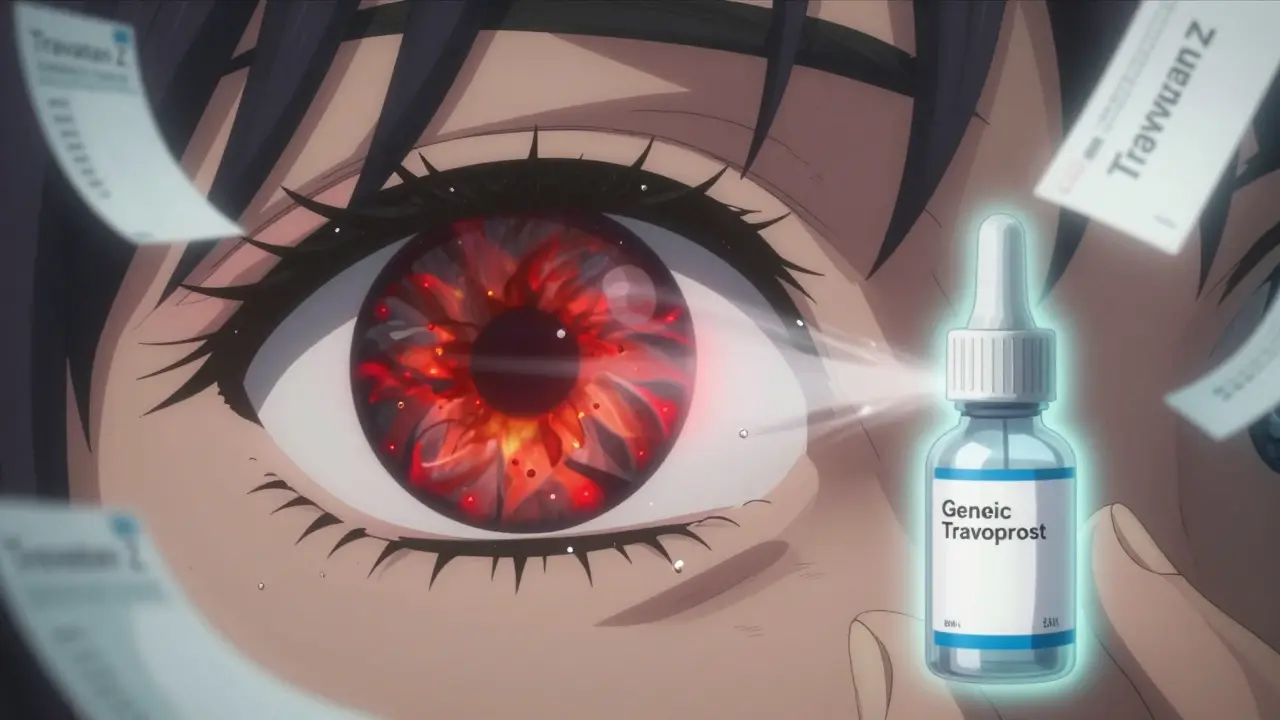
You might not realize that a pill you’ve taken for years suddenly started causing headaches, rashes, or stomach pain because the manufacturer changed its dye. Artificial food dyes like Red 40 and Yellow 5 have been linked to migraines and hyperactivity in children. A 2022 study in the Review of Ophthalmology found that patients switching from branded Travatan Z to a generic version of travoprost developed severe eye irritation-not because the active drug changed, but because the generic used benzalkonium chloride (BAK) as a preservative, while the brand used SofZia. BAK is known to irritate sensitive eyes. Patients who had never had issues before suddenly developed burning, redness, and blurred vision.Gluten and lactose are other silent culprits. If you have celiac disease or lactose intolerance, even a trace amount in a pill can trigger a flare-up. The FDA doesn’t require manufacturers to label excipients as gluten-free or dairy-free unless they’re marketing to those populations. So unless you check the manufacturer’s website or call your pharmacist, you won’t know what’s in that little pill.
When a Switch Goes Wrong
It’s not just about what’s in the pill-it’s about how it’s made. A 2018-2019 recall of the blood thinner valsartan affected over 2.3 million people because of contamination with NDMA, a probable carcinogen. That wasn’t a bad batch-it was a systemic manufacturing flaw. And 73% of the active ingredients in U.S. generics come from overseas facilities, mostly in India and China. While most follow strict standards, inspections aren’t always consistent. The Government Accountability Office found that 18.3% of foreign generic plants had delayed or limited inspections between 2020 and 2022.For some drugs, the risk is higher. Anti-seizure medications like phenytoin and lamotrigine, psychiatric drugs like sertraline and bupropion, and blood pressure pills like amlodipine have all seen spikes in patient reports after generic switches. A 2015 study in the Annals of Internal Medicine found that 8.3% of patients switching from brand-name Zocor to generic simvastatin reported new muscle pain or weakness-far higher than the 2.1% who stayed on the brand. For people with heart disease, that kind of change can be dangerous.
What to Watch For
Not every new symptom means your medication is the problem. But if you notice something unusual within 1-2 weeks of switching to a generic-and it doesn’t fade after 3-5 days-you should pay attention. The FDA defines serious side effects as those that cause hospitalization, disability, life-threatening conditions, or birth defects. But you don’t need to wait for that.Here are red flags that mean you should call your doctor within 24 hours:
- New or worsening swelling (especially in ankles or face)
- Unexplained skin rash, blisters, or peeling skin
- Severe stomach pain, vomiting, or diarrhea lasting more than 48 hours
- Heart palpitations, chest pain, or sudden changes in blood pressure
- Headaches that are worse than usual or accompanied by vision changes
- Extreme fatigue, mood swings, or confusion-especially if you take thyroid or psychiatric meds
- Painful, prolonged erection lasting more than 4 hours (priapism)
Stevens-Johnson Syndrome, a rare but life-threatening skin reaction, has been linked to lamotrigine, allopurinol, and certain antibiotics. It starts with flu-like symptoms, then a painful red rash that spreads and blisters. If you see this, go to the ER immediately.
What to Do Next
Don’t stop taking your medication on your own. That can be just as dangerous as the side effect. Instead:- Write down exactly when the symptom started and what changed-was it a new pharmacy? A different-looking pill? A new manufacturer name on the bottle?
- Check the pill itself. Generic pills often have imprint codes (like “AP 25” or “M 15”). Look up the imprint on websites like Drugs.com or the FDA’s National Drug Code Directory to find the manufacturer.
- Call your pharmacist. Ask: “Which company made this batch?” and “Can I get the same one next time?”
- Tell your doctor. Say: “I switched to a generic and now I’m having [symptom]. I think it might be the formulation.”
- Ask if you can go back to the brand, or if there’s another generic from a different manufacturer that might work better.
Some doctors now keep notes like “Patient responds best to Teva brand of levothyroxine” or “Avoid Mylan version of amlodipine.” That’s a small step, but it helps. A 2023 Johns Hopkins study showed that when doctors documented which generic manufacturer worked for each patient, side effect-related discontinuations dropped by nearly 38%.

The Bigger Picture
The generic drug market is worth over $227 billion. It’s one of the biggest reasons healthcare costs have stayed manageable. But that economic pressure means manufacturers compete on price-not always on consistency. The top five companies now control over 43% of the U.S. generic market. That means fewer options if one version starts causing problems.Thankfully, change is coming. In February 2024, Congress introduced the Generic Drug Safety Act, which would require manufacturers to disclose excipient changes to prescribers. The FDA’s 2024 draft guidance is focusing on complex generics-like inhalers, patches, and eye drops-where small differences matter most. And in March 2024, the FDA announced a new advisory committee to review drugs with the highest rates of side effect variation, starting with thyroid and epilepsy medications.
You’re Not Overreacting
Many patients feel guilty or dismissed when they report side effects from generics. “It’s just a generic,” they’re told. But your body isn’t a lab. It doesn’t care about regulatory equivalence-it cares about what actually happens to you. If you feel different, you are different. And your experience matters.Keep track. Ask questions. Don’t assume all generics are the same. And if something feels wrong after a switch? Don’t wait. Call your doctor. It might just be the difference between a bad week and a life-changing health crisis.
Can generic medications really cause different side effects than brand-name drugs?
Yes. While the active ingredient must be the same, the inactive ingredients (excipients) like dyes, fillers, and preservatives can vary between manufacturers. These differences can trigger allergic reactions, digestive issues, or changes in how the drug is absorbed-especially in people with sensitivities or those taking narrow therapeutic index drugs like levothyroxine, warfarin, or phenytoin.
Which medications have the highest risk of side effects when switched to generic versions?
Medications with a narrow therapeutic index carry the highest risk. These include thyroid medications (levothyroxine), blood thinners (warfarin), anti-seizure drugs (phenytoin, lamotrigine), and some psychiatric medications (sertraline, bupropion). Studies show 7-15% of patients experience new or worsening side effects after switching, compared to under 5% on the same brand consistently.
What should I do if I think my generic medication is causing side effects?
Don’t stop taking it. Instead, note when symptoms started, check the pill’s imprint code to identify the manufacturer, and contact your doctor and pharmacist. Ask if you can switch back to the brand or try a different generic. Documenting which manufacturer works best for you helps avoid future issues.
Are generic drugs less safe than brand-name drugs?
No-most generics are safe and effective. Over 90% of prescriptions in the U.S. are filled with generics. But safety isn’t just about the active ingredient. Variations in manufacturing, excipients, and quality control mean that for some people, especially those with sensitivities or complex conditions, switching can trigger problems. It’s not about overall safety-it’s about individual response.
How can I find out which company made my generic medication?
Look at the pill-it usually has a code printed on it (like “44 375” or “V 35 97”). Go to Drugs.com or the FDA’s National Drug Code Directory, enter the code, and it will show you the manufacturer. You can also ask your pharmacist directly. Keeping a note of which manufacturer works best for you can prevent future problems.



Comments
Jeff Card
March 2, 2026 AT 12:08I switched to generic levothyroxine last year and started having heart palpitations every morning. Thought it was stress, then anxiety, then maybe caffeine. Turned out the new batch had lactose as a filler-turns out I’m secretly intolerant. My endo had no idea. Took three months to connect the dots. Now I only take the Teva brand. Don’t let them gaslight you-your body knows.
Also, check the imprint code. Mine was ‘A 147’-looked up on Drugs.com and saw it was made by a company in Punjab. Weird, right? I call my pharmacy now before every refill.
Matt Alexander
March 3, 2026 AT 08:08If you’re on generic meds and feel weird, don’t ignore it. Seriously. I had a friend on generic sertraline who got suicidal thoughts after a switch. She thought it was ‘just depression getting worse.’ Turns out the new manufacturer used a different dye and her body reacted. She went back to brand-name and was fine in a week. Talk to your doc. It’s not ‘just a pill.’
Gretchen Rivas
March 4, 2026 AT 16:17My mom’s on warfarin. Switched generics. INR spiked. Almost bled out. Pharmacist didn’t even know the manufacturer changed. Always ask: ‘Who made this?’
Mike Dubes
March 5, 2026 AT 06:27Y’all are overthinking this. I’ve been on generic meds for 15 years. No issues. Maybe your body’s just sensitive? Try not to panic. Also, ‘excipients’? Sounds like a sci-fi word. Just call ‘em filler junk.
My cousin took generic Lamictal, got a rash, switched back, fine. So yeah, it happens. But most people? Fine. Chill.
Helen Brown
March 7, 2026 AT 02:42They’re hiding something. The FDA doesn’t test generics properly. Big Pharma owns the regulators. The ‘same active ingredient’ line? That’s a lie. They’re putting nanoparticles in the pills to track us. That’s why your body reacts. They want you dependent. Watch your pill. If it glows under UV light? Run.
Also, benzalkonium chloride? That’s in snake venom. They’re poisoning us slowly. Call your senator. Now.
Donna Zurick
March 8, 2026 AT 03:48Just had to switch my amlodipine because my insurance dropped the brand. Took 3 days to feel normal again. I didn’t tell my doctor because I didn’t want to be that patient. But now I know. Always ask the pharmacist. Always.
And write down the imprint code. It saved me.
Tobias Mösl
March 8, 2026 AT 20:49You’re all being manipulated. This isn’t about ‘excipients.’ This is about corporate greed. The FDA is a puppet of Big Pharma. They let foreign plants with zero inspections make 73% of our meds. That’s not healthcare-that’s a death lottery.
My cousin died after a generic switch. They called it ‘unexplained cardiac arrest.’ I know better. They don’t want you to know the truth. But I’m telling you: stop taking generics. Go to a compounding pharmacy. Or starve.
And if you’re still on this thread? You’re part of the problem.
Mariah Carle
March 10, 2026 AT 20:32It’s not the pill. It’s the meaning of the pill. We live in a world where identity is commodified, and even our medicine is reduced to a transaction. The generic is not just a chemical-it’s a symbol of our alienation from care.
When you swallow that pill, you’re swallowing capitalism. The excipient is the quiet scream of a system that values cost over conscience.
Maybe your body is reacting not because of lactose… but because it knows you’re being used.
Megan Nayak
March 11, 2026 AT 14:07Oh wow. So we’re supposed to believe that 90% of Americans are fine with generics, but the 10% who suffer are somehow ‘special’? That’s not science-that’s narcissism. You think your body is unique? Everyone’s body is unique. But most people don’t whine about it.
Also, ‘I called my pharmacist’? Congrats. You’re now a pharmacy technician. Maybe you should’ve just stayed on brand-name and paid $400 a month. That’s the real solution.
Stop treating your body like a fragile porcelain doll. You’re not a lab rat. You’re a human. And humans adapt.
Tildi Fletes
March 12, 2026 AT 01:21It is imperative to acknowledge that the regulatory framework governing generic pharmaceuticals is predicated upon bioequivalence standards, which, while statistically valid, do not account for interindividual pharmacokinetic variance. Consequently, patients with underlying metabolic polymorphisms or hypersensitivities to excipients may indeed experience clinically significant deviations in therapeutic response.
One is strongly advised to maintain a pharmaceutical log, including manufacturer, lot number, and temporal correlation of symptom onset. This methodology facilitates traceability and supports informed clinical discourse.
Siri Elena
March 12, 2026 AT 18:51Oh honey. You think you’re the first person to notice that generics can be weird? Welcome to the club. I’ve been on 12 different generics of the same drug. I keep a spreadsheet. Color-coded. My pharmacist calls me ‘the pill whisperer.’
Also, the red one? Always bad. The white one? Usually fine. The one with the weird squiggle? Avoid. I’ve got notes.
And yes, I know the imprint codes by heart. You’re welcome.
Divya Mallick
March 13, 2026 AT 20:02In India, generics are made with precision. We don’t have this drama. You Americans think your body is special. We have 1.4 billion people on generics. No one is crying. You need to stop being so sensitive. Also, why are you paying so much for medicine? That’s your problem, not ours.
Our generics are cheaper and better. You just don’t know how to use them. Maybe you should come to India and learn.
Pankaj Gupta
March 14, 2026 AT 00:13While I respect the concerns raised, it is important to contextualize the data. The FDA’s bioequivalence threshold (80–125% AUC) is scientifically robust. Variability in patient-reported side effects often correlates with heightened awareness post-switch, not pharmacological difference.
That said, for narrow-therapeutic-index drugs, manufacturer consistency matters. I recommend patients who experience adverse effects request the original manufacturer’s product via prescription notation. Documentation is key.
Also, the GAO’s inspection delay statistic is misleading-it refers to scheduling delays, not quality failures. Most foreign facilities meet cGMP standards.