
DASH Diet for Hypertension and Weight: What Really Works

High blood pressure doesn’t always come with symptoms, but it’s silently increasing your risk of heart attack, stroke, and kidney damage. And if you’re also carrying extra weight, that risk climbs even higher. The good news? You don’t need pills or extreme restrictions to make a real difference. The DASH diet was built for exactly this situation - to lower blood pressure fast, with side benefits that include steady weight loss, without making you feel like you’re on a punishment diet.
What Is the DASH Diet, Really?
The DASH diet - short for Dietary Approaches to Stop Hypertension - wasn’t invented by a trendsetter or a celebrity. It was created by scientists at the National Heart, Lung, and Blood Institute (NHLBI) in the 1990s after running two major clinical trials with over 5,000 people. The goal? Find out what eating pattern could lower blood pressure without drugs. The answer wasn’t a miracle food or a magic supplement. It was a simple, balanced way of eating that most people already kind of knew was healthy - but never had a clear plan for.
Unlike keto or intermittent fasting, DASH doesn’t cut out entire food groups. No fasting windows. No carb bans. No protein overload. Instead, it gives you a clear list of what to eat more of - and what to cut back on. The core idea? Load up on vegetables, fruits, whole grains, lean proteins, nuts, and low-fat dairy. Cut way back on salt, sugary drinks, red meat, and processed snacks. That’s it.
The standard version allows 2,300 mg of sodium per day. For better results - especially if you’re already hypertensive - the lower-sodium version drops that to 1,500 mg. That’s about the amount in one teaspoon of salt. Most Americans eat over 3,400 mg daily. The shift isn’t about deprivation. It’s about retraining your taste buds.
How Fast Does It Lower Blood Pressure?
One of the most surprising things about DASH is how quickly it works. In clinical trials, people saw their systolic blood pressure drop by 6 to 11 mmHg in just two weeks. For someone with stage 1 hypertension (140/90 or higher), that’s like going from 148 to 135 - or even lower - without touching a pill.
When you combine DASH with sodium reduction to 1,500 mg, the results get even better. In the PREMIER trial, overweight participants with high blood pressure saw an average drop of 16.1 mmHg in systolic pressure. That’s more than most single blood pressure medications achieve. And it wasn’t just about the number on the monitor. Their hearts started to recover. Left ventricular mass - a sign of heart strain - decreased. Inflammation markers like hs-CRP dropped. Even a protein linked to heart damage, high-sensitivity cardiac troponin I, fell by nearly 18% after 12 weeks.
What’s even more telling? The American Heart Association calls DASH the “Gold Standard.” U.S. News & World Report has ranked it #1 for heart health every year since 2018. It’s not just popular - it’s backed by decades of peer-reviewed science.
Does DASH Help With Weight Loss?
This is where people get confused. DASH isn’t designed as a weight loss diet. But guess what? Most people lose weight on it anyway.
Why? Because it replaces calorie-dense, nutrient-poor foods with ones that fill you up without packing on the pounds. A plate of grilled chicken, brown rice, steamed broccoli, and a side of low-fat yogurt is far less calorie-heavy than a burger, fries, and soda - even if you eat the same volume. In trials, people lost an average of 1 to 3 kg (2-6 lbs) over 6 months without even trying to count calories.
But if you want more dramatic weight loss? Pair DASH with portion control. The PREMIER trial showed that when participants combined DASH with intentional weight loss (averaging 4.5 kg lost), their blood pressure dropped even more - and their vascular function improved significantly. So yes, DASH helps with weight loss, but it’s not a magic bullet. It’s a foundation. Add awareness of portions, and the results multiply.
Compared to low-carb diets, which can drop 5-8% of body weight in 3 months, DASH is slower. But it’s also more sustainable. People don’t crash. They don’t binge. They just start eating better - and keep doing it.

What Does a Real DASH Day Look Like?
Let’s say you’re aiming for the standard DASH plan (2,300 mg sodium). Here’s what your day might look like:
- Grains: 6-8 servings - think 1 slice whole wheat bread, ½ cup cooked oatmeal, ½ cup brown rice
- Vegetables: 4-5 servings - 1 cup raw leafy greens, ½ cup cooked carrots, a small bell pepper
- Fruits: 4-5 servings - 1 medium apple, ½ banana, ¾ cup berries
- Dairy: 2-3 servings - 1 cup low-fat milk, 1 small container of plain yogurt
- Lean protein: 6 or fewer servings - 85g chicken, fish, or tofu (about the size of a deck of cards)
- Nuts/seeds/legumes: 4-5 servings per week - ⅓ cup almonds, 2 tbsp peanut butter, ½ cup lentils
- Fats/oils: 2-3 servings - 1 tsp olive oil, 1 tbsp avocado
- Sweets: 5 or fewer per week - 1 small cookie or 1 tbsp jam
Notice anything? No portion sizes are tiny. No food is banned. You’re not eating salad for every meal. You’re eating real food - just smarter.
The trick? Use your hand as a guide. A serving of meat = your palm. A serving of veggies = your fist. A serving of grains = your cupped hand. It’s not rocket science.
Why Most People Struggle - And How to Beat It
Here’s the truth: DASH works. But it’s not easy to stick with - especially if you’re used to eating packaged snacks, canned soups, or takeout.
Here are the top three reasons people quit - and how to fix them:
- Sodium is hiding everywhere. 70% of the salt in the average diet comes from processed foods - bread, sauces, frozen meals, deli meats. You can’t just avoid table salt. You have to read labels. Look for “no salt added,” “low sodium,” or “unsalted.”
- Dairy is hard if you’re lactose intolerant. About 1 in 3 adults have trouble digesting milk. Solution? Swap regular milk for fortified almond, soy, or oat milk. Same calcium. Same vitamin D. Same results. Greek yogurt? Try lactose-free versions.
- Meal planning feels overwhelming. You don’t need to cook from scratch every night. Batch-cook grains on Sunday. Keep frozen veggies on hand. Use canned beans (rinse them to cut sodium by 40%). A simple rule: if it comes in a box with more than 5 ingredients, think twice.
People who use apps like DASH Diet Helper or MyFitnessPal to track sodium see 73% higher adherence. Digital tools make it easier to stay on track without constant mental effort.
Who Shouldn’t Try DASH?
DASH isn’t perfect for everyone.
If your blood pressure is already below 120/80, the diet won’t make it drop much - and that’s fine. You’re already in the healthy zone. If you’re eating over 5,000 mg of sodium daily (think fast food daily), the jump to 1,500 mg will feel brutal. Start slow. Cut 500 mg at a time. Give yourself weeks, not days.
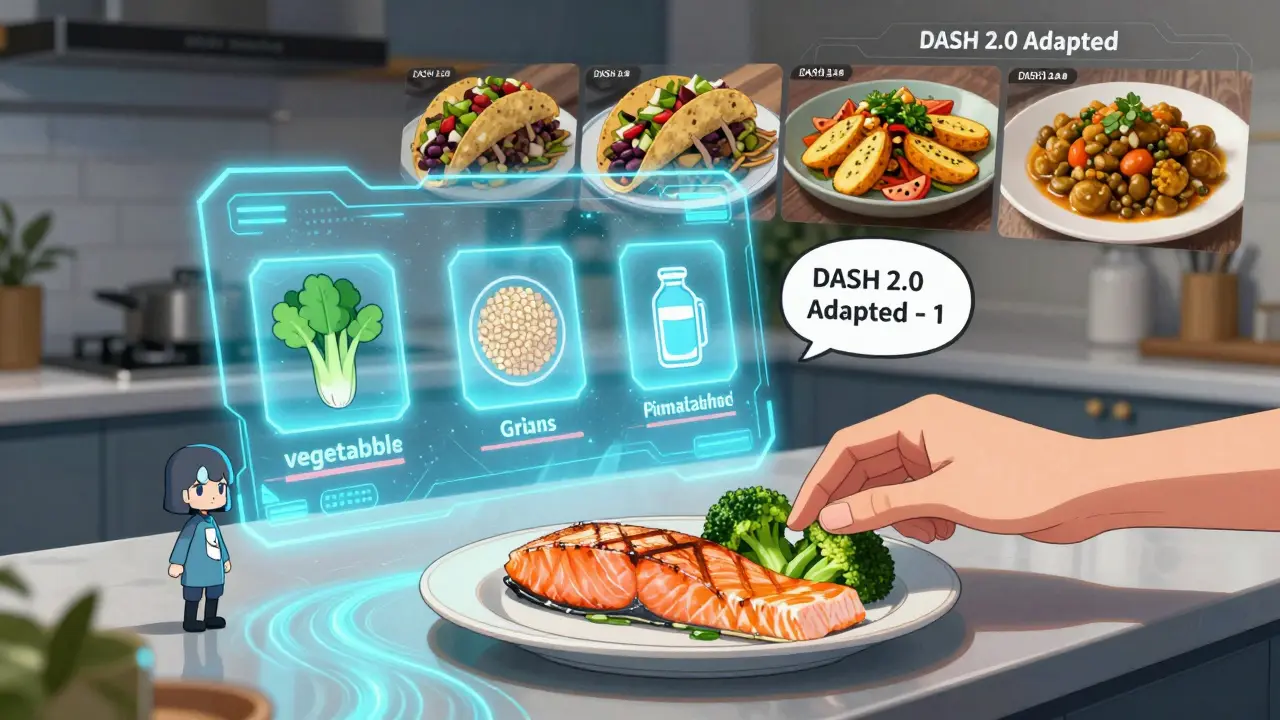
Also, cultural food preferences matter. A 2021 study found that Hispanic communities had 30% lower adherence because traditional meals often rely on salted meats and fried tortillas. That’s why new versions like “DASH Latino” are being tested - swapping in beans, plantains, and grilled fish instead. The same applies to Asian, African, and Indigenous diets. DASH isn’t one-size-fits-all. It’s a framework. Adapt it to your culture. Use spices - cumin, garlic, lime, chili - instead of salt.
The Bigger Picture: Why DASH Is More Than a Diet
DASH isn’t just about lowering blood pressure. It’s about preventing the long-term damage that high blood pressure causes - to your heart, kidneys, arteries, and brain.
Studies show it reduces LDL (“bad”) cholesterol by 11 mg/dL and total cholesterol by 14 mg/dL. It cuts your estimated 10-year risk of heart disease by 10%. For Black adults and women, that risk drops even more - by 13-14%.
And it’s not just for individuals. Medicare has been reimbursing nutrition counselors for DASH-based sessions since 2015. The USDA now includes DASH recipes in SNAP-Ed programs to help low-income families eat better. That’s how powerful this is - it’s becoming part of public health infrastructure.
Even new research is building on it. The NHLBI’s 2023 DASH 2.0 trial combines the original plan with a 12-hour eating window (no food after 8 p.m.). Early results show an extra 8.2 mmHg drop in systolic pressure. And NIH is funding AI-driven DASH plans that adjust based on your glucose levels - something that could personalize it even further by 2025.
Final Thought: It’s Not About Perfection
You don’t need to hit every serving target every day. One study found that people who followed DASH 80% of the time still saw major blood pressure improvements. It’s about progress, not perfection.
Start with one change: swap your morning cereal for oatmeal with berries. Replace your afternoon soda with sparkling water and lime. Use herbs instead of salt on your chicken. Do that for two weeks. Then add another. You don’t need a full meal plan to begin. You just need to start.
High blood pressure doesn’t have to be a life sentence. And you don’t need to be skinny to get healthy. DASH proves that - one vegetable, one whole grain, one low-sodium meal at a time.
Can the DASH diet help me lose weight if I’m overweight?
Yes, but not dramatically on its own. The DASH diet isn’t designed for rapid weight loss. However, because it replaces high-calorie, processed foods with fiber-rich, filling options like vegetables, fruits, and whole grains, most people lose 1-3 kg (2-6 lbs) over 6 months without trying. For more significant weight loss, combine DASH with portion control or a modest calorie deficit. Studies show that when DASH is paired with intentional weight loss (like losing 4.5 kg), blood pressure drops even further and heart health improves more than with either change alone.
How much sodium should I eat on the DASH diet?
There are two versions. The standard DASH diet allows up to 2,300 mg of sodium per day - about one teaspoon of salt. For better results, especially if you have high blood pressure, the lower-sodium version limits intake to 1,500 mg daily. This is the amount recommended by the American Heart Association for optimal heart health. Most people consume over 3,400 mg daily, so reducing sodium is the biggest single change you can make. Focus on cutting processed foods, canned soups, deli meats, and restaurant meals - they’re the main sources of hidden salt.
Is the DASH diet safe for people with diabetes?
Yes, and it’s often recommended for people with type 2 diabetes. The DASH diet emphasizes whole grains, vegetables, legumes, and lean proteins - all foods that help stabilize blood sugar. It’s low in added sugars and refined carbs, which makes it compatible with diabetes management. Many studies show it improves insulin sensitivity and reduces HbA1c levels over time. Just monitor portion sizes of starchy foods like rice and bread, and pair them with protein and fiber to slow digestion. Always consult your doctor if you’re on medication, as diet changes can affect your glucose control.
Can I follow DASH if I’m lactose intolerant?
Absolutely. Dairy is just one part of the plan. You can replace milk, yogurt, and cheese with fortified plant-based alternatives like unsweetened almond, soy, or oat milk. Look for brands that add calcium and vitamin D - these mimic the nutritional profile of dairy. A cup of fortified almond milk counts as one dairy serving. Greek yogurt? Try lactose-free versions. The key is matching the nutrient content, not the source. Many people find plant-based options taste better and are easier to stick with long-term.
Do I need to count calories on the DASH diet?
No, you don’t need to count calories. The DASH diet works by focusing on food groups and portion sizes, not numbers. You’re told how many servings of each food to eat daily - like 4-5 servings of vegetables or 2-3 servings of low-fat dairy. By following those guidelines, you naturally eat fewer processed foods and more nutrient-dense options, which leads to fewer calories without feeling hungry. If you’re trying to lose weight, then calorie awareness helps - but it’s not required for lowering blood pressure.





Comments
Ali Hughey
March 13, 2026 AT 17:44So let me get this straight… the government created a diet that works… and it’s NOT about keto, fasting, or protein shakes? 😱
Who’s funding this? Big Pharma? Big Salt? Big Broccoli??
I’ve been told for 20 years that salt is evil… but then I saw a documentary where a scientist admitted they *wanted* us to stay hypertensive so we’d keep buying meds…
Now this? DASH? A diet with NO banned foods? REAL food? No magic pills?
CONVENIENT.
Who benefits? Who wrote this? Why now?
Are we being groomed for a ‘healthy’ dystopia where we eat oatmeal and smile while our freedoms dissolve?
My neighbor lost 12 lbs on DASH… then got a bill for ‘nutritional coaching’ from Medicare.
…I’m suspicious. Very suspicious. 🤔👁️
Alex MC
March 15, 2026 AT 04:24I’ve been on DASH for 8 months. No dramatic weight loss, but my BP dropped from 148/92 to 124/78.
Not because I was perfect - I still have pizza on weekends.
But I swapped soda for sparkling water, started eating veggies with every meal, and stopped buying packaged snacks.
It’s not sexy. It’s not viral.
But it works - quietly, steadily, without drama.
And honestly? That’s the point.
rakesh sabharwal
March 15, 2026 AT 21:41The DASH diet is merely a rebranding of the Mediterranean paradigm, repackaged with neoliberal nutritional dogma under the guise of ‘evidence-based public health.’
Its efficacy is statistically significant but clinically marginal when compared to low-carb, high-fat protocols that modulate insulin resistance at a systemic level.
Furthermore, the reliance on USDA-derived serving metrics reflects a colonialist, agrarian bias toward grain-based subsistence - anathema to ancestral metabolic patterns.
One must question the institutional capture of the NHLBI by agribusiness lobbies.
Adherence is low not because of ‘taste,’ but because the paradigm fails to account for evolutionary biology.
Yogurt? Please. Fermented soy, grass-fed ghee - now we’re talking biohacking.
Also, ‘1,500 mg sodium’? That’s a medieval punishment. Human physiology evolved on 5,000+ mg daily. This is nutritional puritanism dressed as science.
Aaron Leib
March 17, 2026 AT 03:58My dad was pre-hypertensive and hated dieting.
So we started simple: swapped his morning bagel for oatmeal, added a banana, and switched to unsalted almonds.
Three months later, his BP was normal. No meds.
He didn’t even notice he was ‘on a diet.’
Just ate better.
That’s the magic.
Start small. Stay consistent.
You don’t need to be perfect - just present.
Amisha Patel
March 18, 2026 AT 18:09I tried DASH after my doctor said my BP was creeping up.
It felt too vague at first - ‘eat more veggies’ - but then I started using my hand to measure portions.
It made it real.
Now I snack on carrot sticks instead of chips.
I drink water with lime instead of soda.
It’s not about willpower.
It’s about replacing habits, one tiny choice at a time.
And honestly? I like the food better now.
Elsa Rodriguez
March 19, 2026 AT 15:59I followed DASH for 6 weeks. Lost 4 lbs. Felt like a robot eating boiled chicken and kale.
My husband said I was ‘emotionally unavailable’ because I wouldn’t eat his nachos.
Then I broke down and had a whole pizza.
And guess what? My BP didn’t skyrocket.
Turns out, one cheat meal doesn’t undo months of progress.
But the guilt? The guilt was worse than the sodium.
Why do we turn food into a moral test?
I’m done with diets.
I’m just done.
Serena Petrie
March 20, 2026 AT 05:03DASH works. Just eat less junk.
Buddy Nataatmadja
March 20, 2026 AT 22:10I’m from Indonesia. We eat lots of fried food, salty soy sauce, and coconut milk.
But I adapted DASH: swapped fried tempeh for grilled, used tamarind and lime instead of salt, ate more jackfruit and spinach.
My BP dropped.
My mom still makes nasi goreng… but now she adds extra veggies.
DASH isn’t American.
It’s just good eating.
Adapt it. Make it yours.
That’s how change happens.