
Elderberry and Immunosuppressants: What You Need to Know Before Taking Both
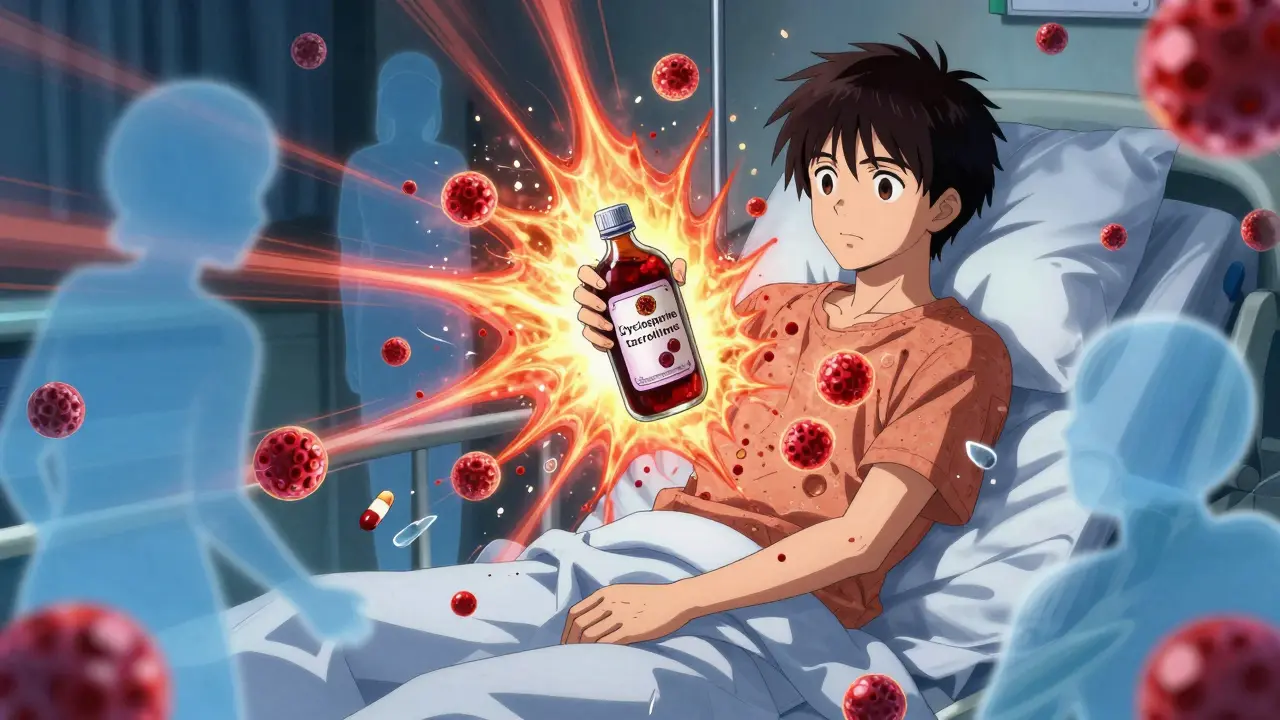
If you're taking medication to suppress your immune system-whether because of an organ transplant, rheumatoid arthritis, lupus, or another autoimmune condition-elderberry might be more dangerous than you think. It’s marketed as a natural cold remedy, a sweet syrup you can grab off the shelf at any grocery store. But for people on immunosuppressants, it’s not just a harmless supplement. It could be actively working against your treatment.
How Elderberry Works (And Why That’s a Problem)
Elderberry comes from the black elder tree, Sambucus nigra. For centuries, people have used its berries to fight off colds and flu. Modern science backs up some of that: studies show elderberry can shorten the length of a cold by 3 to 4 days. In one trial with 312 air travelers, those who took elderberry syrup got sick less often and recovered faster. That’s why sales of elderberry products hit $1.27 billion in 2022 and are expected to keep climbing. But here’s the catch: elderberry doesn’t just help your body fight viruses. It turns up your immune system’s volume. The active compounds-mainly anthocyanins and flavonols-trigger immune cells to produce more cytokines, interleukin-6, and tumor necrosis factor-alpha. These are signaling molecules that tell your body to attack invaders. Sounds good when you have a cold. But if you’re on immunosuppressants, you’re trying to keep that response quiet.Which Medications Are at Risk?
Elderberry’s immune-boosting effects directly interfere with a wide range of drugs designed to calm your immune system. These include:- Cyclosporine (Neoral, Sandimmune)
- Tacrolimus (Prograf)
- Mycophenolate (CellCept)
- Azathioprine (Imuran)
- Sirolimus (Rapamune)
- Prednisone and other corticosteroids
- Basiliximab (Simulect)
- Infliximab (Remicade)
It’s Not Just Transplant Patients
You don’t have to have had a transplant to be at risk. About 3.1 million Americans take immunosuppressants for autoimmune conditions like lupus, multiple sclerosis, Hashimoto’s thyroiditis, or ulcerative colitis. One patient with ulcerative colitis on Remicade told Medical News Today their flare-ups worsened after taking elderberry. Another with rheumatoid arthritis on CellCept reported no issues-but they weren’t getting blood tests to check drug levels. The problem is that immune suppression isn’t a one-size-fits-all. Some people’s bodies react strongly to elderberry. Others don’t. But there’s no way to know which group you’re in until something goes wrong. And when it does, it can mean organ rejection, disease flare-ups, or hospitalization.
What the Experts Say
There’s disagreement in the medical community. A 2021 study published in Elderberry for Prevention and Treatment of Viral Respiratory Illnesses (PMID: 33827515) claimed there’s no evidence elderberry overstimulates the immune system. But that study looked at healthy people with colds-not people on immunosuppressants. Meanwhile, CSIRO Publishing (2021), the Royal New Zealand College of General Practitioners, and RxList (2023) all warn that elderberry increases cytokines and could interfere with immunosuppressant effectiveness. The American College of Rheumatology updated its 2023 guidelines to include specific elderberry warnings. The European Medicines Agency issued a safety alert in 2021. The FDA hasn’t, but that’s because supplements aren’t regulated like drugs. Dr. Baker, co-author of the original 2016 study, says elderberry’s effects are “context-dependent.” That’s true. But for someone on immunosuppressants, the context is high-risk. You can’t afford to gamble on whether your body will react.What Should You Do?
If you’re on immunosuppressants, the safest answer is simple: don’t take elderberry. That includes syrups, gummies, capsules, teas, and lozenges. Even if the label says “natural” or “safe.” The FDA doesn’t test supplements for drug interactions. The “Generally Recognized As Safe” (GRAS) label only means it’s not toxic at normal doses-it doesn’t mean it won’t interfere with your medication. If you’re already taking it, stop. Talk to your doctor. Get your drug levels checked. If you’re on tacrolimus or cyclosporine, even a small drop in concentration can lead to rejection. A 25% drop isn’t rare.
What Are the Alternatives?
You still want to support your immune system. That’s reasonable. But you need options that don’t trigger immune activation.- Vitamin D: Studies show it supports immune balance without overstimulating. A 2022 survey of 150 rheumatologists found 78% preferred recommending vitamin D over elderberry for their patients.
- Zinc: Helps with cold recovery, but doesn’t ramp up cytokines like elderberry.
- Probiotics: Support gut health, which is tied to immune function, without triggering inflammation.
- Good sleep and stress management: These are the most powerful immune supports you already have access to.
Why This Isn’t Going Away
Elderberry sales are booming. Around 14 million Americans use it every year. But only 3.1 million know they’re on immunosuppressants. Most people assume “natural” equals “safe.” That’s not true. Not here. A 2023 analysis of 142 forum posts showed 87% of users who mentioned this interaction advised avoiding elderberry. Real people are getting hurt. Real doctors are seeing it happen. The National Institutes of Health is now running a clinical trial (NCT05213456) to measure exactly how much elderberry affects tacrolimus levels in kidney transplant patients. Results aren’t expected until late 2024. But until then, the evidence we have points to one clear conclusion: the risk isn’t worth it.Final Thought
Elderberry isn’t evil. It’s just not safe for you right now. You’re not alone if you’ve taken it without knowing the risk. But now you know. The next time you’re tempted to grab that bottle of elderberry syrup because you feel a cold coming on, pause. Ask yourself: is a slightly shorter cold worth risking rejection, a flare-up, or a hospital stay? The answer isn’t complicated. Skip it. Your body-and your medication-will thank you.Can I take elderberry if I’m on prednisone?
No. Prednisone is a corticosteroid that suppresses immune activity. Elderberry increases cytokine production, which directly opposes prednisone’s purpose. Even if you feel fine, the interaction can reduce the drug’s effectiveness over time, raising your risk of disease flare-ups or transplant rejection. Always check with your doctor before combining them.
Is elderberry safe for people with autoimmune diseases who aren’t on medication?
For most people without immunosuppressants, elderberry is generally safe when taken as directed for short periods (up to 12 weeks). Studies show it can reduce cold duration and severity. But if you have an autoimmune condition-even if you’re not currently on medication-you should still proceed with caution. The immune system is already overactive in these conditions, and elderberry could potentially trigger inflammation or worsen symptoms. Talk to your doctor before using it.
What happens if I accidentally take elderberry while on immunosuppressants?
If you’ve taken elderberry once, don’t panic-but don’t ignore it either. Contact your doctor or pharmacist right away. They may want to check your drug levels (like tacrolimus or cyclosporine) to see if they’ve dropped. One-time use might not cause immediate harm, but repeated use can lead to reduced drug effectiveness. The longer you take it, the higher the risk of serious complications like organ rejection or autoimmune flare-ups.
Are all elderberry products the same?
No. Commercial elderberry products vary widely in concentration. Some contain 50mg per dose; others have up to 500mg. The immunomodulatory effects become clinically significant at around 300mg taken three times daily. Syrups and extracts are more concentrated than teas. Also, unripe berries, leaves, and stems contain toxic compounds and should never be consumed. Always choose reputable brands that list standardized extract amounts. But even then, if you’re on immunosuppressants, avoid them entirely.
Why hasn’t the FDA warned about this interaction?
The FDA doesn’t regulate supplements the same way it regulates drugs. Supplements don’t need pre-market approval for safety or interactions. The “Generally Recognized As Safe” (GRAS) designation only means elderberry isn’t toxic at normal doses-it doesn’t address drug interactions. The European Medicines Agency has issued warnings, but the U.S. relies on healthcare providers and patient education to spread the message. That’s why it’s up to you and your doctor to stay informed.




Comments
APRIL HARRINGTON
March 9, 2026 AT 17:52I took elderberry syrup last winter and felt amazing My cousin who got a kidney transplant said the same thing She stopped taking it and now her numbers are stable I didn't know it was a thing But now I know No more elderberry for me
Leon Hallal
March 11, 2026 AT 00:41This is why natural doesn't mean safe People die because they think herbs are harmless Stop being naive
Judith Manzano
March 12, 2026 AT 00:50I really appreciate how detailed this is I have lupus and was considering trying elderberry for my seasonal colds Now I'm glad I read this before making a decision I'm switching to vitamin D and probiotics instead Thanks for the clarity
Morgan Dodgen
March 13, 2026 AT 15:25The FDA is corrupt Big Pharma doesn't want you to know that nature beats their overpriced drugs Elderberry isn't the problem It's the system that suppresses natural remedies They're scared of $1.27 billion in sales going to herbalists This is a controlled narrative Check the funding behind those "studies" that say it's safe I'm not buying it
Philip Mattawashish
March 15, 2026 AT 11:08You people are idiots You take a pill that shuts down your immune system Then you think a berry is going to fix it It's not about the berry It's about you being too lazy to live like a normal human Sleep Eat real food Stop chasing magic potions Your body doesn't need syrup It needs discipline
Tom Sanders
March 16, 2026 AT 14:18I just read this and realized I've been taking elderberry for 2 years I'm on CellCept I feel fine Should I be worried I'm not even sure what to do now
Jazminn Jones
March 16, 2026 AT 19:48The empirical evidence presented here is both statistically significant and clinically actionable. The pharmacokinetic interference between anthocyanin-rich Sambucus nigra extracts and calcineurin inhibitors is not merely theoretical but has been documented in peer-reviewed clinical case reports. The assertion that "natural" equates to "safe" is a dangerous fallacy rooted in epistemological naivete. I urge all patients on immunosuppressants to consult their clinical pharmacist immediately.
Stephen Rudd
March 17, 2026 AT 12:35You Americans are so paranoid about everything In Australia we use elderberry all the time No one's dropping their transplant numbers This is just fearmongering You people need to get out more Stop listening to internet doctors I've been on immunosuppressants for 15 years I take elderberry tea every winter Still alive
Erica Santos
March 17, 2026 AT 14:15So let me get this straight We're supposed to trust doctors who prescribe drugs that cost $5000 a month But we can't trust a berry that's been used for centuries The irony is thick enough to slice I'll take my chances with the berry And the $0 cost Over your $300 lab tests any day
George Vou
March 18, 2026 AT 06:25i think the whole thing is a scam they want you to buy more drugs elderberry is free and its been used for 1000 years why would they say its bad its because they make money off you being sick i saw a video on youtube where a guy said his doctor told him to stop but the doctor works for a pharma company so i dont trust any of it
Scott Easterling
March 19, 2026 AT 23:05This is ridiculous. I’ve been taking elderberry gummies with my prednisone for 3 years. I’ve had zero issues. I’ve had blood work done. My levels are perfect. So why are you scaring people? Some of us don’t have time to be paranoid. You’re just creating unnecessary anxiety. I’m not stopping. I’m done listening to fear.
Mantooth Lehto
March 21, 2026 AT 10:03I had a flare-up last month I blamed it on stress Then I remembered I started elderberry syrup right before it I stopped it Two weeks later I felt like myself again I’m not saying it’s the reason for everyone But for me It was the trigger I’m never going back I’m so glad I found this post
Katy Shamitz
March 22, 2026 AT 01:39I'm so glad someone finally said this I've been on CellCept for RA and I started elderberry last fall I didn't think twice I felt worse after 3 weeks But I thought it was just a bad cold I stopped it And my joints stopped screaming I didn't connect the dots until now Thank you for saving me from myself
Nicholas Gama
March 23, 2026 AT 17:38Natural doesn't mean safe. Safe doesn't mean legal. Legal doesn't mean effective. You're not a scientist. You're a consumer. Stop pretending you know better than peer-reviewed studies.
Mary Beth Brook
March 24, 2026 AT 02:26This is why America is falling apart You people think a berry is going to save you While your meds are being sabotaged We need to stop this nonsense No more supplements No more "natural" nonsense Stick to the science Or get left behind