
Using Wearables to Track Side Effects: Heart Rate, Sleep, and Activity
Side Effect Tracker Calculator
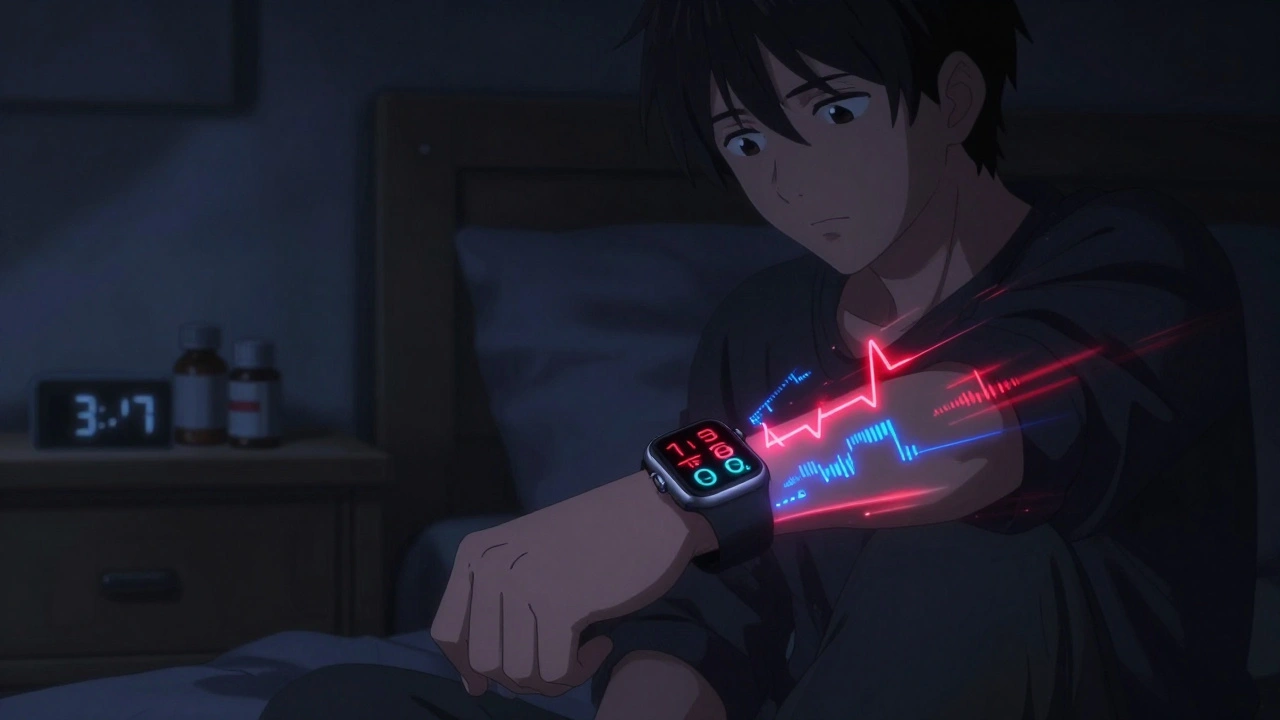
When you start a new medication, you’re told to watch for side effects: dizziness, fatigue, nausea, irregular heartbeat. But what if the warning signs show up before you even notice them? That’s where wearables come in. Smartwatches and fitness trackers aren’t just for counting steps anymore. They’re becoming quiet sentinels for your body’s hidden reactions to drugs - detecting changes in heart rate, sleep patterns, and movement that could signal something serious, long before a doctor’s visit.
How Wearables Catch What You Miss
Your body doesn’t wait for your next appointment to react to medication. It starts changing right away - often in ways you don’t feel. A rising heart rate at night might mean a drug interaction. A sudden drop in daily steps could signal muscle weakness from a new statin. Fragmented sleep might point to anxiety caused by an antidepressant. Wearables track these signals continuously, 24/7, using sensors that measure more than you realize.
Heart rate is monitored through photoplethysmography (PPG), a light-based sensor that detects blood flow changes under your skin. Modern devices like the Apple Watch Series 8 and Fitbit Charge 5 capture this data every few seconds, with accuracy close to clinical ECGs in controlled settings. Sleep tracking combines movement data from accelerometers, heart rate variability, and even skin temperature to estimate sleep stages. Activity monitoring uses 9-axis motion sensors to detect tiny shifts in how you move - like slower walking speed or reduced arm swing, which can be early signs of neurological side effects from Parkinson’s meds.
These aren’t guesses. A 2025 study in npj Digital Medicine showed wearables detected subtle movement changes in Parkinson’s patients on levodopa - changes so small, they were missed in monthly clinic visits. One user on Reddit reported their Garmin flagged increased nighttime twitching. Their neurologist confirmed it was early dyskinesia, and adjusted the dose before it got worse.
What Devices Actually Work for Side Effect Tracking
Not all wearables are built the same. If you’re using one to monitor drug side effects, you need the right tool.
- Apple Watch Series 8/9: Best for heart rate detection. Its algorithm can spot atrial fibrillation with 98.8% sensitivity. The Series 9 even got FDA clearance in September 2024 to detect beta-blocker induced bradycardia - when heart rate drops below 40 bpm for more than 5 minutes.
- Fitbit Charge 5: Top for sleep analysis. It matches polysomnography (the gold standard sleep test) at 92.4% accuracy. If you’re on a medication that messes with sleep - like stimulants or SSRIs - this is your best bet.
- Garmin Venu 2S: Strong on activity patterns. Its motion sensors pick up changes in gait and movement rhythm, useful for tracking side effects from antipsychotics or Parkinson’s drugs.
- BioIntelliSense BioSticker: A medical-grade patch, not a watch. FDA-cleared for continuous vital sign monitoring. Used in clinical trials. Costs $1,200 and requires a prescription. Overkill for most, but the most accurate.
Consumer devices like these cost between $100 and $400. Medical-grade options are pricier and harder to get. But even the cheapest tracker can give you useful trends - if you know how to read them.
Why Your Data Might Be Wrong - And How to Fix It
Wearables aren’t perfect. And they’re not magic. They can give you false alarms, miss real problems, or just confuse you.
One major issue: accuracy varies by skin tone. PPG sensors work best on lighter skin. Studies show accuracy drops to 85% for people with darker skin (Fitzpatrick types V-VI). That means a high heart rate reading might be a sensor error, not a side effect. If you have darker skin, cross-check with manual pulse checks.
Another problem: false alerts. A 2024 Consumer Reports survey found 63% of Fitbit users got alerts for abnormal heart rates that turned out to be noise - from tight bands, arm movements, or even cold weather. Too many false alarms lead to alert fatigue. People stop paying attention.
And then there’s interpretation. A 2023 JAMA Internal Medicine study found 78% of patients couldn’t tell if a spike in heart rate was from the drug, stress, caffeine, or just bad sleep. That’s why baseline data matters.
Before starting a new medication, wear your device for 2-4 weeks without changing your routine. Record your normal heart rate, sleep duration, and daily step count. Then compare. A 20% drop in steps? A 15 bpm rise at rest? That’s worth mentioning to your doctor.
The Real Danger: Anxiety, Not Side Effects
Here’s the dark side no one talks about: some people become obsessed with their data.
One user on Amazon wrote: “I stopped wearing my watch because checking my heart rate became obsessive and actually increased my anxiety.” That’s not rare. A 2024 Mayo Clinic survey found 83% of patients worried about what their wearable was telling them. They’d wake up at 3 a.m. to check their heart rate. They’d cancel plans because their sleep score was low.
Wearables are tools, not diagnoses. A single odd reading doesn’t mean your drug is dangerous. Look for patterns. Is your heart rate consistently higher after taking your pill? Does your sleep stay broken for three nights in a row? That’s data. A one-time spike? Probably just coffee or stress.
Dr. Joseph Kvedar from Harvard warns that early pilot programs generated 12-15 alerts per patient per week - but only 18% were actually clinically relevant. If you’re getting 10 alerts a day, you’re not being helped. You’re being overwhelmed.
What Doctors Really Think
Doctors are cautiously excited. Dr. Mintu Turakhia, who led the Apple Heart Study, says continuous monitoring gives a “temporal resolution previously impossible in pharmacovigilance.” In other words: we can now see how a drug affects you hour by hour, not just once a month.
But they’re also frustrated. Most clinics don’t know how to use the data. A Johns Hopkins case study found it took 120 hours to integrate wearable data into their electronic health records. Nurses spent 15-20 minutes per patient just reviewing the numbers.
Insurance rarely pays for it. Only 27% of U.S. insurers cover wearable monitoring for high-risk meds as of mid-2024. So unless you’re in a clinical trial, you’re on your own.
Still, pharmaceutical companies are jumping in. In 2023, 43% of phase III cancer trials used wearables to track side effects - up from 7% in 2019. The FDA has issued draft guidelines requiring 90% sensitivity and 85% specificity for side effect detection claims. That means better tech is coming.

How to Use This Without Getting Overwhelmed
You don’t need to be a data scientist to use wearables safely. Here’s how:
- Set a baseline. Wear your device for 2-4 weeks before starting a new drug. Note your normal sleep, heart rate, and activity.
- Track timing. Note when you take your meds. Compare heart rate spikes or sleep disruptions to your dosing schedule. Is your pulse up 30 minutes after your pill? That’s a clue.
- Look for trends, not spikes. One bad night? Ignore it. Three nights in a row? Talk to your doctor.
- Don’t trust the app’s labels. “Poor sleep” or “high stress” are guesses. Look at raw numbers: total sleep time, resting heart rate, steps per day.
- Share the data - don’t self-diagnose. Export your weekly summary (Apple Health, Fitbit app) and bring it to your next visit. Say: “My heart rate’s been up 15 bpm after my pill for the past week. Could this be a side effect?”
There’s no magic number. But if your resting heart rate jumps 10-15 bpm for more than 3 days, or your daily steps drop by 30%, or you’re sleeping less than 5 hours for 4 nights straight - those are red flags worth discussing.
The Future: Smarter, Safer, Faster
The next wave of wearables won’t just track - they’ll predict. Researchers are testing devices that combine heart rate, skin conductance (sweat), and voice tone to catch neurological side effects before they show up. Early trials with Parkinson’s patients hit 94% accuracy in predicting dyskinesia.
AI models are being trained to forecast side effects based on your unique physiology. If your heart rate variability drops 20% after taking your med, the system might warn you: “Risk of dizziness increased. Avoid driving.”
But none of this matters if the data doesn’t reach the right person. Until clinics can easily pull wearable data into patient records, and until insurers pay for it, this tech will stay in the hands of the motivated few.
For now, wearables are like a silent partner in your health. They don’t replace your doctor. But they give you something you never had: a detailed, real-time record of how your body reacts to the drugs you take. And that’s powerful.
Can wearables detect if a medication is causing heart problems?
Yes. Devices like the Apple Watch Series 8 and 9 can detect abnormal heart rhythms, including atrial fibrillation and dangerously low heart rates caused by beta-blockers. These alerts are based on continuous monitoring, not single readings. A sustained heart rate below 40 bpm for over 5 minutes triggers a specific FDA-cleared alert in the Series 9. But false positives happen - always confirm with a doctor using an ECG if you get an alert.
Are fitness trackers accurate for sleep tracking when on medication?
Fitbit and Apple Watch sleep tracking is about 85-93% accurate compared to clinical sleep studies. Medications that affect sleep architecture - like antidepressants, stimulants, or steroids - can make patterns harder to interpret, but the devices still capture changes in total sleep time, wake after sleep onset, and sleep efficiency. Use these as trends, not exact measurements. If your sleep score drops for multiple nights, it’s worth investigating.
Can wearables help with mental health side effects like anxiety or depression?
Indirectly. Wearables don’t measure mood, but they track behaviors linked to mental health: reduced activity, disrupted sleep, elevated resting heart rate. A 2024 study found patients on SSRIs who showed a 40% drop in daily steps and 2+ hours less sleep per night were more likely to report worsening depression. These patterns can help doctors adjust treatment faster than relying on self-reports alone.
Do I need a medical-grade wearable to track side effects?
No. Consumer devices like the Apple Watch, Fitbit, or Garmin are sufficient for spotting trends in heart rate, sleep, and activity. Medical-grade wearables like the BioSticker are more accurate and used in clinical trials, but they cost $1,200 and require a prescription. For most people, a $200 smartwatch gives enough data to spot problems - as long as you know how to interpret the patterns.
What should I do if my wearable shows a side effect?
Don’t panic. Don’t stop your medication. First, check if the change is consistent - is it happening every day for 3+ days? Then, review your medication timing. Did the change start after you switched pills or changed doses? Export your data and bring it to your doctor. Say: “My heart rate’s been up 15 bpm after my pill for a week. Could this be related?” That’s how you turn data into action.
Are there privacy risks with using wearables for health tracking?
Yes. 83% of patients in a 2024 Mayo Clinic survey expressed concern about how their health data is stored and shared. Wearable companies may sell anonymized data to researchers or advertisers. Always check your device’s privacy settings. Use Apple Health or Google Fit to sync data - they offer more control than third-party apps. Never upload raw data to unsecured cloud services. Your heart rate history is sensitive information.





Comments
Sam Mathew Cheriyan
December 7, 2025 AT 22:58lol so now my apple watch is gonna tell me when my meds are tryna kill me? next theyll say my fitbit detected i was mad at my boss and its gonna call 911. also i think my watch thinks im dead bc it says i slept 12 hrs but i was just passed out from zoloft. 🤡
Nancy Carlsen
December 8, 2025 AT 17:39This is actually so cool 😊 I started wearing my Fitbit after my antidepressant changed and I noticed my sleep dropped from 7hrs to 4.5hrs over 3 days. I showed my doc and we tweaked the dose. No more 3am panic-scrolling! You got this 💪
Helen Maples
December 10, 2025 AT 01:53Baseline data is non-negotiable. Without it, you're just interpreting noise. If you don't have 14 days of pre-medication tracking, your 'red flags' are statistically meaningless. Stop self-diagnosing with consumer-grade sensors. Your doctor needs real clinical context, not a heatmap of your anxiety.
Oliver Damon
December 11, 2025 AT 00:30The PPG sensor's spectral sensitivity is fundamentally biased toward Fitzpatrick I-III skin tones. The 85% accuracy drop for darker skin isn't a flaw-it's a design limitation rooted in training dataset homogeneity. Until manufacturers audit their data pipelines, these devices perpetuate healthcare disparities under the guise of innovation.
Stacy here
December 12, 2025 AT 08:50They’re watching you. Always. Your heart rate, your sleep, your steps-sold to Big Pharma so they can tweak dosages before you even feel sick. And the FDA? They cleared the Apple Watch for bradycardia detection because they got a nice donation from Apple. Wake up. You’re not a patient-you’re a data point in a corporate algorithm.
Desmond Khoo
December 13, 2025 AT 15:01I got my first 'abnormal heart rate' alert at 2am. Thought I was dying. Turned out I'd drunk a whole coffee before bed. Now I just laugh and turn off notifications after 10pm. 🤪 My watch doesn't know I'm a caffeine monster.
Kyle Oksten
December 14, 2025 AT 20:34There's a philosophical tension here: we outsource bodily awareness to machines, then become dependent on them for validation. The wearable doesn't reveal side effects-it constructs a new kind of illness: the illness of constant surveillance. We're not monitoring our bodies anymore. We're performing them.
Ernie Blevins
December 15, 2025 AT 16:50This is why people are so anxious. You give someone a gadget that pings them 10 times a day with fake alarms and then tell them to 'just look for trends.' That's not medicine. That's psychological torture. My cousin stopped taking her meds because her watch kept saying she was 'stressed'-she was just walking to the fridge.
Sadie Nastor
December 17, 2025 AT 10:43i love how tech tries to fix everything but forgets people are messy 😅 i wear my garmin but i also just listen to my body sometimes. if i feel dizzy, i sit down. if i cant sleep, i drink chamomile. the numbers help, but they dont own me. peace out 🌿
Kyle Flores
December 19, 2025 AT 04:34I’ve been using my Apple Watch since my statin started. Noticed my steps dropped 30% over a week. Took it to my doc. Turns out it was just muscle fatigue-not a side effect. But I wouldn’t have known without the data. Thanks for the reminder to check trends, not spikes.
Ryan Sullivan
December 19, 2025 AT 20:58This article is a masterclass in techno-optimist propaganda. You present consumer wearables as clinical tools while ignoring that their accuracy is worse than a drunk nurse’s guess. And the FDA clearance? That’s a marketing license, not a medical endorsement. This is snake oil with a touchscreen.
Wesley Phillips
December 20, 2025 AT 05:35So basically your watch is now your therapist your pharmacist and your personal trainer and you’re okay with that? Bro. You’re not a robot. Your body isn’t a dashboard. I’d rather just feel tired than get a notification that says ‘Your soul is low on energy.’
Olivia Hand
December 21, 2025 AT 15:45Has anyone considered that the real side effect isn't the drug-it's the obsession with tracking it? I watched my sleep score for 3 weeks straight. Started having insomnia because I was terrified of getting a 'poor' rating. The device didn't cause my anxiety. I did.
Jennifer Anderson
December 21, 2025 AT 22:51i just wanna say to anyone out there feelin overwhelmed by the numbers-you’re not broken. your body is just trying to tell you something. if your watch says your heart is racing but you’re chillin with tea and a cat? maybe it’s just the band too tight. you got this 💕