
Common Prescription Label Misunderstandings and How to Avoid Them
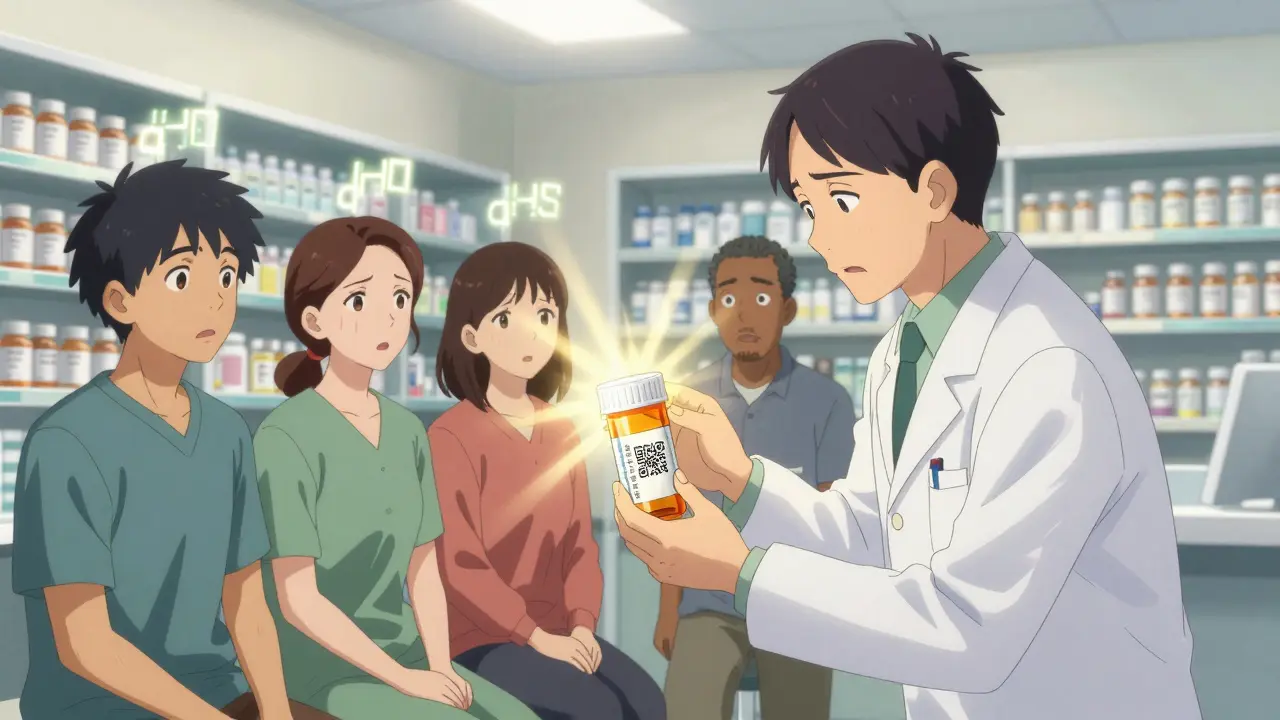
Every year, millions of people in the U.S. take their medication wrong-not because they’re careless, but because the label on the bottle doesn’t make sense. You might think you’re following the instructions, but if the wording is unclear, you could be taking too much, too little, or at the wrong time. And it’s not just older adults or people with low literacy. Even college graduates get confused. A study found that 23% of people with good reading skills still misunderstood basic directions like "take twice daily." That’s not a small number. It’s a public health problem hiding in plain sight.
What’s Actually on the Label That Confuses People?
Pharmacy labels are often written by pharmacists for other pharmacists, not for patients. You’ll see phrases like "ii tab PO qHS" or "take 1 tablet BID." If you don’t know Latin abbreviations or medical shorthand, you’re already lost. Even when labels are translated into plain language, they’re still too complex. One study found that 27% of prescription instructions were written at a reading level higher than high school. That means if you didn’t finish college, you’re being asked to decode instructions meant for someone with a science degree. Common mistakes happen because of vague wording:- "Take every 4 to 6 hours" → Many people think this means "take four times a day" (24 ÷ 6 = 4), not "take when needed, spaced at least 4 hours apart."
- "Take with food" → Some patients think this means "take instead of food," not "take while eating a meal."
- "Take once daily" → Some patients skip days because they think "once" means "only one time total," not "every day."
- "Take at bedtime" → Without a time reference, people take it at 9 p.m. one night and 2 a.m. the next, throwing off their schedule.
Why Icons and Symbols Don’t Always Help
You’ve probably seen little pictures on prescription bottles: a plate with food for "take with meals," a sun for "take in the morning," or a moon for "take at night." These are supposed to make things easier. But here’s the problem: 68% of patients misinterpret the "take with food" icon. Some think it means "only eat when you take this pill." Others ignore it completely because they don’t recognize the symbol. The FDA tested dozens of icons and found that only a few are consistently understood:- ✅ A clock with 8 a.m. and 8 p.m. → Clear for "twice daily."
- ✅ A plate with a pill beside it → Works for "take with food."
- ❌ A hand holding a pill over a plate → Often confused with "take before eating."
- ❌ A calendar with "D1" → Patients think it means "Day 1," not "once daily."
How Language Barriers Make Things Worse
In the U.S., over 41 million people speak Spanish at home. But only 12% of pharmacies offer translated prescription labels. Even when they do, the translations are often done by software or untrained staff. One study found that Spanish labels had 3.2 times more confusion than English ones-not because the language was harder, but because terms like "una vez al día" were mistranslated as "take once" instead of "take every day." This isn’t just a Spanish problem. It affects anyone whose first language isn’t English. A patient from Vietnam might see "take with food" and think it means "take after you finish eating," not "during." A Somali speaker might not know what "daily" means in context. Labels need to be simple, not just translated.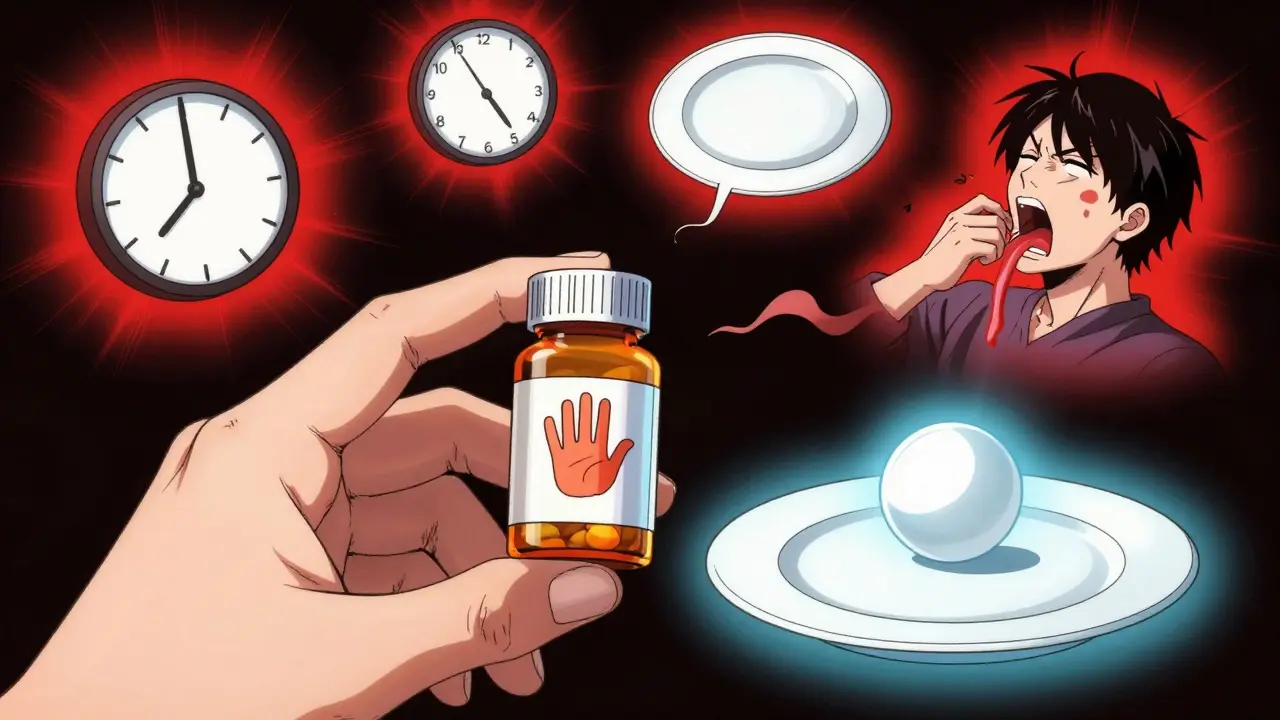
What Patients Do When Labels Don’t Make Sense
Most people don’t call the pharmacy. They don’t ask their doctor. They guess. Here’s what actually happens:- 78% of patients create their own pill organizers with sticky notes or phone alarms.
- 29% record the pharmacist’s verbal instructions on their phone.
- 39% of seniors have skipped a dose because the timing didn’t make sense.
- 52% of adults over 50 have changed their dose because "the instructions didn’t make sense."
What Pharmacies Are Doing Right
Some pharmacies are fixing this. The US Pharmacopeia (USP) created standards called Chapter <17>, which require:- Drug name in large, bold font (at least 12pt)
- Clear dosage: "Take 2 tablets by mouth at bedtime" instead of "ii tab PO qHS"
- Standardized icons for "with food," "morning," "night"
- Reading level no higher than 6th grade
What You Can Do Right Now
You don’t have to wait for the system to fix itself. Here’s what works:- Ask for "when to take" labels. Say: "Can you write out exactly when I should take this? Like, 8 a.m. and 8 p.m. instead of BID?" Most pharmacies will do it.
- Request large-print labels. By law, pharmacies must offer them. Ask for 14pt or 16pt font. You don’t need a doctor’s note.
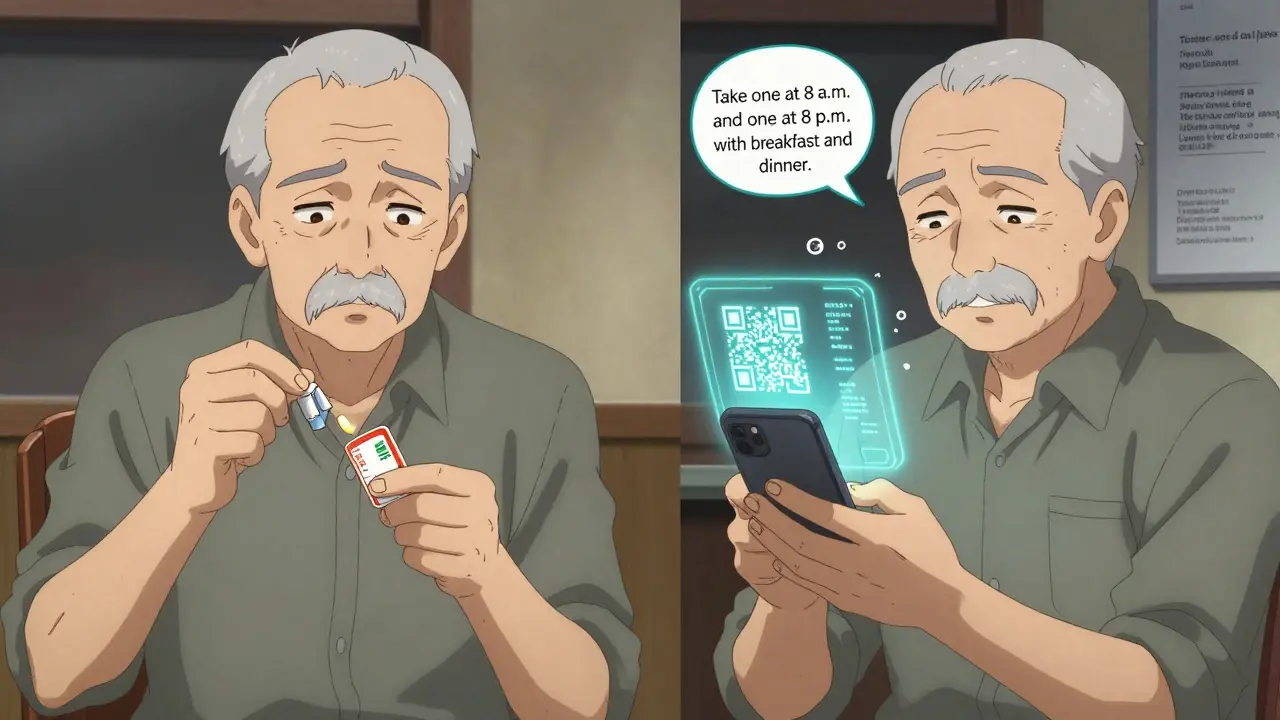
- Use the "Teach-Back" method. After the pharmacist explains, say: "Just to make sure I got it right-I take one pill at 8 a.m. and another at 8 p.m., with food, right?" If they say yes, you’re good. If they correct you, you just avoided a mistake.
- Download a label helper app. GoodRx’s "Label Lens" app lets you scan your prescription label and gets a plain-language summary in seconds. It’s free and works offline.
- Ask for a printed handout. Many pharmacies have simple one-page sheets that explain common instructions with pictures. Ask for one.
Why This Matters More Than You Think
Medication errors from misunderstood labels cause 1.3 million emergency room visits and 350,000 hospital stays every year in the U.S. That’s more than car accidents. And it’s not just about health-it’s about money. The cost of these errors? Over $200 billion a year. The good news? We know how to fix this. Simple changes-clear words, real times, good icons, and patient feedback-work. The bad news? Not everyone has access to those changes. If your pharmacy still uses tiny, jargon-filled labels, you have the right to ask for better.What’s Coming Next
By January 2025, new federal rules may require all prescription labels to include QR codes that link to audio or video instructions. Amazon Pharmacy is already testing voice-enabled labels that read the instructions out loud when you press a button. AI tools like GoodRx’s app are getting smarter at translating medical jargon into everyday language. But technology alone won’t fix this. The real solution is human interaction. A pharmacist who takes five extra minutes to explain, "This isn’t a suggestion-it’s a rule," can prevent a hospital visit. That’s why training pharmacy staff in health literacy is just as important as updating software.What does "take twice daily" really mean?
"Take twice daily" means two times every day-not every two hours. The best way to understand it is to ask for specific times: "Take one pill at 8 a.m. and one at 8 p.m." If your label just says "BID," ask your pharmacist to write it out clearly. Most will do it.
Is it safe to skip a dose if I feel fine?
Never skip doses just because you feel better-especially with antibiotics or blood pressure meds. Missing doses can make the medicine less effective or cause your condition to worsen. If you miss a dose, check the label or call your pharmacy. Don’t guess. For most medications, if you miss one, take it as soon as you remember-if it’s not close to the next dose. If it is, skip the missed one and go back to your schedule.
Why do some labels say "take with food" and others say "take on an empty stomach"?
Some medicines work better when they’re absorbed with food-like antibiotics that upset your stomach. Others need to be absorbed quickly, so food slows them down. "Take with food" means eat something while you take it. "Take on an empty stomach" means wait at least one hour before eating or two hours after. If you’re unsure, ask your pharmacist to explain why it matters for your specific drug.
Can I ask for my prescription label in Spanish or another language?
Yes. Under federal law, pharmacies must provide language assistance if you need it. You don’t have to ask twice. Just say: "I need this label in Spanish," or whatever language you prefer. If they say no, ask to speak to the manager. Many chain pharmacies now offer multilingual labels, but independent ones may need time to order them.
Are there apps that can help me understand my prescription label?
Yes. GoodRx’s "Label Lens" app lets you take a photo of your prescription label and instantly gets a plain-language explanation. It works offline and supports multiple languages. Other apps like Medisafe and MyTherapy also let you set reminders and explain what your meds do. These aren’t replacements for talking to your pharmacist, but they’re great backups.



Comments
Timothy Davis
January 28, 2026 AT 11:07Let’s be real-pharmacies are still using labels from the 1990s. The fact that 23% of college grads mess up 'twice daily' isn’t a literacy issue, it’s a design failure. They’re not trying to confuse people, they’re just lazy. And don’t get me started on those stupid icons. The FDA has had standards since 2018, but most pharmacies won’t upgrade because it costs $3k. Meanwhile, people are ending up in the ER because 'qHS' looked like 'qD' and they took it every day instead of at bedtime. This isn’t just inconvenient-it’s lethal. We need mandatory compliance, not 'nice-to-have' guidelines.
Howard Esakov
January 28, 2026 AT 23:05Wow. Just... wow. 😒 You’d think after 20+ years of digital health, we’d have moved past 'take BID' like it’s 1987. But nope. We’re still treating patients like they’re middle schoolers who can’t read Latin. And don’t even get me started on 'take with food'-that icon? It looks like someone drew a pill on a plate with their non-dominant hand after three beers. The fact that 68% misinterpret it? That’s not a patient problem. That’s a system-wide failure of basic UX design. If your product can’t be understood by a 6th grader, you shouldn’t be allowed to sell it.
Bryan Fracchia
January 30, 2026 AT 20:23I’ve been there-staring at a label like it’s a cryptic crossword puzzle. But here’s the thing: most pharmacists *want* to help. They just don’t have the time or the tools. I used to work at a clinic, and I saw how rushed things get. The real fix isn’t just better labels-it’s better training, more staff, and a culture that says, 'If they don’t understand, we didn’t do our job.' I’ve started asking my pharmacist to draw me a little schedule on a napkin. It’s silly, but it works. And hey-if we all ask for clearer labels, maybe they’ll start prioritizing it. Small steps, right? 🌱
Lance Long
January 31, 2026 AT 09:21OH MY GOODNESS. 😭 I had a friend take her blood pressure med 'every 4 to 6 hours' and ended up taking it 8 times in one day because she thought 'every' meant 'whenever I remember.' She almost passed out. And guess what? The pharmacist didn’t even notice she was confused-she just handed her the bottle and said 'you got this.' That’s not healthcare. That’s negligence wrapped in a smile. We need to stop treating patients like they’re supposed to decode medical hieroglyphics. This isn’t rocket science-it’s basic human dignity. If you’re handing someone a life-changing drug, you owe them clarity. Period.
fiona vaz
February 2, 2026 AT 07:36I’ve been a pharmacy tech for 12 years, and I can confirm-most of us want to do better. But we’re stuck with software that hasn’t been updated since 2015. I’ve personally printed out handwritten instructions for over 200 patients in the last year because the system wouldn’t let me change the font or add icons. We’re not ignoring the problem-we’re drowning in it. The good news? The new USP standards are finally trickling in. I’ve seen a 40% drop in follow-up calls since we started using clock icons and 14pt font. It’s not perfect, but it’s progress. And yes-you *can* ask for large print. Just say it. We’ll do it.
Sue Latham
February 3, 2026 AT 07:18Ugh. I can’t believe we’re still having this conversation. Like, really? People are dying because we can’t write 'take one pill at 8 a.m. and one at 8 p.m.'? And yet, pharmacies still use 'BID' like it’s a badge of honor. 🙄 I mean, if you’re going to use Latin abbreviations, at least put a decoder ring on the bottle. Or better yet-just use English. It’s 2025. We have AI. We have voice assistants. We have QR codes. Stop pretending this is hard. It’s not. It’s just laziness dressed up as tradition.
James Dwyer
February 4, 2026 AT 16:37My grandma skipped her heart med for three days because she thought 'once daily' meant 'once total.' She ended up in the hospital. I didn’t even know until a week later. We need to stop blaming patients. The system is broken. And if you’re a pharmacy owner who won’t spend $3k to fix your label software, you’re putting lives at risk for profit. That’s not business. That’s moral failure.
jonathan soba
February 5, 2026 AT 15:08Interesting data, but the real issue is the lack of standardized regulatory enforcement. The FDA’s pictogram guidelines are voluntary. That’s not a policy-it’s an invitation for negligence. Until there’s a federal mandate with penalties for non-compliance, this will continue. The 78% adoption rate among chain pharmacies is misleading-it’s not about willingness, it’s about scale. Independent pharmacies are being left behind because they can’t afford compliance. The solution isn’t individual action-it’s systemic reform. And until that happens, patients are essentially gambling with their health.
matthew martin
February 6, 2026 AT 10:16Man, this post hit me right in the feels. I used to work in a pharmacy back in college, and I’ll never forget this one guy who came in with a prescription for insulin. He couldn’t read the label-never learned English well. The tech just handed him the bottle and said 'take one at bedtime.' He took it at 11 p.m. one night, then 3 a.m. the next. Ended up in the ER with a sugar crash. We fixed it after he came back, crying, saying he didn’t want to be a burden. That’s the thing-people don’t ask because they’re scared, ashamed, or think they’re stupid. But here’s the truth: you’re not stupid. The label is. And if you’re reading this and you’ve ever been confused by a prescription? You’re not alone. Ask. Again. And again. Your life’s worth it.