
Counterfeit Generics: How to Protect Yourself from Fake Medications
Every year, millions of people rely on generic medications to manage chronic conditions, control pain, or treat infections. They’re cheaper, widely available, and regulated - or at least they should be. But what if the pill you swallowed didn’t contain the drug it was supposed to? What if it had sugar, chalk, or worse - a toxic chemical? This isn’t science fiction. It’s happening right now, and you might be at risk without even knowing it.
What Exactly Are Counterfeit Generics?
Generic drugs are meant to be exact copies of brand-name medications, approved by agencies like the FDA or EMA. They must prove they deliver the same amount of active ingredient into your bloodstream at the same rate. That’s called bioequivalence. But counterfeit generics? They’re fake. No testing. No oversight. Just criminals copying the packaging and slapping on a label.
These fakes don’t just lack the right medicine - they often contain nothing at all. Or worse, they’re laced with dangerous substitutes. A 2024 report from the Pharmaceutical Security Institute found that over half of the counterfeit medicines seized globally had no active ingredient, or worse, contained substances like rat poison, industrial dyes, or even cement dust. In some parts of Africa, as many as 70% of medicines sold in local markets are fake, according to WHO data.
It’s not just happening overseas. In 2025, U.S. Customs intercepted counterfeit versions of Ozempic, Botox, and erectile dysfunction drugs shipped from Asia. An Iowa pharmacy was fined $25,000 for selling fake Ozempic. These aren’t rare cases. They’re symptoms of a growing crisis.
Why Are Counterfeit Generics So Dangerous?
Imagine you’re taking a generic version of metformin for type 2 diabetes. You take it every day. You feel fine. But the pill you swallowed had only 5% of the active ingredient - not enough to control your blood sugar. Over time, your condition worsens. You develop nerve damage. You end up in the hospital. That’s not hypothetical. It’s happened.
Counterfeit antibiotics are even more terrifying. If a pill contains too little of the drug, it doesn’t kill the bacteria - it just makes them stronger. This fuels antimicrobial resistance, a global threat the World Health Organization says could cause 10 million deaths per year by 2050. Fake cancer drugs? They don’t just fail to treat the disease - they give false hope while the cancer spreads unchecked.
And it’s not just about health. Fake medications cost the global economy an estimated $30.5 billion a year. Criminal networks profit from your desperation. They don’t care if you live or die. They just want your money.
How Do You Spot a Fake Generic?
Counterfeiters are getting better. Some fakes look identical to the real thing. But there are still clues - if you know where to look.
- Check the packaging. Look for spelling errors, blurry logos, mismatched fonts, or incorrect colors. Even small mistakes - like a misplaced period or a different shade of blue - can mean it’s fake.
- Examine the pill itself. Authentic generics have consistent shape, size, and color. If your pill looks different - too shiny, too dull, too large, or oddly textured - it’s a red flag.
- Verify the NDC number. Every U.S. medication has a National Drug Code (NDC). You can enter it into the FDA’s database to confirm the product exists and matches the manufacturer.
- Look for the VIPPS seal. Only buy from online pharmacies that display the Verified Internet Pharmacy Practice Sites (VIPPS) seal. If it’s not there, walk away.
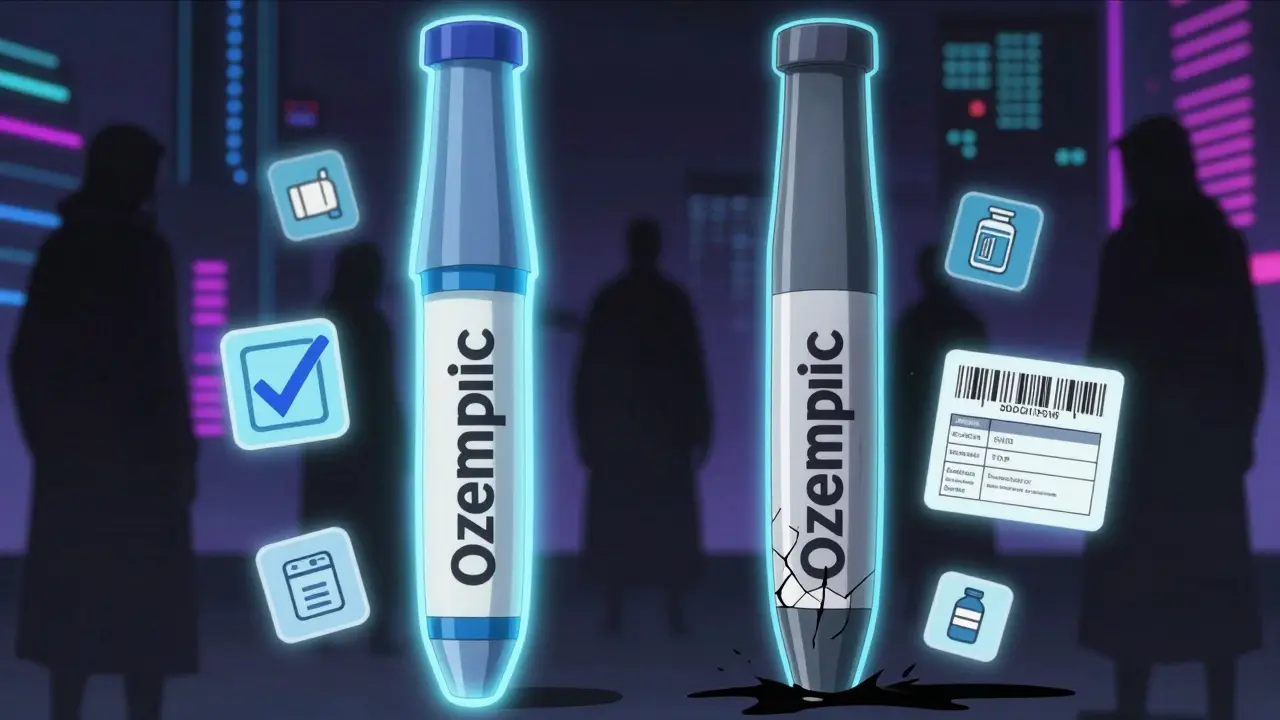
- Use manufacturer verification tools. Novo Nordisk’s Verify Your Pen system lets you scan the QR code on your Ozempic pen. In Q3 2025 alone, over 2 million scans were done - and 1.8% were flagged as fake.
TrueMed’s authentication app, which has a 4.7-star rating from over 1,200 users, lets you scan barcodes and check if your medication is real. It’s especially popular for verifying erectile dysfunction drugs - where counterfeits are rampant.
Where Are Fake Medications Coming From?
Most counterfeit generics enter the supply chain through illegal online pharmacies. Interpol’s 2025 Operation Pangea shut down 13,000 fake websites and social media accounts selling fake drugs. Many of these sites pretend to be based in Canada or the U.S., but they’re actually run from China, India, or Eastern Europe.
Even legitimate-looking pharmacies can be compromised. In 2025, the FDA reported that 50% of online pharmacies that hide their physical address sell fake medications. And 89% of them don’t require a prescription - a huge red flag.
Supply chain gaps also play a role. Between September 2023 and January 2025, the FDA received 2,465 bulk shipments of semaglutide (the active ingredient in Ozempic) and tirzepatide. Of those, 239 came from unregistered companies - and 195 were allowed into the country anyway.
High-income countries like the U.S. and Canada are not immune. The problem is growing because demand is rising. Weight-loss drugs like Ozempic are in high demand - and so are the fakes.
Real Stories: What Happens When You Take a Fake?
Reddit user "MedSafety42" posted in August 2025: "I bought Ozempic from a Canadian pharmacy. Three months later, my blood sugar didn’t drop. I checked the pen with Novo’s app - it was flagged as fake. I almost died. My A1C went from 7.2 to 9.8 in six weeks. I had no idea."
In Nigeria, consumers reported liver damage after taking counterfeit malaria treatments. In South Africa, police seized R2.2 million worth of fake drugs in Gqeberha - including insulin, antibiotics, and heart medications.
Trustpilot reviews show that 68% of negative feedback about online pharmacies mention: "The packaging looked perfect. But nothing happened when I took it."
These aren’t isolated incidents. They’re the tip of the iceberg.
How to Stay Safe: A Simple Checklist
You don’t need to be a pharmacist to protect yourself. Here’s what you can do today:
- Buy only from licensed pharmacies. If it’s not a local pharmacy or a VIPPS-certified online site, don’t buy from it.
- Ask your pharmacist to verify. Most pharmacies can check the NDC number or contact the manufacturer.
- Use manufacturer tools. For Ozempic, use Novo Nordisk’s app. For other drugs, check the manufacturer’s website - many offer verification codes or QR scans.
- Report suspicious products. Use the FDA’s MedWatch program or call Pfizer’s Anti-Counterfeiting Hotline at 1-800-593-5685.
- Never buy from social media or text messages. If someone DMs you with "discounted Ozempic," it’s a scam.
These steps take less than 10 minutes. But they could save your life.
What’s Being Done - And What’s Still Missing
Regulators are fighting back. The EU requires safety features on all prescription packages. India now mandates QR codes on drug containers. Blockchain tracking has cut counterfeits by 22% in pilot programs across 15 countries.
But progress is uneven. Only 32% of pharmacies in low-income countries have access to verification tools. Meanwhile, criminal networks are using AI to create more convincing fakes. Interpol says 123 criminal groups were dismantled in 2025 - but new ones pop up every week.
Experts warn: without more funding for enforcement, counterfeit generics will remain a major threat. The FDA’s new guidance in November 2025 requires stricter checks on high-risk generics - but enforcement still lags behind demand.
Final Warning: Don’t Trust Luck
Counterfeit generics aren’t a distant problem. They’re in your neighborhood, your inbox, and maybe even your medicine cabinet. You can’t see them. You can’t taste them. But you can feel the consequences - and they’re deadly.
The best defense? Awareness. Verification. Caution.
If it’s too cheap, too easy, or too good to be true - it probably is. Always check. Always verify. And never assume a pill is safe just because it looks right.
How common are counterfeit generics?
According to the World Health Organization, at least 1 in 10 medicines in low- and middle-income countries are counterfeit or substandard. In some regions, that number rises to 70%. Even in high-income countries like the U.S., fake medications are increasing - especially for high-demand drugs like Ozempic and Botox.
Can I tell if a generic drug is fake just by looking at it?
Sometimes - but not always. Many counterfeiters now copy packaging perfectly. Look for small inconsistencies: misspelled words, mismatched colors, blurry logos, or pills that look different in size or texture. But the most reliable way is to verify using the manufacturer’s app or check the NDC number with the FDA.
Is it safe to buy generics online?
Only if you buy from a VIPPS-certified pharmacy. Most online pharmacies that don’t require a prescription or hide their physical address are illegal. Interpol found that 89% of illegal online pharmacies don’t require prescriptions - and 50% sell fake drugs. Always verify the website before purchasing.
What should I do if I think I took a fake medication?
Stop taking it immediately. Contact your doctor or pharmacist. Report the product to the FDA through MedWatch or call Pfizer’s Anti-Counterfeiting Hotline at 1-800-593-5685. If you’re experiencing side effects, seek medical help right away. Even if you feel fine, the drug may have been ineffective - which can be just as dangerous.
Are all generic drugs safe?
Yes - if they’re legally manufactured and distributed. Legitimate generic drugs go through strict testing to prove they’re bioequivalent to brand-name drugs. The danger comes from illegally produced fakes that bypass regulation. Always buy from trusted sources - and verify when in doubt.
Comments
Marie Fontaine
February 9, 2026 AT 17:15Just bought my metformin from a local pharmacy after reading this. Scared the hell outta me. I always thought generics were safe. Not anymore. Thanks for the wake-up call. 🙏
Alex Ogle
February 10, 2026 AT 02:03Look, I’ve been on insulin for 12 years. I’ve bought generics online because my insurance won’t cover the brand. I never checked the NDC. I never scanned a QR code. I just trusted the packaging. Now I’m going back to my pharmacist tomorrow and demanding verification. This isn’t paranoia - it’s survival. And if you’re still buying from random websites? You’re playing Russian roulette with your pancreas.
There’s a whole underground economy built on people like me - desperate, overworked, underinsured. They don’t care if you live. They care if you click ‘Buy Now.’
I used to think fake meds were a third-world problem. Turns out, they’re just harder to spot here. The packaging looks perfect. The pill looks right. The price? Too good to be true. And that’s the trap.
My cousin in Ohio died last year from a counterfeit seizure med. They said it was ‘just sugar.’ But sugar doesn’t make your brain seize. That’s what I didn’t know. Until it was too late.
So yeah. I’m paranoid now. And you should be too.
Simon Critchley
February 11, 2026 AT 01:12LOL. So now we’re all supposed to become pharmaceutical forensic scientists just to get our blood pressure meds? 🤦♂️
The FDA’s got a 1970s database. The NDC system? A glorified Excel sheet. And you expect me to scan QR codes on my metformin like it’s a TikTok challenge?
Meanwhile, Big Pharma is raking in billions off the ‘generic’ label while outsourcing production to factories that don’t even have running water. The real crime isn’t the counterfeit pills - it’s the regulatory capture that lets this happen.
And don’t get me started on the VIPPS seal. That’s like trusting a ‘Certified Organic’ sticker on a can of spray paint.
Real solution? Single-payer drug distribution. Or at least ban online sales of prescription meds. But nope. We’ll keep letting people die so we can sell them more ads for ‘discounted Ozempic.’
Also - fake insulin? Bro, that’s not a health crisis. That’s a mass assassination. 🤨
MANI V
February 12, 2026 AT 17:07Of course you’re getting fakes - you’re buying from Amazon. You think the government cares? They’re all in on it. The FDA, the WHO, the CDC - they’re paid off. Why do you think they never shut down the Chinese labs? Because they want you sick. More pills. More profits. More control.
And you’re out here checking NDC codes like it’s a game? Wake up. The system is rigged. You think a QR code will save you? It’s a distraction. A placebo for the gullible.
Real talk? Don’t take any pills. Eat turmeric. Drink lemon water. Let your body heal. That’s the only real medicine left.
Andy Cortez
February 13, 2026 AT 21:44Yeah right. Like the FDA actually checks anything. I bought a box of generic Adderall last month. Looked legit. Took it. Felt like I’d been hit by a truck. Turned out the pills were laced with meth. I reported it. Got a form letter back. Two weeks later, same site was still selling it.
They don’t care. You’re a number. A statistic. A potential lawsuit waiting to happen.
And now they want us to scan QR codes? Like that’s gonna stop a criminal syndicate with AI-generated packaging? LOL. I’m just gonna stop taking meds altogether. My body’s been fine for 30 years. Why start poisoning it now?
Brett Pouser
February 14, 2026 AT 06:03My grandma in rural Texas buys all her meds from a guy who drives around in a van. Says he’s ‘from Canada.’ I tried to explain about VIPPS. She said, ‘Son, if it looks like a pill and tastes like a pill, then it’s a pill.’
I don’t know how to fix this. But I do know we can’t just tell people to ‘check the NDC’ when they’re choosing between food and insulin.
Maybe the real solution isn’t more apps. Maybe it’s more access. More transparency. More trust in the system. But right now? We’re just scaring people into silence.
Ken Cooper
February 15, 2026 AT 10:11so i just got my ozempic from a site that looked legit and i used the verify app and it said FAKE. like. i almost cried. i’ve been trying to lose weight for 5 years and now i have to start over. and the worst part? the packaging was perfect. no typos. no weird colors. nothing. just… nothing in the pen. no liquid. just air.
how do you even trust anything anymore? i feel like i’m being hunted. every pill i take could be a bomb. and no one’s doing anything. the fda is asleep. the government is asleep. we’re all just… waiting to die.
why is this not on the news? why isn’t this a national emergency? why is it just… us? just us trying to stay alive while the whole system crumbles?
please. someone. tell me what to do next.
Joseph Charles Colin
February 16, 2026 AT 01:08Let’s clarify some terminology: counterfeit generics ≠ substandard generics. Counterfeits are intentionally deceptive - fake packaging, fake active ingredients. Substandard are legitimate products that degraded due to poor storage. The latter is a logistics issue; the former is criminal.
Also - the 70% fake drug stat in Africa? That’s from unregulated street markets. Not pharmacies. There’s a difference. In regulated channels, the global counterfeit rate is under 1%. The problem isn’t generics - it’s unregulated supply chains.
Verify your source. Use the NDC. Use manufacturer apps. Don’t buy from Instagram. That’s it. This isn’t a systemic failure - it’s a behavioral one.
And for the record: blockchain tracking isn’t ‘pilot.’ It’s live in 15 countries and cutting counterfeits by 22% annually. We have tools. We just need enforcement.
Patrick Jarillon
February 17, 2026 AT 09:50Oh, so now we’re supposed to trust the FDA? The same agency that approved opioids while ignoring overdose deaths? The same one that let 195 unregistered semaglutide shipments slip through? Don’t make me laugh.
This isn’t about fake pills. It’s about trust. And trust is dead. You think a QR code will bring it back? You think scanning a barcode will fix a system that lets Big Pharma profit from your illness?
The real counterfeit? The one sold to you as ‘safety.’
Stop consuming. Start rebelling.
Marie Fontaine
February 18, 2026 AT 21:16OMG I just used TrueMed on my blood pressure med and it said NOT AUTHENTIC 😱 I thought I was safe because I bought from CVS! Turns out the batch was recalled 3 weeks ago and they just restocked it?!
Went back today. They apologized and gave me a new one. But I’m never trusting a pharmacy again without scanning. #MedSafety
Andrew Jackson
February 19, 2026 AT 15:55It is a national disgrace that American citizens must resort to scanning QR codes to ensure their medications contain the proper dosage. This is not a free market. This is a dystopian nightmare of regulatory failure. The United States of America - once the global leader in pharmaceutical integrity - now permits the importation of unregistered, unverified, and potentially lethal substances under the guise of ‘affordability.’
We have abandoned our duty to protect the citizen. We have surrendered our sovereignty to foreign manufacturers. We have allowed profit to supersede life.
This is not a problem of counterfeit pills. This is a problem of moral collapse.
Ryan Vargas
February 19, 2026 AT 21:44Every time someone says ‘just verify with the NDC,’ they’re ignoring the real issue: the NDC system is a joke. It’s not real-time. It’s not linked to batch tracking. It’s not even digitally encrypted. It’s a static database maintained by a government agency that hasn’t updated its software since 2007.
And let’s not pretend that ‘legitimate generics’ are safe. They’re manufactured in the same factories as the fakes. The only difference? The label. The paperwork. The bribe.
The real solution? Nationalize drug production. Or at least, enforce a single, state-controlled supply chain. Anything less is just theater.
And if you’re still buying online? You’re not just at risk - you’re complicit.
Kathryn Lenn
February 21, 2026 AT 06:24So… we’re supposed to trust the FDA to verify pills… when they let 195 unregistered shipments of Ozempic through? 😂
Also - ‘use the manufacturer’s app’? Novo Nordisk’s app flagged 1.8% as fake. That’s 1 in 55 pens. So… 98.2% are safe? Or just not flagged yet?
What if the app itself is compromised? What if the QR code is part of the scam?
Who verifies the verifier?
Also - why is this not a presidential emergency? Why are we still talking about QR codes and NDCs? Why aren’t we shutting down every online pharmacy that doesn’t require a prescription? Why isn’t this on CNN?
I’m not scared of fake pills. I’m scared of the silence.
Joshua Smith
February 22, 2026 AT 08:27I appreciate the info. I’ve been taking a generic statin for 4 years. Never thought to check. I’m going to my pharmacist tomorrow. Thanks for the nudge. 👍