
How Generics Are Shaping Global Healthcare Spending
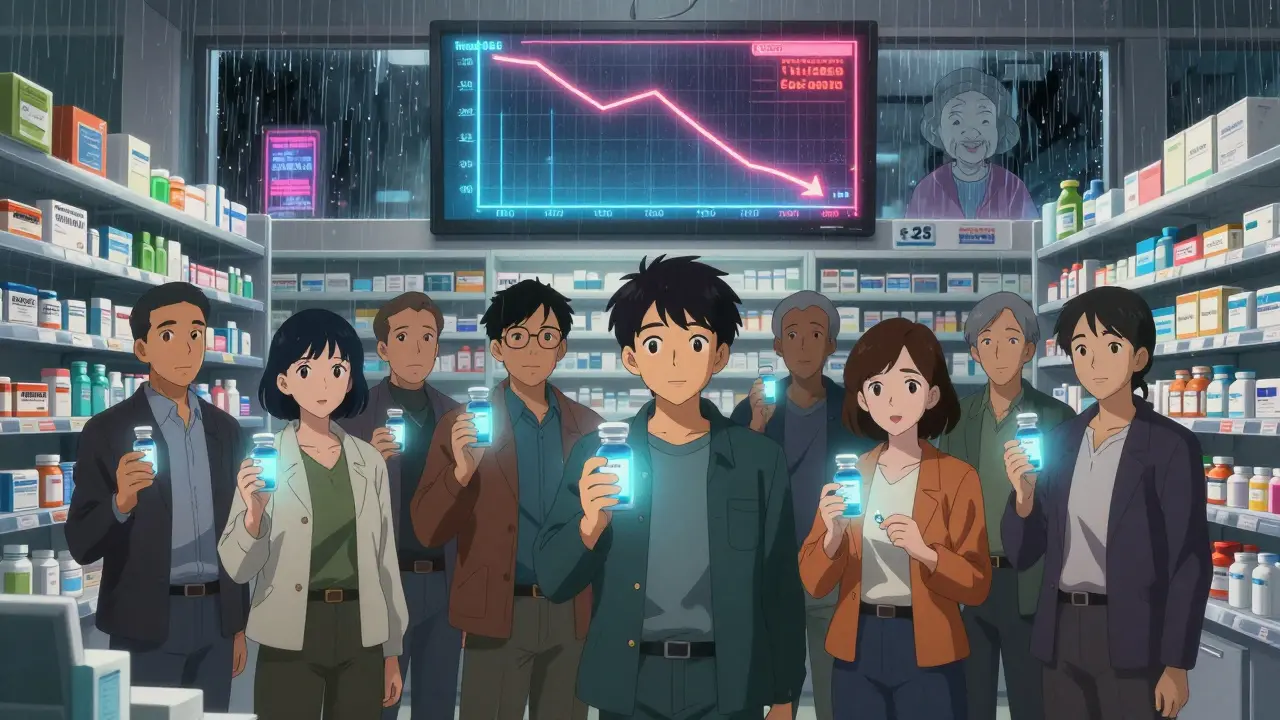
The world is spending more on healthcare than ever before - and generics are the quiet force holding it back from spiraling even higher. While new drugs for cancer, diabetes, and obesity make headlines, it’s the humble generic pill - often costing 80-90% less - that keeps millions of people from choosing between medicine and rent. In 2025, global healthcare spending is projected to hit $10.7 trillion, with prescription drugs alone accounting for over $1.7 trillion in the U.S. alone. Without generics, that number would be far worse.
Why Generics Matter More Than You Think
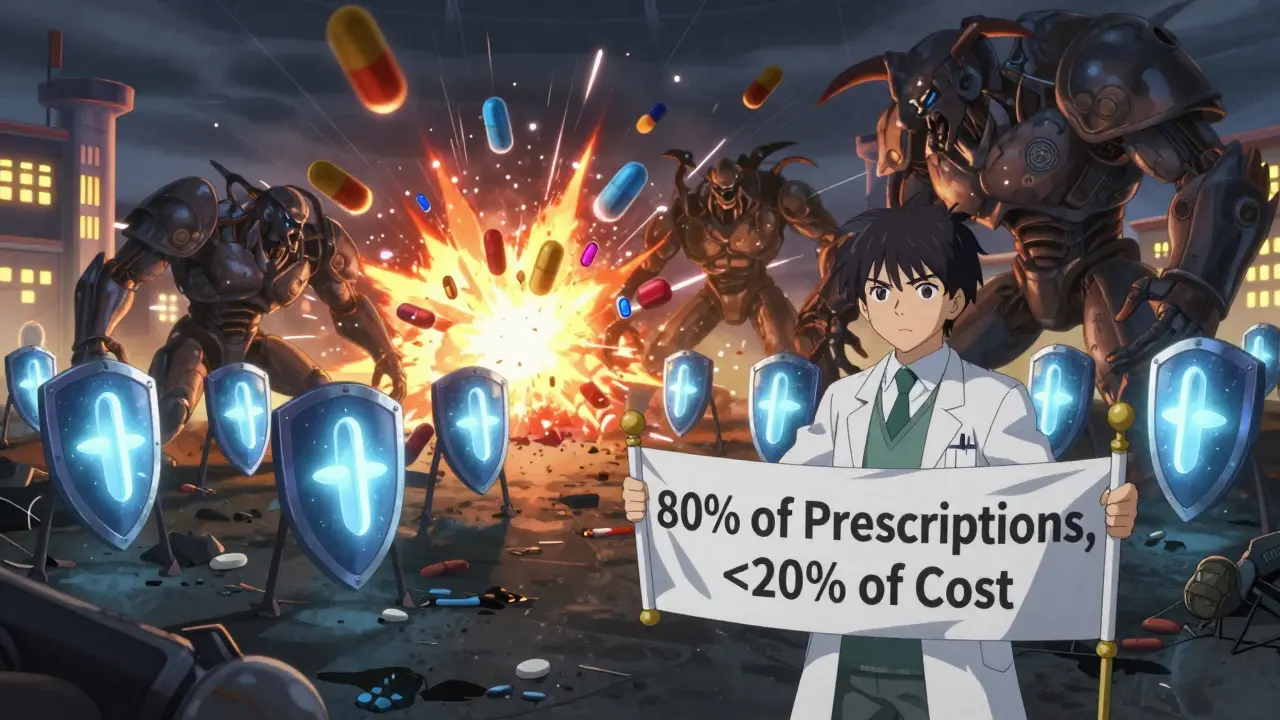
Most people think of generics as cheap copies of brand-name drugs. But they’re far more than that. They’re economic anchors. In high-income countries like the U.S., Canada, and across Western Europe, generics make up over 80% of all prescriptions filled. Yet they account for less than 20% of total drug spending. That’s the math: 8 out of 10 pills you take are generic, but they cost less than 1 in 5 of what you spend on medicine.
Take insulin. A brand-name vial can cost over $250 in the U.S. The generic version? Around $25. That’s not a price drop - it’s a lifeline. In 2024, U.S. drug spending jumped $50 billion, mostly because of high-cost specialty drugs. But without generic alternatives for older conditions like hypertension, asthma, or depression, that spike would’ve been twice as bad.
The Global Divide in Healthcare Spending
Not all countries are equal when it comes to paying for health. In 2022, the average country spent 3.8% of its GDP on healthcare. But that number hides a brutal truth: high-income nations spent 5.8%, while low-income countries scraped by on just 1.2%. In Turkmenistan, Afghanistan, and Nigeria, over 75% of healthcare costs come straight out of people’s pockets. No insurance. No safety net. Just cash.
That’s where generics become survival tools. In these places, a single generic antibiotic or blood pressure pill might be the only medicine a family can afford. The World Health Organization estimates that over 55 countries rely on out-of-pocket payments as their main source of health funding. Generics aren’t a convenience here - they’re the only option.
Meanwhile, in the U.S., even with insurance, out-of-pocket drug costs are rising. From $177 per person in 2025 to $231 by 2033, according to CMS data. That’s a 30.5% increase. Generics are the only thing slowing that climb.
Generics vs. Innovation: A Tug-of-War
The pharmaceutical industry isn’t ignoring generics. It’s betting on the opposite: expensive new drugs. Biologics, gene therapies, and AI-designed medicines are flooding the market. In 2025, 55% of insurers in the Americas and Middle East said new medical tech is the top driver of their rising costs. Oncology drugs alone can cost over $100,000 a year.
But here’s the twist: innovation doesn’t mean affordability. A new drug might work better - but if it costs 100 times more than a generic, it doesn’t help the average patient. That’s why generics are the counterweight. When patents expire on blockbuster drugs like Humira or Lipitor, prices crash. Generic manufacturers enter, competition kicks in, and costs drop by 90% within months.
IQVIA reports that in developed markets, generic competition is the main reason drug spending growth hasn’t exploded despite new treatments. Without generics, the $1.6 trillion global medicine market in 2025 would be closer to $2 trillion.
Where Generics Are Struggling
It’s not all smooth sailing. In emerging economies like China, India, and Brazil, the trend is shifting. As incomes rise and healthcare systems expand, more people are asking for newer, brand-name drugs - even if they cost more. China’s drug market is accelerating post-COVID, with greater use of original medicines. That’s good for innovation, but bad for affordability.
And then there’s biosimilars - the next generation of generics for complex biologic drugs. They’re cheaper than the originals, but still expensive compared to traditional generics. Adoption varies wildly. In Europe, biosimilars are widely used. In the U.S., doctors are slow to switch. In many low-income countries, they’re not even available.
Regulation, reimbursement rules, and physician habits all play a role. A 2025 Deloitte report found that low- and lower-middle-income countries face severe shortages of trained pharmacists and health workers. That makes it harder to even distribute generics, let alone educate patients about them.
The Real Cost of Not Using Generics
When countries skip generics, the damage shows up fast. Lebanon’s public healthcare spending dropped 71% between 2019 and 2021. Malawi’s fell 41%. In both cases, patients were forced to pay more out of pocket - or go without. The Institute for Health Metrics and Evaluation found that global development aid for health is falling, hitting its lowest level since 2009 in 2025. That means governments can’t just buy more expensive drugs. They need to stretch every dollar.
Generics let them do that. In 2023, generic drugs saved the U.S. healthcare system an estimated $374 billion over ten years. That’s enough to cover the entire Medicaid program for a year. In the UK’s NHS, over 90% of prescriptions are for generics - and that’s why the system still functions despite budget pressures.
What’s Next? The Future of Generic Access
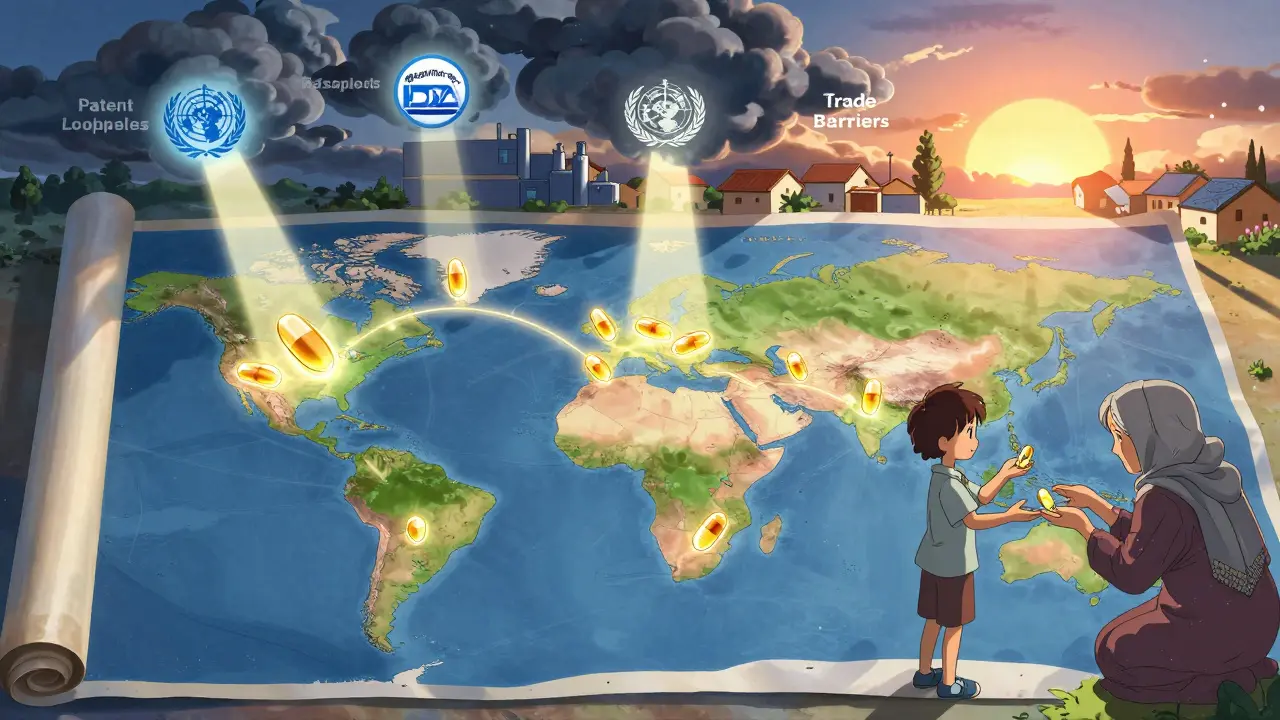
By 2030, over 100 blockbuster drugs will lose patent protection. That includes top-selling drugs for mental health, diabetes, and heart disease. If regulators and manufacturers act fast, we could see a massive wave of affordable alternatives. But if patent loopholes, legal delays, and slow approvals continue, prices won’t drop - and patients will suffer.
Some countries are already ahead. India and Bangladesh produce over 40% of the world’s generic drugs. Their factories keep prices low for the Global South. But trade policies, tariffs, and intellectual property rules still limit access. The U.S. and EU often block cheaper imports, even when they’re safe and approved.
Meanwhile, mental health spending is expected to rise 15% or more per person in the next three years, according to WTW’s 2025 survey. Generic antidepressants and antipsychotics are among the most cost-effective tools we have. Yet stigma, poor prescribing habits, and insurance barriers still keep many patients from using them.
Generics Are the Unsung Hero of Global Health
There’s no glamour in a generic pill. No flashy ads. No celebrity endorsements. But without them, millions would go without care. They’re the reason a grandmother in rural Nigeria can afford her blood pressure medicine. The reason a single parent in Ohio can fill their child’s asthma prescription. The reason a public hospital in Colombia doesn’t shut its doors.
Healthcare spending will keep rising. New drugs will keep coming. But if we want a system that works for everyone - not just the wealthy - we need to protect and expand access to generics. Not as a last resort. As a first choice.
Are generic drugs as safe as brand-name drugs?
Yes. In the U.S., the FDA requires generics to have the same active ingredients, strength, dosage form, and route of administration as the brand-name drug. They must also meet the same strict manufacturing standards. Studies show they work just as well - and have the same side effect profile. The only differences are in inactive ingredients like color or filler, which don’t affect how the drug works.
Why are generic drugs cheaper?
Brand-name drugs cost billions to develop and get approved. Companies recover those costs by setting high prices during their patent period. Generics skip those expenses. Once a patent expires, multiple manufacturers can make the same drug. Competition drives prices down - often to 10-20% of the original cost. No marketing, no clinical trials, no patent protection - just the medicine.
Do all countries have equal access to generics?
No. High-income countries have strong systems for approving and distributing generics. Low-income countries often lack infrastructure - pharmacies, trained staff, supply chains - to make them widely available. Some governments also restrict imports of cheaper generics from countries like India, even when they’re FDA- or WHO-approved. Trade policies and patent laws play a bigger role than medical need.
Can I switch from a brand-name drug to a generic?
In most cases, yes - and you should. Ask your doctor or pharmacist. For over 90% of medications, switching to a generic is safe and effective. Some complex drugs like certain biologics or seizure medications require extra caution, but even those often have biosimilar or generic alternatives now. The biggest barrier is often habit - both for patients and doctors.
Why aren’t more generics available for newer drugs?
Many new drugs are protected by patents that last 20 years or more. Companies also use legal tricks - like filing multiple patents on minor changes - to delay generic entry. This is called "patent evergreening." It’s legal, but it keeps prices high. In some cases, generics aren’t available for a decade after the original patent expires. Advocacy groups are pushing for faster approval and tougher rules against these delays.

Comments
Ashley Hutchins
February 8, 2026 AT 11:22people just dont get it generics arent some cheap knockoff theyre literally the reason my mom can afford her heart meds and not have to choose between that and her insulin
if you think brand name is better youve never read the FDA studies
its the same damn thing just without the marketing budget
Lakisha Sarbah
February 10, 2026 AT 04:44i used to think generics were sketchy until my cousin got on them for her depression meds and she said she felt the exact same. no difference. just saved her $300 a month. why are we still stigmatizing these?
Ariel Edmisten
February 10, 2026 AT 09:45Generics save lives. Simple as that.
Savannah Edwards
February 10, 2026 AT 14:47you know what really gets me? how we act like generics are some last resort when they should be the first option. in india they make 40% of the world's generics and we here in the u.s. still act like they're suspicious. i had a friend from delhi tell me her grandma gets all her meds from a local pharmacy that sources from indian manufacturers. the cost? 1/10th of what we pay. and the quality? better than some of the brand-name stuff i've seen in u.s. pharmacies that have been sitting on shelves for 3 years. we're not just overpaying, we're being manipulated. the system is designed to keep us scared of the cheap option even when science says it's identical. and don't even get me started on how insurance companies still make you jump through hoops to get a generic even when it's literally the same pill with a different label
it's not about safety. it's about profit. and the people who suffer are the ones who can't afford to be fooled anymore
AMIT JINDAL
February 12, 2026 AT 02:19bro india makes 40% of the world's generics and we in the west act like they're some shady underground operation 😭
the truth? our own pharma companies are the ones blocking imports because they're scared of competition
you think the FDA doesn't approve these? they test every batch
my cousin works in a pharma lab in mumbai and they follow stricter protocols than some u.s. plants
yet we still call them 'cheap' like it's a bad thing
we need to stop being so colonial about this. generics aren't inferior-they're intelligent. and we're the ones being stupid for not using them
Niel Amstrong Stein
February 14, 2026 AT 01:55generics are the unsung heroes of modern medicine 🤖💊
no one throws a parade for them but without them we'd all be paying $1000 for a 30-day supply of metformin
and honestly? i love that they exist. it's like the universe said 'here's a solution that doesn't require a loan' 🙌
we need to stop treating medicine like a luxury item and start treating it like a human right. generics are the closest thing we have to that right right now
Joey Gianvincenzi
February 16, 2026 AT 01:06The assertion that generics are universally safe and effective is not supported by empirical data across all therapeutic classes. The bioequivalence standards are intentionally lenient, permitting a 20% variance in plasma concentration-a threshold that, in pharmacokinetic terms, constitutes a clinically significant deviation for narrow-therapeutic-index drugs. Furthermore, the manufacturing oversight of foreign facilities-particularly in jurisdictions lacking FDA-equivalent regulatory infrastructure-remains profoundly inconsistent. To conflate cost-efficiency with therapeutic equivalence is not only scientifically irresponsible but morally negligent toward patient outcomes.
Amit Jain
February 17, 2026 AT 06:40oh wow generics are great right? until you take one and your blood pressure spikes because the filler was different
and yeah i know the fda says they're the same
but i've been on 3 different generic versions of lisinopril and two of them made me dizzy as hell
so don't tell me they're all perfect
the system is rigged and the only ones who win are the big pharma companies who make the brand names and then the generics too
they own both sides
Ritu Singh
February 17, 2026 AT 18:02The structural inequities in global pharmaceutical access cannot be resolved through market-based solutions alone. While generics do provide cost relief, their distribution remains entangled in colonial trade hierarchies. India's dominance in generic production is not an accident-it is the legacy of postcolonial policy innovation, yet Western nations continue to impose intellectual property barriers and import restrictions under the guise of safety. The WHO’s 2025 report on pharmaceutical equity reveals that 73% of low-income countries face supply chain gaps that prevent even approved generics from reaching rural clinics. This is not a failure of manufacturing-it is a failure of political will. To call generics a 'lifeline' without addressing the geopolitical mechanisms that hoard them is to romanticize suffering.
Catherine Wybourne
February 18, 2026 AT 10:14i love how america acts like generics are some radical idea when europe’s been using them for decades like it’s normal
in the uk, if you ask for a brand name drug, your doctor will look at you like you asked for a gold-plated toothbrush
we’re not just behind on cost-we’re behind on common sense
and honestly? the fact that we still have people arguing about whether generics are safe… that’s the real scandal
Eric Knobelspiesse
February 20, 2026 AT 05:27so like… if generics are so great why do we still have brand names? 🤔
because the system is built to keep people confused
and also because people are scared of the word 'generic' like it means 'fake' or 'bad' or 'not real medicine'
it’s psychological manipulation disguised as healthcare
also why is it that when i go to the pharmacy and ask for generic i get this weird look like i’m asking for a discount coupon for oxygen?
we need to rebrand this. call them 'economy-grade' or 'value-line' or something
because 'generic' sounds like a bad movie
Heather Burrows
February 21, 2026 AT 18:10i just don't get why we're so obsessed with generics. why not just fix the system? why not make sure everyone has insurance? why not stop letting drug companies charge whatever they want? why do we keep putting the burden on patients to find the cheapest pill instead of holding the people who profit accountable?
Mayank Dobhal
February 22, 2026 AT 05:32in india we have generics for everything
but now the new rich want brand names
they think it's 'better' because it's more expensive
so now our factories are shifting from making cheap meds for the poor to making fancy versions for the middle class
we're losing our edge
and the world needs us to keep making the cheap ones
Gouris Patnaik
February 22, 2026 AT 09:46india makes 40% of the world's generics? that's a lie. we make 62%. the west just doesn't want to admit it because then they'd have to stop pretending they're the only ones who can do medicine right
we don't need your patents. we don't need your approval. we have the science. we have the will. and we have the people who need it most
Jesse Lord
February 23, 2026 AT 05:15my dad was on a generic for his cholesterol and he said he felt better than he had in years
he didn't even know it was generic until i told him
he was like 'so what? it works' and that was it
we need more of that mindset
not every solution has to be fancy
sometimes the quiet one is the one that saves you