
Anticoagulant Reversal Agents: Idarucizumab, Andexanet Alfa, PCC, and Vitamin K Explained

Anticoagulant Reversal Decision Tool
Select Patient Information
Click 'Get Recommendation' to see your results
Speed
---
Success Rate
---
Clot Risk
---
When someone on blood thinners suffers a serious bleed - like a brain hemorrhage or internal bleeding after a fall - time is everything. The difference between life and death can come down to minutes. That’s why doctors need tools that can instantly undo the effects of these medications. Enter anticoagulant reversal agents: targeted drugs designed to stop bleeding fast. Four main players dominate this space: idarucizumab, andexanet alfa, prothrombin complex concentrate (PCC), and vitamin K. Each works differently, works for different drugs, and comes with its own risks, costs, and real-world limitations.
How These Reversal Agents Work - And What They’re For
Not all blood thinners are the same, and neither are their antidotes. There are two big categories of anticoagulants in use today: vitamin K antagonists (like warfarin) and direct oral anticoagulants (DOACs) like dabigatran, rivaroxaban, and apixaban. Each needs a different kind of reversal.
Vitamin K is the oldest tool in the box. It’s been around since the 1940s and only works on warfarin. Warfarin blocks vitamin K from helping your body make clotting factors. Giving more vitamin K lets your liver start making those factors again. But it’s slow. You won’t see results for at least 4 to 6 hours. Full reversal takes up to 24 hours. That’s fine for planned procedures, but useless in an emergency.
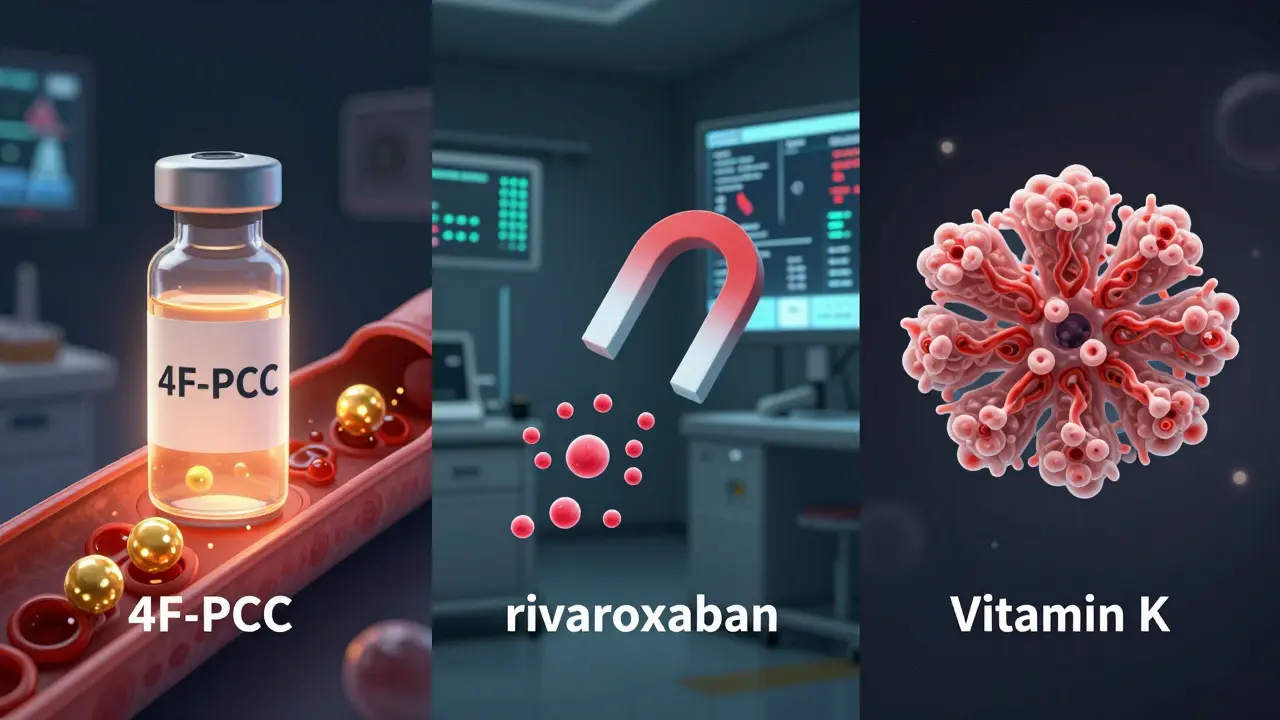
That’s where PCC comes in. It’s a concentrated mix of clotting factors - II, VII, IX, X - pulled from donated blood plasma. A 4-factor PCC (4F-PCC) also includes proteins C and S. It works fast: within 15 to 30 minutes. It’s the go-to for warfarin emergencies, especially when combined with vitamin K. Without vitamin K, the effect fades fast as the PCC’s clotting factors get used up or break down. Rebound bleeding is real.
Then come the newer, targeted agents: idarucizumab and andexanet alfa. These were built for DOACs. Idarucizumab is a monoclonal antibody fragment that latches onto dabigatran like a magnet and neutralizes it. Andexanet alfa is a modified version of factor Xa - it acts as a decoy, soaking up rivaroxaban, apixaban, or edoxaban before they can interfere with clotting. Both are designed for speed. Idarucizumab reverses dabigatran in under 5 minutes. Andexanet alfa works in 2 to 5 minutes.
Speed, Success, and Survival - The Numbers Behind the Drugs
Speed alone doesn’t tell the whole story. What matters is whether the bleeding stops and whether the patient survives. A 2022 analysis of 32 studies involving over 1,800 patients with brain bleeds showed clear differences in reversal success:
- Idarucizumab: 82% success rate
- 4F-PCC: 77% success rate
- Andexanet alfa: 75% success rate
But success isn’t just about stopping the bleed - it’s about what happens next. Mortality rates tell another story:
- Idarucizumab: 11% death rate
- Andexanet alfa: 24% death rate
- 4F-PCC: 26% death rate
And then there’s the risk of new clots. This is where things get tricky. Andexanet alfa has a higher rate of thrombotic events - 14% of patients developed dangerous clots like heart attacks or strokes. Idarucizumab? Only 5%. PCC? Around 8%. That’s why some experts worry about using andexanet alfa unless absolutely necessary.
One big reason idarucizumab might have lower death rates? Dabigatran is easier to reverse than factor Xa inhibitors. It’s a simpler molecule. Andexanet alfa, designed for rivaroxaban and apixaban, has to compete with more complex drug behavior in the body. Plus, its half-life is only about an hour. That means if the patient keeps absorbing the DOAC from their gut, the reversal can wear off - and the bleeding can come back. Some doctors now give a second dose or extend the infusion to prevent this.
Cost and Availability - The Real-World Bottlenecks
Here’s where the perfect clinical plan meets the messy reality of hospital budgets.
Idarucizumab costs about $3,500 for a full 5g dose. 4F-PCC runs $1,200 to $2,500 depending on how much you need. Andexanet alfa? $13,500 per treatment. That’s nearly four times the cost of idarucizumab and over ten times the cost of PCC.
And availability? It’s uneven. According to 2023 data from the American Hospital Association, only 65% of U.S. hospitals stock andexanet alfa. That’s because it’s expensive, complex to store, and not always needed. Vitamin K? Every ER has it. PCC? Almost every hospital carries it. Idarucizumab? Widely available. Andexanet alfa? Not so much.
That’s why many emergency departments still use 4F-PCC off-label for DOAC reversals - especially apixaban or rivaroxaban. It’s not FDA-approved for that use, but in a crisis, when the specific agent isn’t on hand, it’s the best option many have. A 2022 survey of 127 emergency departments found that 63% of clinicians worried about andexanet alfa’s clotting risk, and 78% preferred idarucizumab for dabigatran cases.
What Doctors Actually Do - Real Stories, Real Choices
In the ER, decisions aren’t made from textbooks. They’re made under pressure.
When a 72-year-old man on apixaban falls and hits his head, the team checks his INR. It’s normal. The DOAC isn’t measurable on standard tests. The CT scan shows a small brain bleed. The team has two choices: wait for andexanet alfa (which might not arrive for hours) or use 4F-PCC now.
Most go with PCC. Why? Speed. Availability. Cost. A 2023 review from the EMCrit Project documented multiple cases where 50 units/kg of PCC stopped the bleeding within 30 minutes - not as fast as andexanet alfa, but fast enough. And crucially, no new clots formed.
On the flip side, when a 68-year-old woman on dabigatran has a major GI bleed, idarucizumab is the clear winner. It’s targeted. It’s fast. It’s safe. The reversal is near-total within minutes. The patient stabilizes. The bleeding stops. The outcome? Better than average.
But here’s the catch: if the hospital doesn’t have idarucizumab? Then they use PCC anyway. And if they don’t have PCC? They give vitamin K and hope for the best - even though it takes a day to work. That’s why training matters. A 2022 ASH guideline says emergency staff need 30 to 60 minutes of training to dose PCC correctly. Too little, and you under-reverse. Too much, and you risk clotting.

What’s Next? The Future of Reversal
The field isn’t standing still. Ciraparantag - a synthetic molecule being tested in Phase III trials - could be a game-changer. Unlike the current agents, it reverses multiple anticoagulants at once: heparin, low-molecular-weight heparin, and all DOACs. Early data suggests it works fast and has a low clotting risk. If approved by late 2025, it could replace all current agents.
Meanwhile, researchers are refining how we use what we have. The 2024 ACCP draft guidelines say: use specific agents if they’re available and accessible. But if they’re not? PCC is still a solid, cost-effective alternative. And vitamin K? Always give it with PCC for warfarin - never skip it.
The big unanswered question remains: do these expensive, targeted drugs really save more lives than PCC? A 2016 review in Circulation said there’s no convincing proof. A 2021 meta-analysis in JACC said the same. The data is still emerging. But what we know for sure is this: if you don’t reverse the anticoagulant fast enough, mortality jumps more than threefold.
Bottom Line: What to Remember
- For warfarin: Use 4F-PCC + vitamin K. PCC stops the bleed fast. Vitamin K prevents rebound.
- For dabigatran: Idarucizumab is the gold standard - fast, safe, reliable. If unavailable, use 4F-PCC.
- For rivaroxaban or apixaban: Andexanet alfa works best, but it’s expensive and risky. PCC is a common, cheaper alternative with good results.
- For vitamin K: Only for warfarin. Too slow for emergencies. Always pair with PCC.
There’s no perfect agent. But there is a right choice - based on the drug, the patient, the hospital’s inventory, and the clock. The goal isn’t just to reverse the anticoagulant. It’s to stop the bleeding - and keep the patient alive.
Can vitamin K reverse DOACs like apixaban or rivaroxaban?
No. Vitamin K only works on warfarin and other vitamin K antagonists. DOACs like apixaban, rivaroxaban, edoxaban, and dabigatran work through completely different mechanisms - they don’t rely on vitamin K. Giving vitamin K to someone on a DOAC will have no effect on their anticoagulation. Using it in these cases delays proper treatment and can worsen outcomes.
Is PCC safe to use for reversing DOACs if the specific agent isn’t available?
Yes, and it’s commonly done. While 4F-PCC isn’t FDA-approved for DOAC reversal, multiple studies and real-world data show it’s effective. Emergency departments use it regularly when idarucizumab or andexanet alfa aren’t on hand. The key is dosing correctly: 25-50 units/kg based on the patient’s weight and severity. It’s not as fast as the specific agents, but it’s often fast enough to save a life.
Why is andexanet alfa associated with more blood clots than the other agents?
Andexanet alfa works by mimicking factor Xa, which is part of the clotting cascade. When you flood the bloodstream with this decoy protein, you’re also increasing the overall clotting potential. In some patients, especially those with underlying heart disease or recent clots, this can trigger new clots - like heart attacks, strokes, or deep vein thrombosis. The FDA even added a boxed warning about this risk. That’s why it’s used cautiously, and why many clinicians prefer PCC or idarucizumab when possible.
Do all hospitals carry idarucizumab and andexanet alfa?
No. Idarucizumab is widely available - stocked in over 90% of U.S. hospitals. Andexanet alfa is in only about 65%. Its high cost ($13,500 per dose) and complex storage requirements limit its adoption. Smaller hospitals, rural centers, and community ERs often don’t carry it. That’s why PCC remains a critical backup - it’s cheaper, more accessible, and still effective in most cases.
What happens if you reverse anticoagulation but don’t give vitamin K with PCC?
You risk rebound anticoagulation. PCC gives you clotting factors, but they last only 6 to 24 hours. If the patient is on warfarin, their liver is still blocked from making new factors. Once the PCC wears off, their INR can spike again - sometimes dangerously high. This can cause renewed bleeding hours or even days later. That’s why vitamin K is mandatory with PCC for warfarin reversal - it restarts the body’s natural production of factors to prevent this rebound.
Are there any new reversal agents coming soon?
Yes. Ciraparantag is in Phase III trials and could be approved by late 2025. It’s a synthetic molecule that reverses multiple anticoagulants - including heparin and all DOACs - with a single dose. Early data shows it works quickly and has a low risk of causing clots. If approved, it could replace idarucizumab, andexanet alfa, and even PCC in many cases, simplifying emergency protocols.



Comments
Randy Harkins
February 8, 2026 AT 03:00Just wanted to say this post is a lifesaver for ER nurses like me. We don't always have the fancy drugs on hand, but knowing when to use PCC + vitamin K? Game changer. Seriously, thank you for breaking this down so clearly.
Elan Ricarte
February 8, 2026 AT 20:48Andexanet alfa at $13.5K? Bro, that’s not a drug, that’s a bank heist with a syringe. Meanwhile, PCC is sitting there like the humble uncle who shows up to every family reunion and actually fixes the damn grill. Why are we paying for a luxury sedan when a Toyota Camry gets you there without a heart attack?
Marie Fontaine
February 9, 2026 AT 09:10OMG YES this is exactly what I needed for my rotation! 🙌 PCC + vit K for warfarin? Always. Idarucizumab for dabigatran? 100%. Andexanet? Only if the patient has a private jet and a cardiologist on speed dial 😅
Lyle Whyatt
February 9, 2026 AT 11:40Let me tell you something about reversal agents that nobody talks about - it’s not just about the drug, it’s about the system. You can have the most perfect, targeted, FDA-approved agent in the world, but if your hospital’s pharmacy is closed at 2 a.m. because they can’t afford overnight staff, you’re stuck with what’s in the cold box. And that’s often PCC. And you know what? It works. Not as fast, not as pretty, not as expensive - but it works. We’ve saved lives with it. And we’ve done it without fanfare. The real heroes aren’t the drugs - they’re the nurses who run down the hall with a 50-unit/kg bag at 3 a.m. while the resident is still trying to find the order form.
Tatiana Barbosa
February 9, 2026 AT 15:13From a clinical pharmacist perspective - the rebound bleed risk with PCC without vit K is terrifying. I’ve seen it twice. INR jumps from 1.8 to 7.2 in 12 hours. Patient re-bleeds. Family cries. We all cry. Vit K isn’t optional - it’s the anchor. And for DOACs? PCC off-label is legit. Studies show non-inferiority. Stop acting like it’s some kind of hack. It’s standard of care in 70% of US EDs. The guidelines know it. The data knows it. Stop pretending we’re all in fancy academic centers with every agent on the shelf.
Ken Cooper
February 10, 2026 AT 22:58wait so if you give andexanet and the patient still has rivaroxaban in their gut, the reversal wears off?? so like… you reverse them… and then they re-anticoagulate?? that’s wild. like a drug ghost. i feel bad for the nurses who have to watch for this. also why is it called andexanet? sounds like a spaceship. lol
MANI V
February 11, 2026 AT 21:06Of course the rich hospitals get the shiny new drugs. Meanwhile, in real America - the ones without 200-bed ICUs - we’re using PCC like it’s duct tape and hope. And you want to know what’s worse? The pharma reps who come in with free lunch and tell you andexanet is ‘the future.’ The future is a scam when half the country can’t afford the damn thing. Wake up. This isn’t medicine. It’s capitalism with a stethoscope.
Ryan Vargas
February 13, 2026 AT 19:43Have you ever stopped to think that maybe these reversal agents aren’t really about saving lives… but about creating dependency? Think about it. We used to treat bleeding with transfusions and pressure. Now? We need a $13,500 monoclonal antibody. Who profits? Who owns the patents? Who lobbies Congress to keep these prices high? And why is ciraparantag - the one that could make all of this obsolete - still in Phase III? Coincidence? Or is this a carefully orchestrated system to keep the blood thinners market alive? The answer is obvious. They don’t want you to be able to reverse it. They want you to need it forever.
Sam Dickison
February 13, 2026 AT 20:06For DOACs, PCC is totally valid. Just dose it right. 25-50 U/kg. Don’t go full shotgun. I’ve seen people give 100 U/kg and then wonder why the patient had a stroke. Also - vit K for warfarin? Always. No exceptions. If you’re skipping it, you’re not a clinician. You’re a liability.
Joshua Smith
February 13, 2026 AT 22:18Just curious - anyone here use ciraparantag in trials? I’ve been reading up on it and it sounds like a dream. Single dose, reverses everything, low clot risk. If it’s approved in 2025, I’m betting half of these current agents go extinct. Would be nice to have one go-to instead of memorizing 4 different protocols.
PAUL MCQUEEN
February 15, 2026 AT 03:07So you’re telling me we spend 10x more on andexanet and get a higher death rate? That’s not science. That’s a marketing department with a budget and a PowerPoint.
glenn mendoza
February 15, 2026 AT 11:01Thank you for this meticulously researched and clinically nuanced overview. The data-driven approach to comparing reversal agents - particularly the mortality and thrombotic event stratification - is profoundly informative and aligns with current evidence-based guidelines. The emphasis on system-level constraints, including availability and cost, further underscores the imperative for equitable access to life-saving therapeutics. This is precisely the kind of synthesis that informs responsible clinical decision-making at the bedside.
Tori Thenazi
February 17, 2026 AT 01:48Wait… so you’re telling me the FDA approved andexanet alfa knowing it causes heart attacks?? And they still let hospitals use it?? Who’s really behind this?? I bet it’s the same people who made the vaccine… and the masks… and the 5G towers… they’re all connected. I’ve been researching this for 3 years. They’re using these drugs to control the population. You think it’s about bleeding? No. It’s about creating more patients who need MORE drugs. It’s a trap.
Ritteka Goyal
February 17, 2026 AT 09:29India has been using PCC for DOAC reversal for years and we never had these expensive drugs. Why? Because we know medicine is about people, not profit. In Mumbai, we give 30 units/kg PCC + vit K for warfarin. For dabigatran? We use 4F-PCC. For apixaban? Same. We save lives. We don't need $13,500 magic bullets. We have skilled nurses, trained residents, and a system that values care over corporate greed. Maybe the US needs to stop buying fancy toys and start trusting its clinicians.
Jonah Mann
February 17, 2026 AT 21:31just a heads up - if you're using PCC for apixaban, make sure you're not giving it with heparin at the same time. i did that once. bad idea. patient got a clot. lesson learned. also - idarucizumab is way more reliable than people think. i've seen it work in under 2 mins. like magic. kinda wish we had more of it.