
Why Generic Medications Cost Less for Patients and Insurers
When you pick up a prescription, you might see two options: the brand-name drug you recognize from TV ads, or a smaller bottle with a plain label and a much lower price. That’s the generic. And if you’ve ever wondered why it costs so much less, the answer isn’t magic-it’s math, competition, and decades of policy changes designed to make medicine affordable.
Same Medicine, Lower Price
Generic drugs aren’t knockoffs. They’re exact copies. The FDA requires them to have the same active ingredient, strength, dosage form, and route of administration as the brand-name version. That means if your doctor prescribes lisinopril for high blood pressure, the generic version works the same way, in the same amount of time, with the same side effects. The FDA doesn’t allow generics to be "good enough"-they have to be identical in how they work inside your body.The difference isn’t in effectiveness. It’s in cost. And that cost gap exists because generic manufacturers don’t have to start from scratch. When a brand-name drug is first developed, the company spends years and hundreds of millions of dollars on research, clinical trials, and regulatory approval. That’s the price of innovation. Once the patent expires-usually after 20 years-other companies can step in and make the same drug without repeating those expensive steps.
How the System Keeps Prices Low
The 1984 Hatch-Waxman Act created the legal pathway for this. It let generic drugmakers file an Abbreviated New Drug Application (ANDA), which only requires proof that their version is bioequivalent to the brand. No need for new clinical trials. No need to prove safety again. That cuts development time from a decade to under two years-and slashes costs by 90% or more.Once one generic enters the market, prices drop. When a second one comes in, they drop even more. By the time five or six companies are making the same drug, the price often falls to just 15-20% of the original brand-name price. The FDA found that lurasidone (brand name Latuda), for example, dropped from $1,400 a month to under $60 after generics arrived. Pemetrexed (Alimta) went from $3,800 to $500. Those aren’t outliers. That’s the pattern.
And it’s not just patients who save. Insurers save too. In 2022 alone, generic and biosimilar drugs saved the U.S. healthcare system $408 billion. Over the last decade, that adds up to $2.9 trillion. That’s more than the entire annual budget of most U.S. states. Generics make up 90% of all prescriptions filled, but they account for only 1.5% of total drug spending. That’s the power of competition.
Why Some Generics Still Cost Too Much
Not all generics are cheap. And that’s where things get messy.Some generic drugs, especially older ones with few manufacturers, still carry high prices. A 2022 JAMA Network Open study found 45 high-cost generics that were over 15 times more expensive than other drugs in the same therapeutic class. In Colorado, replacing just those high-cost generics with cheaper alternatives would have saved $6.6 million-88% of what was spent.
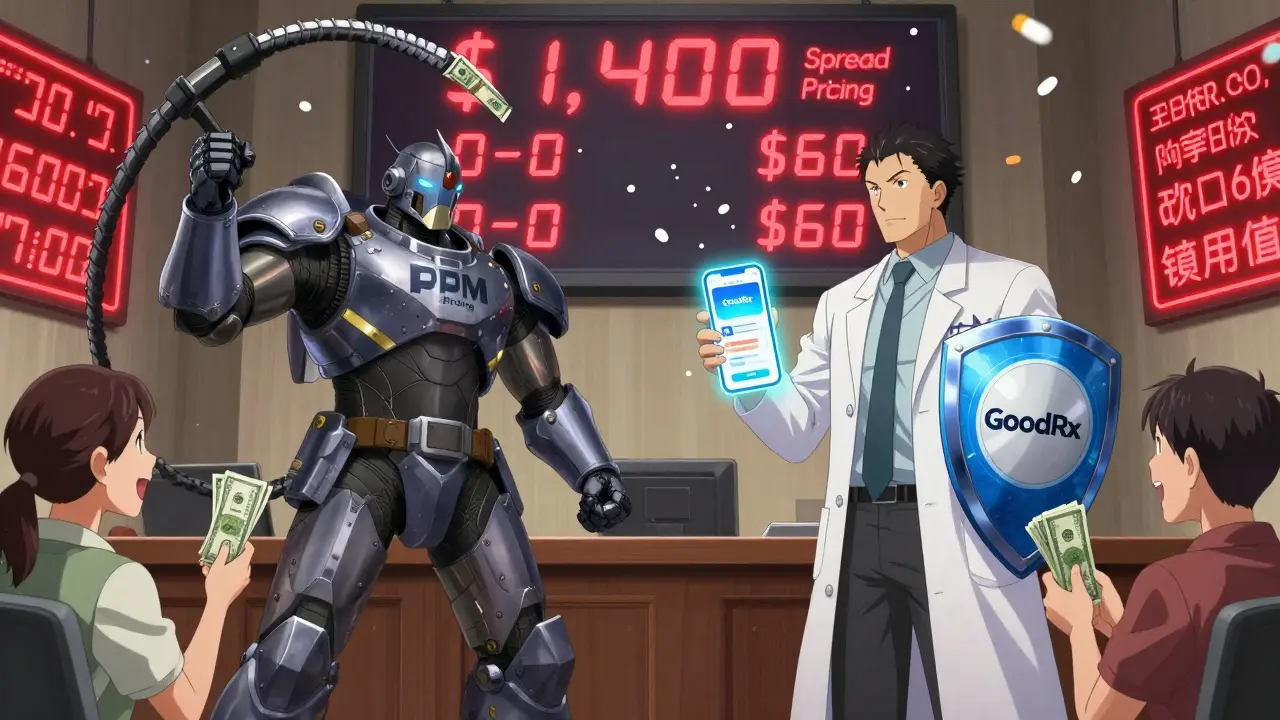
Why? Because pharmacy benefit managers (PBMs)-the middlemen between insurers, pharmacies, and drugmakers-sometimes profit from "spread pricing." That means they negotiate a lower price with the pharmacy, but charge the insurer a higher price. The difference? Their profit. And if a high-priced generic is on the formulary, they make more money-even if a cheaper, equally effective version exists.
This isn’t fraud. It’s a loophole. And it’s why your copay for a generic might still be $30, even though the same drug costs $8 cash at another pharmacy.
What You Can Do to Save More
You don’t have to accept whatever price your pharmacy gives you. Here’s how to get the real deal:- Ask your doctor to write "dispense as written" on your prescription. That gives your pharmacist the legal right to substitute a generic-even if the brand was prescribed.
- Use free tools like GoodRx, SingleCare, or the Mark Cuban Cost Plus Drug Company. In 2023, users saved an average of 67% on depression meds, 58% on blood pressure drugs, and 57% on weight loss pills.
- Compare cash prices vs. insurance prices. If you have a high-deductible plan, paying cash is often cheaper. One Reddit thread with over 1,400 comments found 78% of users saved more by paying out of pocket.
- Consider mail-order pharmacies for maintenance meds. They often offer 90-day supplies at lower rates.
A study in JAMA Internal Medicine found patients who actively compared prices saved an average of $287 a year. That’s not pocket change. That’s a vacation, a new pair of shoes, or a month’s worth of groceries.
Who Benefits the Most?
The biggest winners? People without insurance. The same study that looked at the Mark Cuban Cost Plus Drug Company found uninsured patients saved the most-$6.08 per prescription on average. But even people with insurance benefit. The average copay for a generic is $6.16. For brand-name drugs? $56.12. That’s nearly nine times more.Ninety-three percent of generic prescriptions cost under $20. Only 59% of brand-name prescriptions do. If you’re on a fixed income, managing a chronic condition, or just trying to stretch your paycheck, generics aren’t just a smart choice-they’re essential.
The Bigger Picture: What’s Next?
More than 600 new generic drugs were approved in 2022 and 2023. That’s good news. But challenges remain. Some drugs are at risk of shortage-202 were flagged by the FDA in early 2023. When supply is tight, prices spike. And some brand-name companies still use legal tricks-like "evergreening" patents or "pay-for-delay" deals-to block generics from entering the market.The Inflation Reduction Act is starting to change that. By 2031, it’s projected to save Medicare beneficiaries $105 billion on prescriptions, mostly through increased generic and biosimilar use. The FTC is also investigating PBM practices. If they crack down on spread pricing, more savings could flow directly to patients.
Meanwhile, biosimilars-generic versions of complex biologic drugs-are coming online. These could save another $150 billion between now and 2027. Think of them as the next wave of affordability.
Final Thought: It’s Not About Cheap. It’s About Fair.
Generic drugs aren’t "inferior." They’re not "second-rate." They’re the same medicine, sold at a fair price because competition works. The system was built to make sure no one has to choose between taking their medicine and paying rent. And for the most part, it does.But it only works if you know how to use it. Don’t assume your insurance gives you the best price. Don’t assume the pharmacist knows the cheapest option. Ask. Compare. Switch. Your wallet-and your health-will thank you.
Are generic drugs as safe and effective as brand-name drugs?
Yes. The FDA requires generic drugs to meet the same strict standards as brand-name drugs for quality, strength, purity, and performance. They must be bioequivalent-meaning they work the same way in your body, at the same rate, and with the same results. There’s no difference in safety or effectiveness.
Why do some generics cost more than others?
Not all generics are priced equally. Some are expensive because only one or two companies make them, limiting competition. Others are priced high due to practices like "spread pricing" by pharmacy benefit managers, who profit from the difference between what they pay the pharmacy and what they charge insurers. Always compare prices across pharmacies and consider cash options.
Can I save money by paying cash instead of using insurance for generics?
Yes, often. If you have a high-deductible plan, your insurance may not cover the full cost of a generic until you’ve paid thousands out of pocket. In those cases, paying cash through tools like GoodRx can be significantly cheaper. One study found 78% of users saved more by paying cash than using insurance.
Do generics have different side effects?
No. The active ingredient is identical, so side effects are the same. However, generics may contain different inactive ingredients-like fillers or dyes-which rarely cause reactions in sensitive individuals. If you notice a change after switching, talk to your doctor or pharmacist. It’s usually not the drug-it’s the filler.
How do I know if a generic is available for my prescription?
Ask your pharmacist or doctor. Most brand-name drugs have a generic version once the patent expires. You can also check online tools like GoodRx or the FDA’s Orange Book, which lists approved generics. If your doctor didn’t mention it, ask: "Is there a generic version of this?" It’s a simple question that can save you hundreds.
Why do some pharmacies charge more for the same generic?
Pharmacies set their own prices, and insurance contracts vary. A generic might cost $5 at Walmart, $12 at CVS, and $25 at a specialty pharmacy. PBMs also influence pricing by negotiating deals with certain pharmacies. Always compare prices before filling a prescription-even if you’re using insurance.
Comments
Joy Nickles
January 2, 2026 AT 11:03Okay but why do my CVS generics still cost $40 when the same pill is $3 at Walmart?? PBMs are ROBBING us and no one talks about it!!
Marilyn Ferrera
January 2, 2026 AT 17:39The FDA’s bioequivalence standards are rock solid. If your generic didn’t work, your body would tell you-fast. No magic, no compromise. Just science.
Stewart Smith
January 4, 2026 AT 08:37So we’re supposed to be grateful that the system works… barely? 😅
anggit marga
January 4, 2026 AT 23:17USA thinks it invented medicine but generics are why Africans live longer now. You’re welcome
Emma Hooper
January 5, 2026 AT 17:06My pharmacist once tried to upsell me brand-name insulin because ‘it’s better.’ I laughed so hard I cried. Then I paid $5 cash and walked out like a boss 💸
Aaron Bales
January 6, 2026 AT 10:39Always check GoodRx. Always. Even if you have insurance. I saved $180 last month just by switching. It’s not rocket science-it’s basic math.
John Chapman
January 6, 2026 AT 11:53Generics are the unsung heroes of healthcare 🙌❤️ I take 6 generics daily and I’m alive because of them. Thank you, science. Thank you, competition.
Urvi Patel
January 7, 2026 AT 22:08Most people don’t even know generics exist. They just pay what the pharmacy says. That’s why the system stays broken
Bennett Ryynanen
January 9, 2026 AT 01:01I used to think generics were sketchy until my dad switched to generic metformin and his blood sugar dropped faster than his cable bill. Now he won’t touch brand-name stuff.
Branden Temew
January 10, 2026 AT 17:46If capitalism can make a $2,000 pill into a $50 one just by letting other people copy it… maybe the problem isn’t medicine. Maybe it’s greed.
Martin Viau
January 12, 2026 AT 12:44Let’s not ignore the supply chain fragility. When one Chinese factory shuts down, 30% of the world’s generic antibiotics vanish. It’s a geopolitical time bomb.
Harriet Hollingsworth
January 14, 2026 AT 08:40People who pay cash for generics are the real heroes. Everyone else is just letting corporations take their money while they scroll TikTok.
Robb Rice
January 15, 2026 AT 05:32As someone who works in pharmacy benefits, I can confirm: spread pricing is real. It’s not illegal-it’s just morally bankrupt. And yes, I’m still employed.
Darren Pearson
January 16, 2026 AT 16:35It is a fascinating demonstration of economic theory in practice: when multiple entities compete to provide an identical product, marginal cost approaches zero. The market, in this instance, functions as intended.
Deepika D
January 18, 2026 AT 15:25Let me tell you something-I’m a nurse in rural India. We use generics every single day. My patients don’t have insurance. They don’t have GoodRx. They just have a little paper slip and hope. And guess what? The generics work. They always work. People here don’t have the luxury of doubting science. They live because it works. So when Americans argue about $5 vs $30 for a pill? I just sigh. You have options. We don’t. Don’t take this for granted. Seriously. Just… don’t.