
Energy Drinks and Stimulant Medications: Blood Pressure and Heart Risks

Energy Drink Risk Calculator
Total Caffeine Intake
The FDA recommends 400mg daily caffeine for most healthy adults. But this varies based on your age and medical conditions.
Risk Level
Important Medical Note
If you experience chest pain, heart palpitations, severe headaches, or dizziness after consumption, seek medical attention immediately.
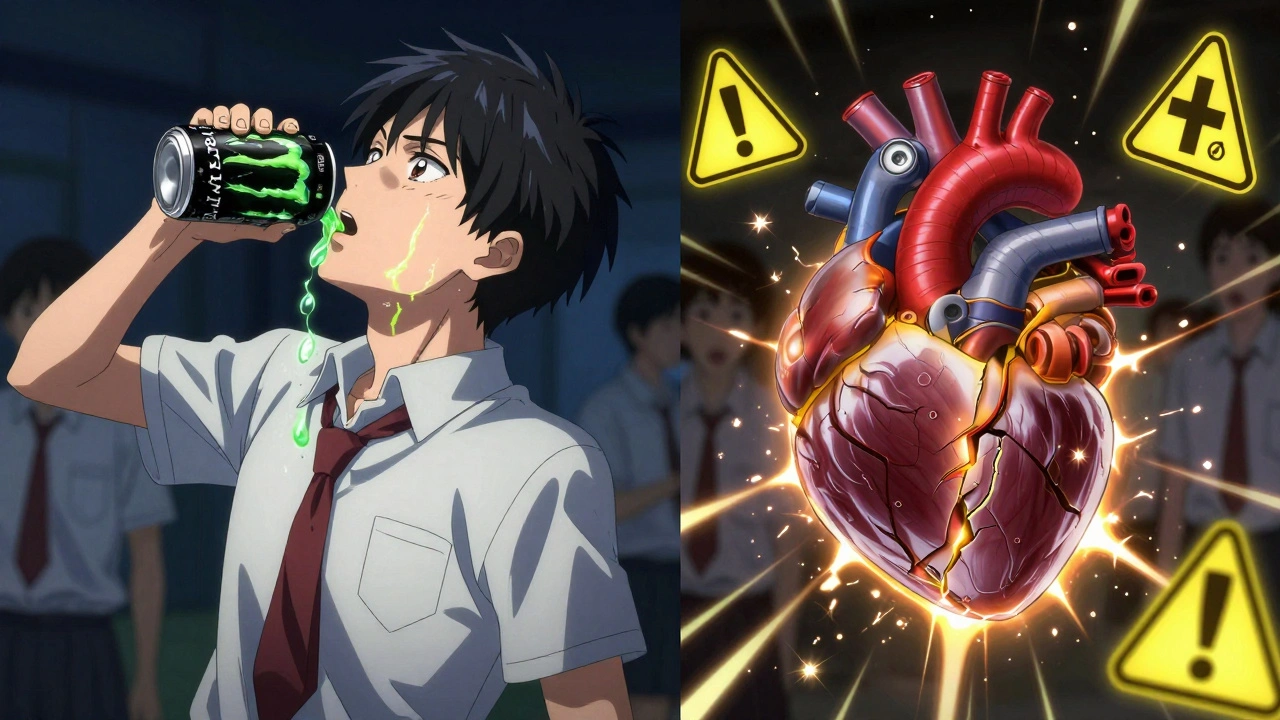
When you down an energy drink after a late-night study session or pop a prescription stimulant to get through a workday, you might think you’re just boosting focus. But what you’re really doing is putting extra strain on your heart-and your blood pressure may be climbing faster than you realize.
What’s Actually in Energy Drinks?
Energy drinks aren’t just sugary soda with caffeine. A typical can of Monster Energy contains 160 mg of caffeine. Bang Energy? That’s 300 mg-more than three cups of coffee. Some brands go even higher. And that’s just the start. These drinks also pack in guarana, a plant seed that’s naturally high in caffeine, taurine, and bitter orange extract (synephrine), which acts like a stimulant on its own.
It’s not just the caffeine. It’s the combo. Studies show that when these ingredients mix, they don’t just add up-they multiply. The result? A sharp spike in adrenaline, heart rate, and blood pressure. One 2015 Mayo Clinic study found that after drinking a 240 mg caffeine energy drink, healthy young adults saw their systolic blood pressure jump by 6.2%. That might sound small, but for someone with even mild hypertension, that’s enough to push them into dangerous territory.
How Stimulant Medications Add to the Danger
If you’re taking Adderall, Ritalin, or another stimulant for ADHD, you’re already on a drug that raises your heart rate and blood pressure. The FDA labels for these medications list increases of 2-7 mmHg in systolic pressure and 3-13 beats per minute in heart rate as common side effects. That’s not a minor note-it’s a warning.
Now imagine mixing that with an energy drink. The effects don’t just stack. They sync up. Both the medication and the drink trigger the same stress response in your body: adrenaline surges, blood vessels tighten, and your heart pounds harder. A 2024 NIH-funded study tracking 5,000 people found that combining stimulant meds with energy drinks raised the risk of a serious cardiac event-like a heart rhythm problem or heart attack-by 3 to 5 times compared to using either alone.
Real Cases, Real Consequences
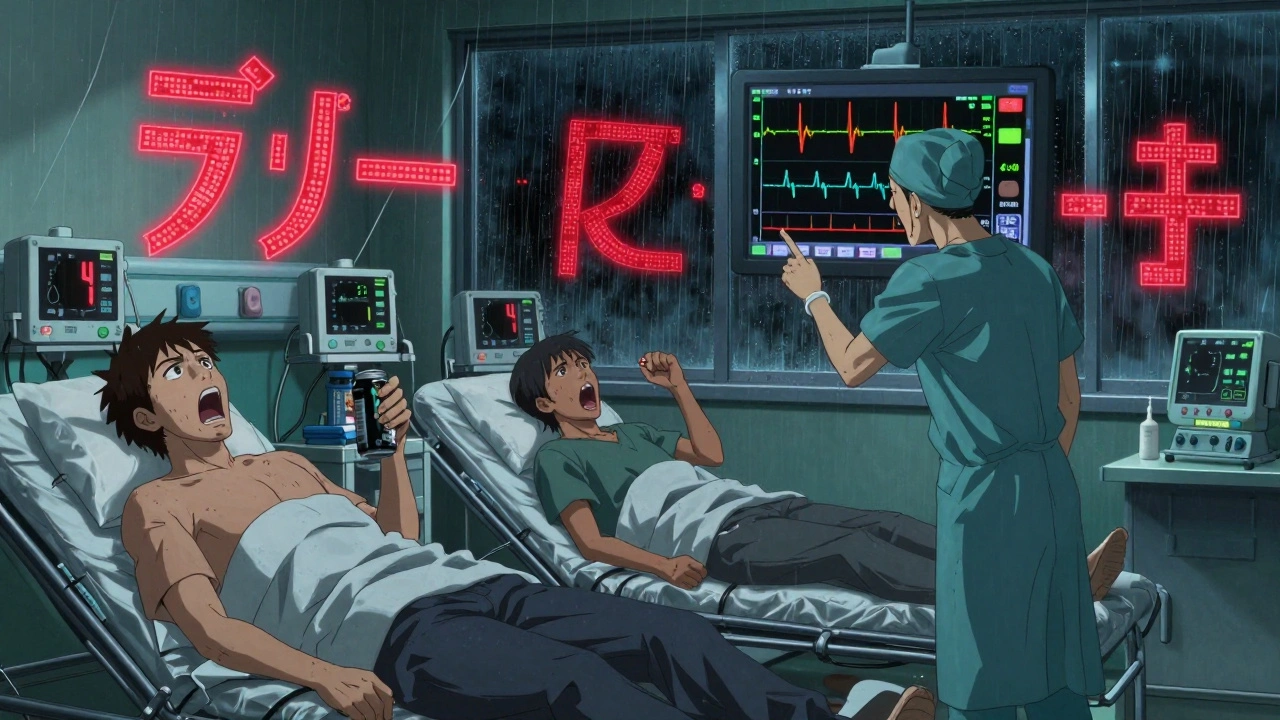
It’s not theoretical. Emergency rooms see the fallout every day. In 2011, nearly 1,500 teens in the U.S. went to the ER because of energy drink-related issues. Symptoms? Heart palpitations, chest pain, seizures, and high blood pressure. More recently, a 19-year-old in California suffered a heart attack after drinking three Monster Energy drinks in two hours. His family sued Monster Beverage Corp.-and won a settlement in 2022.
Online forums are full of similar stories. One Reddit user, u/BloodPressureWatcher, tracked his numbers: 120/80 before an energy drink, 145/95 after just 45 minutes. Another described heart palpitations lasting three hours after two cans of Monster. These aren’t outliers. Medical professionals on forums like Student Doctor Network report seeing young patients with new-onset high blood pressure-all because they drank energy drinks daily.
Who’s Most at Risk?
It’s not just people with diagnosed heart disease. Teens, young adults, and people with undiagnosed conditions are just as vulnerable. The American Academy of Pediatrics says adolescents should avoid energy drinks entirely. Yet, the CDC reports that 30% to 50% of teens still drink them regularly.
Older adults are at higher risk too. As we age, our arteries stiffen, our hearts become less flexible, and our bodies process caffeine slower. Dr. Pieter Cohen from Harvard Medical School warns that stimulants “may be more worrisome in older people, who are more vulnerable to heart problems.” Even a single energy drink can trigger a dangerous spike in blood pressure in someone over 50.
And don’t forget: mixing energy drinks with alcohol or working out after drinking them makes things worse. Alcohol dehydrates you, which thickens your blood. Exercise raises your heart rate. Add stimulants on top? That’s a recipe for cardiac stress.
How Much Is Too Much?
The FDA says 400 mg of caffeine per day is safe for most healthy adults. That’s about one and a half cans of Bang Energy. But that’s a general guideline-not a personal safety limit.
If you’re on stimulant medication, that limit drops. The same amount of caffeine that’s fine for someone else might be dangerous for you. Teens should cap caffeine at 100 mg per day. And if you have high blood pressure, heart disease, or a family history of cardiac issues? You shouldn’t be drinking energy drinks at all.
Here’s the catch: labels aren’t always accurate. A 2023 GoodRx review found that some energy drinks contain up to 20% more caffeine than stated on the can. So even if you think you’re staying under the limit, you might not be.
Warning Signs You Can’t Ignore
Not every reaction is immediate. But if you notice any of these after drinking an energy drink-or taking your stimulant med-stop and get help:
- Chest pain or pressure
- Heart palpitations that last more than a few minutes
- Severe headache or dizziness
- Shortness of breath
- Blurred vision or confusion
These aren’t normal side effects. They’re red flags. If you experience any of these, seek medical attention immediately. You could be having a cardiac event.
What Should You Do Instead?
Feeling tired? Try these instead:
- Get 7-8 hours of sleep-no shortcuts.
- Drink water. Dehydration makes fatigue worse.
- Move your body. A 10-minute walk boosts alertness better than caffeine.
- If you need focus help, talk to your doctor about non-stimulant ADHD options like Strattera or behavioral strategies.
If you’re a regular energy drink user, don’t quit cold turkey. Withdrawal can cause headaches, fatigue, and irritability for up to 9 days. Slowly reduce your intake. Swap one drink a week for sparkling water with a splash of lemon. Build the habit slowly.
The Bigger Picture
Energy drink sales hit $77.6 billion in 2023. The industry is growing, not shrinking. Companies are marketing “sugar-free” and “vitamin-enhanced” versions that make people think they’re healthier. But none of that changes the core problem: these drinks are designed to overstimulate your nervous system.
The American Heart Association made it clear in March 2024: people with known heart disease should avoid energy drinks completely. That advice should extend to anyone on stimulant medication, anyone with high blood pressure, and anyone under 18.
There’s no safe way to combine energy drinks and stimulant meds. The science is clear. The risks are real. And the consequences can be deadly.
Can energy drinks cause high blood pressure even in healthy people?
Yes. Even healthy young adults can experience temporary but significant spikes in blood pressure after consuming energy drinks. Studies show systolic pressure can rise by 6-7 mmHg within 30 minutes, with some individuals seeing increases of 20-30 mmHg. These spikes are more dangerous for people with undiagnosed heart conditions or those taking stimulant medications.
Is it safe to drink energy drinks while taking Adderall or Ritalin?
No. Combining energy drinks with stimulant medications like Adderall or Ritalin can dangerously amplify heart rate and blood pressure increases. Research shows this combination raises the risk of heart rhythm problems, heart attacks, and other serious cardiac events by 3 to 5 times. Medical experts strongly advise against mixing them.
How much caffeine is too much if I’m on stimulant medication?
There’s no official safe limit when combining stimulant meds with caffeine, but experts recommend avoiding caffeine entirely. If you must consume it, stay under 100 mg per day-equivalent to one small cup of coffee. Even that small amount can be risky. The safest choice is to eliminate energy drinks and limit all sources of caffeine.
Do energy drinks affect teenagers differently than adults?
Yes. Teenagers’ bodies are still developing, and their brains are more sensitive to stimulants. The American Academy of Pediatrics advises teens to avoid energy drinks entirely. Studies show emergency room visits for caffeine-related issues have more than doubled among middle schoolers since 2017. Their lower body weight and developing cardiovascular systems make them more vulnerable to dangerous spikes in blood pressure and heart rate.
Are sugar-free energy drinks safer for your heart?
No. Sugar-free energy drinks contain the same stimulants-caffeine, guarana, synephrine-as regular ones. Removing sugar doesn’t reduce the cardiovascular risk. In fact, some people think sugar-free means “safe,” which can lead to higher consumption. The danger comes from the stimulants, not the sugar.
What should I do if I’ve been drinking energy drinks and taking stimulant meds?
Stop consuming energy drinks immediately. Talk to your doctor about your caffeine intake and any symptoms you’ve experienced-like palpitations, dizziness, or high blood pressure. Your medication dosage may need adjustment. Consider switching to non-stimulant ADHD treatments if appropriate. Monitor your blood pressure regularly and avoid other stimulants like coffee, pre-workout supplements, or diet pills.
Comments
Carolyn Ford
December 4, 2025 AT 20:21So let me get this straight: you're telling me that drinking a Monster after staying up all night to cram for finals is basically playing Russian roulette with my heart? And people wonder why I don't trust corporate marketing. These companies know exactly what they're doing. They don't care if you end up in the ER-they just want your money. And now they're selling 'sugar-free' versions like it's some kind of health product? Please.
Alex Piddington
December 5, 2025 AT 06:26This is an exceptionally well-researched and necessary piece. The data presented here is not only alarming but also deeply under-discussed in public health discourse. It is imperative that educational institutions and workplaces begin disseminating this information with the same urgency as they do about smoking or vaping. The normalization of stimulant dependency is a quiet epidemic.
Libby Rees
December 6, 2025 AT 05:07I work in a high school. We have kids drinking these things like they're Gatorade. One boy passed out in chemistry last month. His mom said he had two Bangs and an Adderall before school. No one thinks it's a problem until someone collapses.
Pavan Kankala
December 7, 2025 AT 01:09You know what's really happening? The FDA, Big Pharma, and the energy drink giants are all in bed together. They want you dependent. They want you addicted. They want you to believe you need chemicals to function. Meanwhile, real solutions-sleep, nutrition, sunlight-are ignored because they don't make money. This isn't about health. It's about control.
Martyn Stuart
December 7, 2025 AT 08:08I'm a GP in London, and I see this every week. Young patients coming in with palpitations, convinced it's 'just stress.' They're drinking two energy drinks a day and taking their ADHD meds. I've had three patients under 25 with atrial fibrillation in the past year-all linked to this combo. Please, if you're reading this and you're doing this: stop. Talk to someone. It's not weakness. It's survival.
Shofner Lehto
December 7, 2025 AT 18:06I used to drink 3-4 energy drinks a day while studying for med school. I thought I was being productive. Turns out I was just making my heart work overtime. I quit cold turkey after a panic attack that felt like a heart attack. Took me 11 days to stop shaking. But now? I sleep 8 hours. I walk every morning. I feel more focused than I ever did on caffeine. No joke.
Yasmine Hajar
December 9, 2025 AT 15:59I used to be one of those people who thought energy drinks were just 'fun' and 'needed' for my 60-hour workweeks. Then I started getting chest pains. My doctor said my BP was 150/98. I was 24. I cried in his office. I didn't know it could happen to someone so young. I swapped them for green tea and now I feel like I have actual energy-not jittery, shaky, crash-y energy. You're not lazy if you need rest. You're human.
Karl Barrett
December 9, 2025 AT 23:38There's a neurophysiological feedback loop here that's rarely addressed: stimulants induce sympathetic dominance, which suppresses parasympathetic recovery. When you layer exogenous caffeine on top of endogenous dopaminergic agonists, you're essentially overriding the body's homeostatic mechanisms. The result? Chronic catecholamine exposure leads to receptor downregulation, increased oxidative stress in cardiac tissue, and ultimately, arrhythmogenic substrate formation. This isn't just 'bad for you'-it's a molecular sabotage.
Jake Deeds
December 11, 2025 AT 21:26I mean… I get it. People are tired. But you’re not a machine. You’re a fragile, beautiful, biological organism that needs rest. And yet here we are, treating our bodies like disposable batteries that can be recharged with chemical cocktails. It’s tragic. And frankly, kind of pathetic. If you need a drink to get through your day, maybe your life needs more than caffeine. Maybe it needs meaning.
George Graham
December 13, 2025 AT 15:05I was skeptical until my brother had a cardiac arrest at 28. He was on Adderall and drank Monster every morning. No history of heart problems. No warning signs. Just… gone. For 90 seconds. They brought him back. He’s fine now. But he doesn’t drink caffeine anymore. And neither do I. I used to think he was just being dramatic. Now I know better. Don’t wait for a scare. Just stop.
John Filby
December 14, 2025 AT 09:10I tried cutting out energy drinks after reading this. First week was rough-headaches, zero motivation. But by week 3? I actually started waking up without an alarm. My anxiety dropped. I stopped feeling like my heart was going to explode. I still drink coffee, but only one cup in the morning. It’s not perfect, but it’s way better than before. You can do this.
Elizabeth Crutchfield
December 14, 2025 AT 18:28i just started taking adderall and i’ve been drinking monster every day… i think i might be in trouble 😭
Ben Choy
December 15, 2025 AT 07:38This is such an important topic. I’ve seen friends go from 'just one can' to full-blown dependence. The worst part? They don’t even realize they’re addicted. It’s not about willpower-it’s about how these drinks hijack your brain’s reward system. Please, if you’re reading this and you’re still drinking them: reach out. You’re not alone. And you don’t have to do this alone.
Emmanuel Peter
December 16, 2025 AT 03:37So you're saying if I drink one energy drink and take my Adderall, I'm basically a walking time bomb? What if I only do it on exam days? Or during crunch time? Isn't that okay? I mean, I'm not doing it every day... right? ...Right?