
How to Calculate Total Cost of Therapy Beyond the Copay
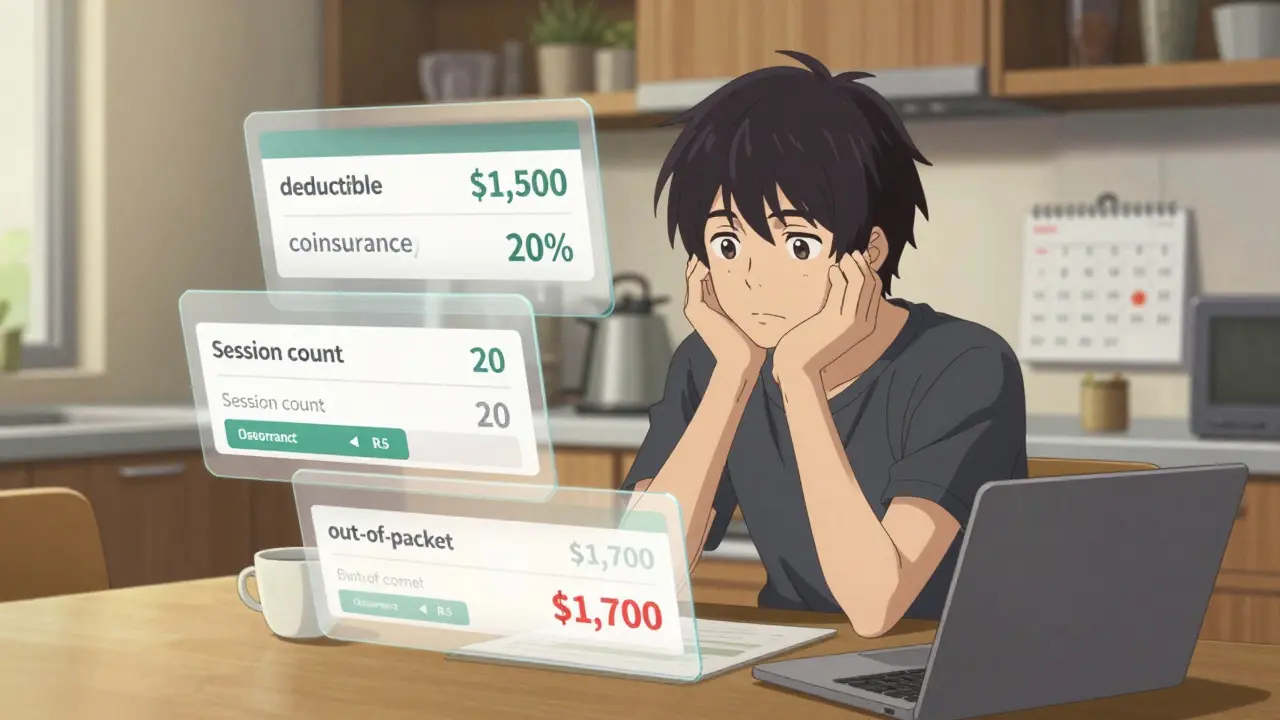
Most people think they know how much therapy will cost because they see a copay on their insurance card-maybe $30 or $50 per session. But that number is just the tip of the iceberg. The real cost of therapy includes your deductible, coinsurance, session frequency, whether your therapist is in-network, and even your monthly premium. If you don’t factor all this in, you could end up shocked when you get your first bill.
What You’re Really Paying: More Than Just the Copay
Your copay is the fixed amount you pay at each session, but it only kicks in after you’ve met your deductible. If you haven’t met your deductible yet, you pay the full session rate-no matter what your card says. For example, if your therapist charges $125 per session and your deductible is $1,500, you’ll pay $125 for each session until you’ve spent $1,500 out of pocket. That’s 12 sessions before your copay even applies.Thriveworks’ 2024 study found that the average uninsured therapy session costs $143.26. With insurance, you might think you’re getting a deal, but if you’re still in your deductible phase, you’re paying close to that full price. And if you need 16 sessions to feel better, as many patients do, you could be paying over $2,000 before insurance starts covering part of it.
Deductibles: The Hidden Upfront Cost
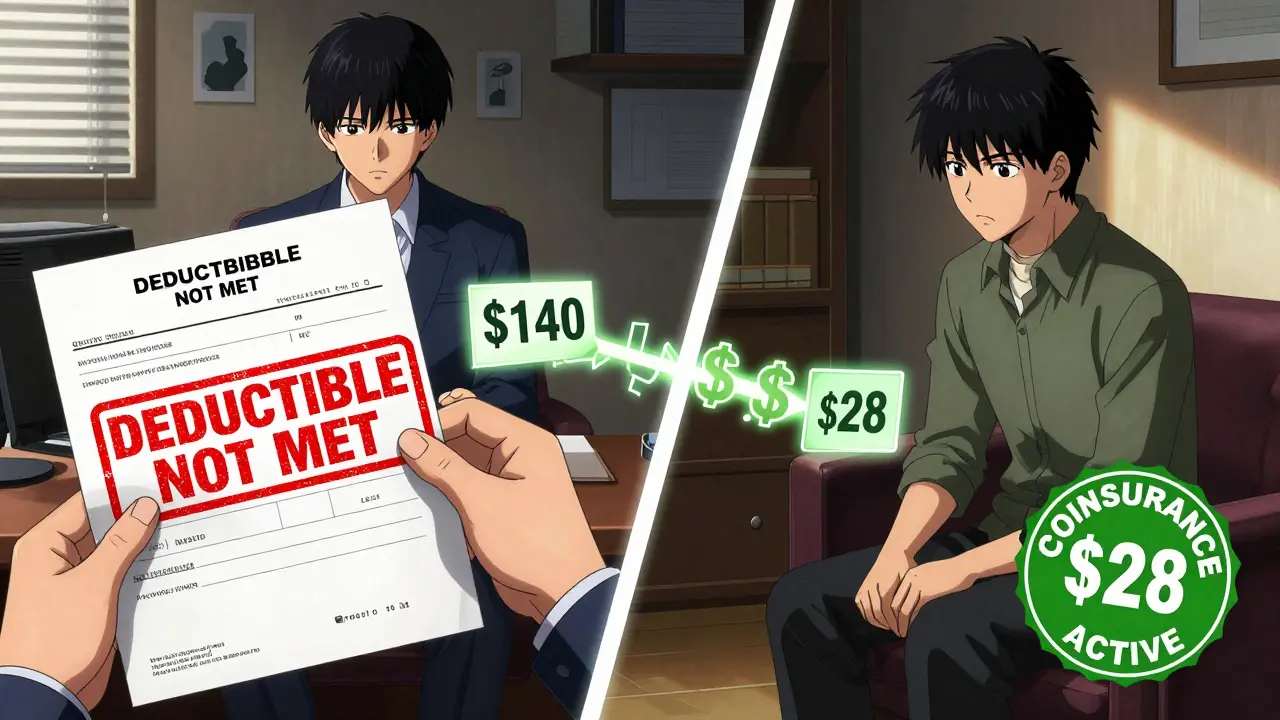
A deductible is the amount you pay each year before your insurance starts sharing the cost. For mental health services, this can be separate from your medical deductible. Some plans have a mental health-specific deductible, which means even if you’ve paid your $1,500 medical deductible through doctor visits or lab tests, you still have to pay another $1,500 for therapy.Let’s say you have a $3,000 deductible for mental health. If each session is $140, you’ll pay the full $140 for each session until you’ve spent $3,000. That’s about 21 sessions before your insurance starts helping. If you’re seeing your therapist weekly, you’ll hit that deductible in under five months. And if you need 20-25 sessions to recover from anxiety or PTSD, as Grow Therapy found, you’re already in deep.
Coinsurance: When You Pay a Percentage
Once you meet your deductible, coinsurance kicks in. This is the percentage you pay after that. Most plans use 20% or 30%. So if your therapist charges $140 per session and your coinsurance is 20%, you pay $28 per session. Sounds good, right? Not if your total therapy costs add up to $30,000.Here’s the math: You pay your $3,000 deductible first. Then, for the remaining $27,000 in therapy costs, you pay 20%-that’s $5,400. Your total out-of-pocket? $8,400. Even with insurance, you’re still paying more than most people expect. And this isn’t rare. A 2023 analysis from Alma showed that patients with high-deductible plans and long-term therapy needs often pay more than $6,000 annually just for mental health services.
In-Network vs. Out-of-Network: A Huge Difference
Choosing an in-network therapist can cut your costs by half. In-network providers have agreed to accept the insurance company’s “allowed amount” as full payment. For example, if your therapist normally charges $180 but the insurance allows only $120, you’ll pay based on $120-not $180.Out-of-network therapists don’t have that agreement. You pay the full fee upfront, then submit a claim. Your insurance might reimburse you 50%-70% of the allowed amount, but you’re still on the hook for the rest. Some patients end up paying $100-$150 per session out-of-pocket, even with insurance, because their plan doesn’t cover out-of-network care well.
And location matters. In New York, therapy averages $176 per session. In North Dakota, it’s $227. So if you’re paying 30% coinsurance, you’re paying $53 in New York-but $68 in North Dakota. Same plan. Different city. Big difference in your wallet.
What About Medicare and Medicaid?
If you’re on Medicare, you pay 20% of the approved amount after meeting your Part B deductible. That usually comes out to about $28.65 per session. But if you have Original Medicare, you’ll need a Medigap Plan G to cover that 20%. Those plans cost $100-$200 per month, so your total monthly cost could be $128.65 if you’re seeing your therapist weekly.Medicaid, on the other hand, often has little to no copay. In many states, therapy is fully covered. But eligibility and coverage vary widely. If you’re on Medicaid, check your state’s mental health benefits before assuming anything.
How Many Sessions Do You Really Need?
Most people assume therapy lasts 6-8 weeks. But that’s not the norm. Thriveworks’ 2024 data shows that 50% of patients need 15-20 sessions to see meaningful improvement. For complex conditions like trauma, depression, or OCD, 30+ sessions are common. If you’re paying $40 per session after your deductible, and you need 20 sessions, that’s $800. But if you’re still paying full price because you haven’t met your deductible? That’s $2,500 before insurance helps.Shasta Health found that nearly 40% of patients didn’t know their true out-of-pocket cost until after they’d already started therapy. That’s because they only looked at the copay-not the deductible, coinsurance, or session frequency.

Sliding Scale and Alternative Options
If you’re uninsured or underinsured, you’re not stuck. About 42% of private practice therapists offer sliding scale fees based on income. That can cut your cost by 30-50%. For example, if you’d normally pay $140 per session, you might pay $70-$98 instead.Platforms like Open Path Collective offer therapy for $40-$70 per session to people without insurance. University training clinics-where graduate students provide therapy under supervision-often charge 50-70% less than private practices. These aren’t second-rate options. Many clients report the same outcomes as with private therapists.
Building Your Real Therapy Budget
Here’s how to calculate your total cost step by step:- Find your insurance plan type: Is it copay, deductible, or coinsurance-based?
- Check if mental health has a separate deductible.
- Know your in-network vs. out-of-network rates.
- Estimate how many sessions you’ll need (12-20 is typical).
- Calculate Phase 1: Full price until deductible is met.
- Calculate Phase 2: Copay or coinsurance after deductible.
- Check your out-of-pocket maximum ($9,350 for individuals in 2024).
- Add monthly premiums (multiply by 12).
- Factor in medication costs if you’re taking any.
Example: You have a $1,500 deductible, 20% coinsurance, and see a therapist who charges $125/session. You need 20 sessions.
- Phase 1: Pay $125 x 12 sessions = $1,500 (deductible met)
- Phase 2: Pay 20% of $125 = $25 per session x 8 sessions = $200
- Total: $1,700
Without insurance? $2,500. With insurance? $1,700. That’s a 32% savings-but only if you understand the full picture.
Tools to Help You Track Costs
- Use your insurance company’s online portal to check your deductible status and allowed amounts.Don’t wait until you’re in crisis to figure this out. Start early. Call your insurer. Ask for a breakdown of your mental health benefits. Write it down. Track your spending. You’ll thank yourself later.
Is the copay the only thing I pay for therapy?
No. The copay is only what you pay after meeting your deductible. Before that, you pay the full session rate. You may also pay coinsurance (a percentage of the cost), monthly premiums, and out-of-network fees. The copay is just one piece of the puzzle.
What if I haven’t met my deductible yet?
You’ll pay the full price of each therapy session until you’ve spent your deductible amount. For example, if your deductible is $1,500 and each session costs $125, you’ll pay $125 for each of the first 12 sessions. Only after that will your copay or coinsurance apply.
Can I use other medical expenses to meet my mental health deductible?
Yes-if your plan uses a combined deductible. Many plans count all covered medical services (doctor visits, lab tests, prescriptions) toward the same deductible. So if you’ve already spent $1,000 on physical therapy or prescriptions, that counts toward your mental health deductible. Check your plan details to confirm.
Does Medicare cover therapy differently?
Yes. Medicare Part B covers 80% of therapy costs after you meet the Part B deductible. You pay 20%-about $28.65 per $143 session. But if you have Original Medicare, you’ll need a Medigap Plan G to cover that 20%. Plan G has its own monthly premium, so your total cost includes both.
How do I know if my therapist is in-network?
Call your insurance provider and ask for a list of in-network mental health providers. You can also check their website or use tools like Alma or Zocdoc, which show network status. Never assume-some therapists list themselves as in-network but aren’t actually contracted with your plan.
Are there affordable options if I can’t afford therapy?
Yes. About 42% of private therapists offer sliding scale fees based on income. Open Path Collective offers sessions for $40-$70. University training clinics often charge 50-70% less than market rates. Community health centers and online platforms like BetterHelp also have financial aid programs. Don’t give up-affordable help exists.
Comments
Natanya Green
February 24, 2026 AT 03:26Oh my GOD, I just realized I’ve been paying $140 a session for 18 months and thought I was doing great because my copay was $30??!!?? I’ve been bleeding money like a stuck pig and didn’t even know it!!!
I’m literally crying right now. My therapist charges $160. My deductible is $3,000. That’s 18 sessions of full price. I’ve done 22. I’ve paid over $3,500 already. I’m not even close to coinsurance yet.
Why does no one talk about this?? Insurance companies act like they’re helping you but they’re just hiding the real cost behind a cute little $30 sticker!!
I’m switching to Open Path Collective next week. $45/session?? I’ll take it. I’d rather pay $45 and feel sane than pay $160 and feel bankrupt.
Also-why is my premium $500/month? That’s $6,000 a year. I’m paying $6,000 just to get $1,700 in therapy coverage?? That’s not insurance, that’s a scam with a logo.
Someone please tell me I’m not the only one who feels like this is a pyramid scheme disguised as mental health care??
Steven Pam
February 25, 2026 AT 08:39Bro, I feel you. I was in the same boat last year. Thought my copay was the whole story. Then I got my first EOB and nearly passed out.
But here’s the good news-you’re not stuck. I found a sliding scale therapist through my university’s clinic. Paid $40/session. Same quality. Just a grad student with a supervisor watching. No judgment. Just results.
Also, if you’re on a high-deductible plan, consider a Health Savings Account (HSA). You can use it for therapy. Tax-free money. Game changer.
Don’t give up. Mental health is worth it. And yeah, the system sucks-but you’ve got options.
Timothy Haroutunian
February 27, 2026 AT 07:19Let me break this down for the people who think insurance is a safety net. It’s not. It’s a trapdoor.
You think you’re paying $30? No. You’re paying the full rate until you hit a deductible that’s higher than your annual income. Then you pay 30% coinsurance on a rate that’s inflated because the provider is a monopoly. Then you hit your out-of-pocket max and realize your insurance company still doesn’t cover your medication or your emergency visits.
And don’t get me started on in-network vs out-of-network. The whole system is designed to confuse you into submission. They want you to quit. They count on it.
Sliding scale? Sure. But most therapists who offer it are overwhelmed. You’ll be on a waitlist longer than you’d be in therapy.
This isn’t a guide to affordability. This is a guide to surviving a broken system.
Erin Pinheiro
February 27, 2026 AT 13:37i cant believe people still think insurace is a good idea for therapy?? like… ugh. i had a therapist who charged 180 and i thought i was getting a deal bc my copay was 50. then i realized i had to pay the full 180 for 16 sessions before the 50 even kicked in. i paid 2880 in 4 months. i had to quit. now i use a app. its 30 a week. its not the same but its better than broke.
also my premium is 600 a month. i pay more for insurace than i do for rent. what is even happening
Michael FItzpatrick
February 28, 2026 AT 17:57Let me paint a picture: You’re not paying for therapy. You’re paying for a system that commodifies emotional survival. The copay? That’s the bait. The deductible? That’s the hook. The coinsurance? That’s the line. And the out-of-pocket max? That’s the fishing net.
But here’s the secret no one tells you: You’re not broken. The system is.
Sliding scale isn’t charity. It’s justice. University clinics aren’t second-rate-they’re revolutionary. People forget that therapy is about connection, not credential. A grad student with a supervisor can give you more insight than a private practice therapist billing $250/hour.
And if you’re on Medicaid? Celebrate. You’ve won the lottery. Most states cover it fully. Use it. Advocate for it. Don’t let anyone make you feel like you’re taking a handout. You’re reclaiming your humanity.
Therapy isn’t a luxury. It’s infrastructure. Like water. Like electricity. We treat it like a spa day. We need to treat it like a civil right.
Brandice Valentino
February 28, 2026 AT 20:42Oh sweetie, you think you’re paying too much? Try being a therapist who charges $180 and gets reimbursed $70 by insurance. Then you have to spend 3 hours filling out paperwork for $70. Then you get audited. Then you get paid 6 months late.
I’ve seen therapists quit because of this. They love their work. But the system is designed to grind them into dust.
And don’t even get me started on how insurance companies classify trauma as ‘pre-existing’ and then deny coverage. It’s not just expensive-it’s cruel.
So yes, Open Path is amazing. University clinics are gold. But let’s not pretend this is fixable with a spreadsheet. It’s a moral failure.
Larry Zerpa
March 1, 2026 AT 12:34You’re all missing the point. This isn’t about therapy. It’s about capitalism exploiting vulnerability.
Insurance companies don’t want you to get better. They want you to stay sick enough to keep paying. That’s why deductibles are set above what most people earn in a month. That’s why coinsurance is 30% instead of 10%. That’s why out-of-network rates are absurd.
And let’s be honest: if therapy were truly accessible, pharmaceutical companies would lose billions. So they fund the insurance system. They lobby for high deductibles. They push you toward meds instead of talk therapy.
Stop looking for hacks. Start looking for revolution.
Christopher Brown
March 2, 2026 AT 19:34Americans think they’re entitled to cheap mental health. We don’t pay for dental. We don’t pay for vision. Why should therapy be different?
Other countries cover it. We don’t. Because we’re not a real healthcare system. We’re a marketplace.
Stop whining. Get a job that pays better. Move to a state with Medicaid expansion. Or pay cash. But don’t act like this is a scandal. It’s the system you voted for.
Kenzie Goode
March 4, 2026 AT 06:01I just want to say-I’ve been in therapy for 3 years. I’ve paid over $10,000 out of pocket. I’ve switched therapists three times. I’ve cried in three different waiting rooms.
But I’m still here. Because I’m worth it.
If you’re reading this and you’re thinking about quitting? Don’t. Find a sliding scale. Try a university clinic. Ask your therapist if they have a payment plan. You’re not a burden. You’re a human being trying to heal.
And if you’ve made it this far? You’re already brave.
Dominic Punch
March 5, 2026 AT 10:16UK here. We’ve got free therapy on the NHS. No copay. No deductible. No coinsurance. You wait 8-12 weeks. But you get it. No one goes bankrupt because they need help.
I know Americans love their ‘freedom’ and ‘choice’ but when choice means you can’t afford to live? That’s not freedom. That’s a death sentence.
Stop romanticizing capitalism. We need universal mental healthcare. Not a spreadsheet. Not a tool. A right.
Brooke Exley
March 6, 2026 AT 04:28I’m a therapist. And I want to say this: I hate the system too.
I charge $150. I take insurance. I spend 2 hours a week on billing. I get paid $60 per session. I’m losing money.
I’ve started offering sliding scale because I can’t bear to turn people away. But I’m exhausted.
If you’re struggling to afford therapy-please know this: your pain matters. Your healing matters. And there are people out there-therapists, nonprofits, clinics-who are fighting to meet you where you are.
You’re not alone. Even if it feels like you are.
Jacob Carthy
March 7, 2026 AT 14:52Just pay cash. No insurance. No hassle. I pay $75/session. No deductible. No waiting. No forms. Just show up. Pay. Leave. Done.
Insurance is a nightmare. Cash is freedom.
Cory L
March 7, 2026 AT 20:45My therapist is in-network. My deductible is $3,000. My coinsurance is 20%. I’ve done 14 sessions. Paid $1,700. Still have $1,300 to go. Then I pay $25/session.
But here’s the thing-I didn’t know any of this until I called my insurance. They sent me a PDF. I printed it. I highlighted it. I stuck it on my fridge.
Knowledge is power. Call them. Ask for a breakdown. Write it down. You’re not stupid. You just didn’t know.
Now I track every session. I budget. I save. I’m not giving up.
Bhaskar Anand
March 9, 2026 AT 13:42India has better mental health access than the US. We have community counselors. We have free government clinics. We have NGOs. We have temples where priests offer emotional support. We don’t need insurance to heal.
You Americans think money = care. It doesn’t. Connection does.
Stop looking for a financial hack. Look for a human one.