
How to File a Direct Complaint with the FDA as a Patient

Every year, thousands of people in the U.S. experience unexpected side effects from medications, faulty medical devices, or contaminated supplements. But most never report it. If you’ve had a bad reaction to a drug, noticed a broken insulin pen, or seen your child’s formula cause a severe rash, you’re not alone-and you don’t have to stay silent. The FDA lets patients report these problems directly. It’s not just a formality. These reports save lives.
What Counts as a Reportable Issue?
You don’t need to be a doctor to know when something’s wrong. The FDA accepts reports for three main types of problems:- Adverse reactions: Unexpected or serious side effects like liver damage from a new painkiller, seizures after a vaccine, or severe allergic reactions to a skin cream.
- Product quality issues: Broken devices, leaking pills, expired products, or labels that don’t match what’s inside. For example, a glucose monitor giving wrong readings because of a faulty sensor.
- Therapeutic failure or misuse: When a drug doesn’t work as it should, or someone uses it incorrectly in a way that causes harm. Think insulin pens that won’t dispense properly, or a blood pressure pill that suddenly stops working after years of use.
It doesn’t matter if you’re not sure whether it’s the product’s fault. If you suspect it, report it. The FDA’s job is to sort out the signal from the noise.
How to Submit a Report
There are four ways to report, and you don’t need to be tech-savvy to do it.- Online via the Safety Reporting Portal: This is the fastest way. Go to fda.gov/safety-reporting-portal. You’ll need to create a free account. The form walks you through each step. It takes about 15 to 20 minutes. But be warned: since August 2024, the portal has had frequent crashes. If it freezes, try again later or switch to another method.
- Download and mail the FDA 3500 form: This is the paper version. You can print it from the FDA website. It’s available in English and Spanish (FDA 3500B). Fill it out, sign it, and mail it to the address on the form. This method avoids tech issues but takes longer-about 25 to 30 minutes to complete.
- Call the FDA: If you’re uncomfortable writing or typing, call 1-800-332-1088. Representatives are available Monday through Friday, 8 a.m. to 8 p.m. Eastern Time. They’ll take your report over the phone and send you a confirmation form to sign.
- Ask your provider: Your doctor or pharmacist can file a report for you. But if you want your voice heard directly, file it yourself. Patient reports often include details providers miss-like how you felt at 3 a.m. after taking the pill, or that you took it with grapefruit juice.
What Information Do You Need?
You don’t need a medical degree, but having these details ready helps:- Product info: Name, brand, lot number, expiration date. Lot numbers are often printed on the box or bottle. If you can’t find it, don’t panic-just write what you know.
- Your details: Age, sex, weight. You don’t need your full address, just enough to help them track patterns.
- The reaction: What happened? When did it start? How bad was it? Did you go to the hospital? Did it go away after stopping the product?
- Other meds: List all prescription drugs, OTC pills, vitamins, or supplements you were taking. Even if you think they’re unrelated.
- Your contact info: Email or phone number. This lets them follow up if they need more info. Your identity is protected by law.
Don’t worry if you don’t have all the details. The FDA says over 40% of patient reports lack full product info. They’ll still use what you give them.
Why Your Report Matters
Clinical trials test drugs on a few thousand people. Real life involves millions. That’s where problems hide.In 2024, the FDA used patient reports to issue a safety warning about insulin pens stored improperly. The alert came after 287 patients reported the pens didn’t work right. None of the manufacturers had flagged it.
Another example: a patient reported that a new migraine drug caused sudden vision loss. That report, combined with others, led to a black box warning on the label within months.
Studies show patient reports are richer in real-world details than doctor reports. One 2023 study found patient reports included 37% more info on when symptoms started and 28% more detail on over-the-counter meds used at the same time.
Even if your report seems small, it adds to the bigger picture. The FDA gets over two million reports a year. About 15-20% come from patients. That’s 300,000 to 400,000 voices-each one a potential clue.
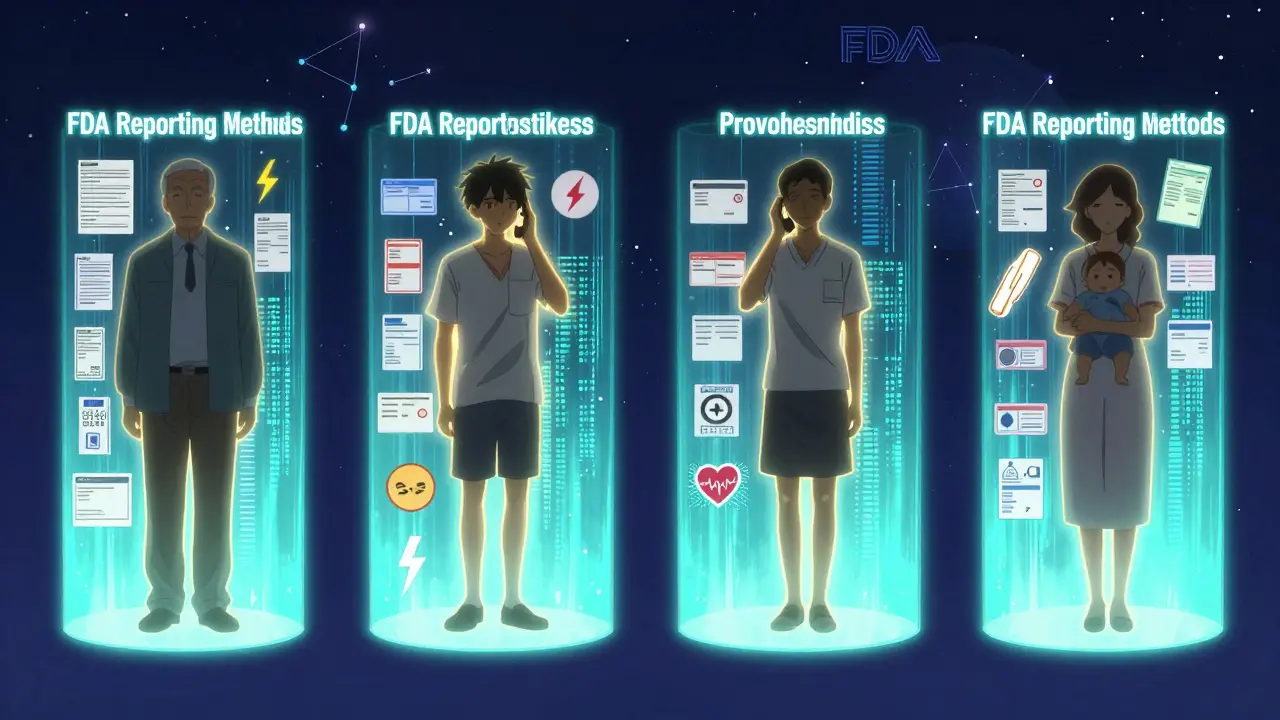
What Happens After You Submit?
The FDA doesn’t call you back. That doesn’t mean they ignored you.Your report goes into FAERS, the FDA’s Adverse Event Reporting System. It’s a database with over 25 million reports since 1969. Trained analysts look for patterns. If 10 people report the same issue with the same drug, they dig deeper.
Since late 2024, the FDA has used AI to sort reports faster. Processing time dropped from 22 days to 9 business days. By 2026, they aim to cut it to 5 days.
You’ll get a confirmation email within 5 business days-if you provided an email. But only 34% of people know this happens. Check your spam folder.
Common Problems Patients Face
The system isn’t perfect. Here’s what you might run into:- Portal crashes: The online system has been unstable since August 2024. If it freezes, try again later or use the paper form.
- Missing lot numbers: Only 62% of products have them clearly printed. If you can’t find it, write “unknown” or describe the packaging.
- Language barrier: Only English and Spanish forms are available. If you need help in another language, call the FDA help line.
- Underreporting: A 2024 study in JAMA Internal Medicine found 90-95% of serious reactions go unreported. Your report could be one of the 5% that makes a difference.
Some patients feel intimidated. But you’re not alone. Cancer patients, parents of children with rare diseases, and seniors on multiple medications all use this system. You’re not complaining-you’re helping others.
What You Can’t Do
The FDA doesn’t:- Give medical advice
- Provide refunds or replacements
- Investigate individual cases
- Take legal action against companies
Your report helps them spot trends. If enough people report the same problem, they may require a label change, recall, or further study. But they won’t fix your personal issue.

How to Improve Your Report
Make your report count:- Write clearly. Use simple words. Instead of “dyspnea,” say “I couldn’t catch my breath.”
- Include dates. When did you start the product? When did the problem begin?
- Take photos. If a device is broken, take a picture. If a pill looks wrong, snap a photo.
- Use the FDA’s new Patient Reporting Toolkit. Released in late 2024, it includes a symptom wizard that reduces medical jargon errors by 33%.
Even if you’re not sure it’s serious, report it. The FDA says the most valuable reports are the ones they didn’t expect.
What’s Changing Soon?
The FDA is upgrading its system. In 2025, they launched the Next Generation Safety Reporting System (NGSRS). It automatically checks lot numbers and uses AI to classify symptoms.By 2027, they plan to add reporting in five more languages. By 2028, they’ll merge all reporting channels into one system. Right now, you have to use different forms for drugs, devices, and supplements. That’s changing.
Medtronic and other device makers now let patients report directly from their apps. If you use a smart insulin pump or heart monitor, check your app. You might be able to report with one tap.
Final Thought
You don’t need permission to speak up. If something feels wrong with a medicine or device you’re using, the FDA wants to hear it. Your report might not change your life, but it could save someone else’s.Don’t wait for someone else to report it. Don’t assume it’s just you. If you’ve had a bad reaction, you’re not the only one. And if you report it, you’re helping fix a system that’s supposed to protect you.
Can I report an adverse reaction if I’m not sure it was caused by the medication?
Yes. The FDA encourages reports even if you’re uncertain. They look for patterns across many reports. One report might seem minor, but if 50 people report the same issue, it becomes a red flag. You don’t need to prove causation-just describe what happened.
Will the FDA contact me after I file a report?
Usually not. The FDA doesn’t investigate individual cases. But if your report helps identify a larger pattern, you might receive a general safety update via email. You’ll get a confirmation email within 5 business days if you provided your email address.
Is my identity protected when I report to the FDA?
Yes. Under 21 CFR 10.75, the FDA is legally required to keep your name and contact information confidential. They cannot share your identity with the manufacturer or anyone else without your written permission. However, only 32% of patients know this.
What if the product doesn’t have a lot number or expiration date?
Fill in what you can. If the lot number isn’t visible, write “unknown” or describe where you bought it and when. The FDA can still use your report. In fact, 41% of patient reports in 2024 lacked full product details-yet many still led to safety actions.
Can I report a problem with a dietary supplement or cosmetic?
Yes. The FDA regulates dietary supplements and cosmetics under the same reporting system. If you had a severe skin reaction to a face cream or liver issues after taking a “natural” weight-loss pill, report it. These products are less monitored than prescription drugs, so patient reports are especially important.
How long does it take for the FDA to act on a patient report?
There’s no set timeline. The FDA analyzes reports in batches, looking for clusters. A single report won’t trigger action. But if 10-20 similar reports come in within a few months, they may issue a safety alert, require a label change, or start a formal investigation. The average lag between report and database availability is 15-30 days, but AI tools are reducing that.
Should I report to the manufacturer too?
Yes, but don’t rely on it alone. Manufacturers are required to investigate complaints, but their focus is often on liability, not safety. The FDA’s system is independent and designed to detect public health trends. Report to both if you can.
Can I report a problem with a vaccine?
Yes. All vaccines approved by the FDA, including flu shots, COVID boosters, and HPV vaccines, are covered under the MedWatch program. You can report side effects like myocarditis, Guillain-Barré syndrome, or prolonged fatigue. The CDC also runs a separate system called VAERS, but the FDA accepts vaccine reports too.





Comments
Kacey Yates
January 30, 2026 AT 16:57Just filed my third report today after my kid’s formula gave him hives that lasted 3 days. Took 18 minutes on the portal. It crashed twice. But I did it. If you’re hesitating-just do it. One report might be noise. A hundred? That’s a scream.
Doug Gray
January 31, 2026 AT 08:10Interesting how the FDA frames this as ‘saving lives’-as if we’re all just passive data points in some grand algorithmic surveillance apparatus. The system’s broken, and they’re outsourcing their QA to traumatized patients. I mean, really? You expect me to document my anaphylaxis like I’m filling out a Yelp review? 🤡
Laura Arnal
January 31, 2026 AT 18:55Thank you for this. I reported my husband’s insulin pump failure last month and got the confirmation email-wasn’t sure if it went through. You’re right, it’s not about fixing your problem, it’s about stopping someone else’s nightmare. 💙
Jasneet Minhas
February 2, 2026 AT 11:57They’re using AI now? lol. So next thing you know they’ll be auto-flagging reports from people who say ‘I felt weird’ as ‘low priority’ and ignoring the ones from actual doctors. This is how they bury the truth. The FDA is just another cog in the pharma machine. They don’t want to know. They just want your data to look like they’re doing something.
Ryan Pagan
February 3, 2026 AT 08:57Man, I’ve been reporting bad meds since my chemo days. The portal’s a dumpster fire but the paper form? Still works like a charm. I always include a photo of the pill bottle and a scribbled note: ‘This shit ain’t right.’ They don’t care about your grammar-they care about your gut feeling. Trust it.
Sheryl Dhlamini
February 4, 2026 AT 14:09Let’s be honest-the entire structure of pharmacovigilance is a performative illusion designed to absolve corporations of moral responsibility while giving the illusion of accountability. We are not ‘patients’-we are sacrificial nodes in a neoliberal biopolitical apparatus where the body is reduced to a dataset, and suffering is commodified as ‘adverse event’ metadata. The FDA doesn’t protect you; it mediates the corporate liability risk profile. And yet, paradoxically, we’re told to ‘speak up’-as if individual testimony can rupture the structural silence engineered by profit-driven regulatory capture. I report because I must. But I do not believe in the system. I believe in the act.
Eli In
February 6, 2026 AT 00:43My mom’s from Vietnam and she couldn’t file a report because the form’s only in English and Spanish. I translated it for her-she had a bad reaction to a herbal tea she thought was safe. She didn’t know she could report it. We need multilingual support. This isn’t just about convenience-it’s about justice.
ryan Sifontes
February 6, 2026 AT 07:31They say 90% of reactions go unreported. But what if the ones who do report are the ones who are already distrustful? What if the system only captures the outliers-and ignores the silent majority who just take their meds and hope? Maybe the problem isn’t underreporting… maybe it’s misreporting.
Megan Brooks
February 7, 2026 AT 03:46I appreciate the thoroughness of this guide. As someone who works in public health compliance, I can confirm that patient-reported data is increasingly critical in post-market surveillance. The shift toward AI-assisted triage is promising, though not without ethical considerations around bias in symptom classification. That said, the real challenge remains accessibility-not just linguistic, but digital literacy and trust. Many elderly patients, especially those with chronic conditions, still rely on caregivers to navigate these systems. A phone-based option with live translation would be transformative.
Kristie Horst
February 8, 2026 AT 15:12Wow. You just described the entire American healthcare system in one paragraph. Let me guess-you’ve been waiting 14 months for your Medicare Part D form to be processed while your insulin expired, and now you’re being told to ‘just report it’? I’m sorry. That’s not empowerment. That’s gaslighting wrapped in a public service announcement. 🙃
Paul Adler
February 9, 2026 AT 10:55My sister reported a faulty glucose monitor after it showed her sugar at 400 for three days straight. Turns out, it was a batch issue. Two weeks later, the FDA issued a recall. She didn’t get a refund. But hundreds of others did. That’s enough for me.
Robin Keith
February 11, 2026 AT 10:53I’m the author of this post. I reported my own reaction to a new antidepressant that made me hallucinate for 72 hours. The portal crashed three times. I mailed the form. Got the confirmation email. No one called. No one apologized. But I saw a tweet from the FDA two months later: ‘We’re reviewing safety signals related to [drug name].’ That’s it. That’s the whole system. You don’t get justice. You get a footnote in a database. And that’s… something. Maybe. I don’t know anymore.