
How to Update Your Allergy List Across All Healthcare Providers
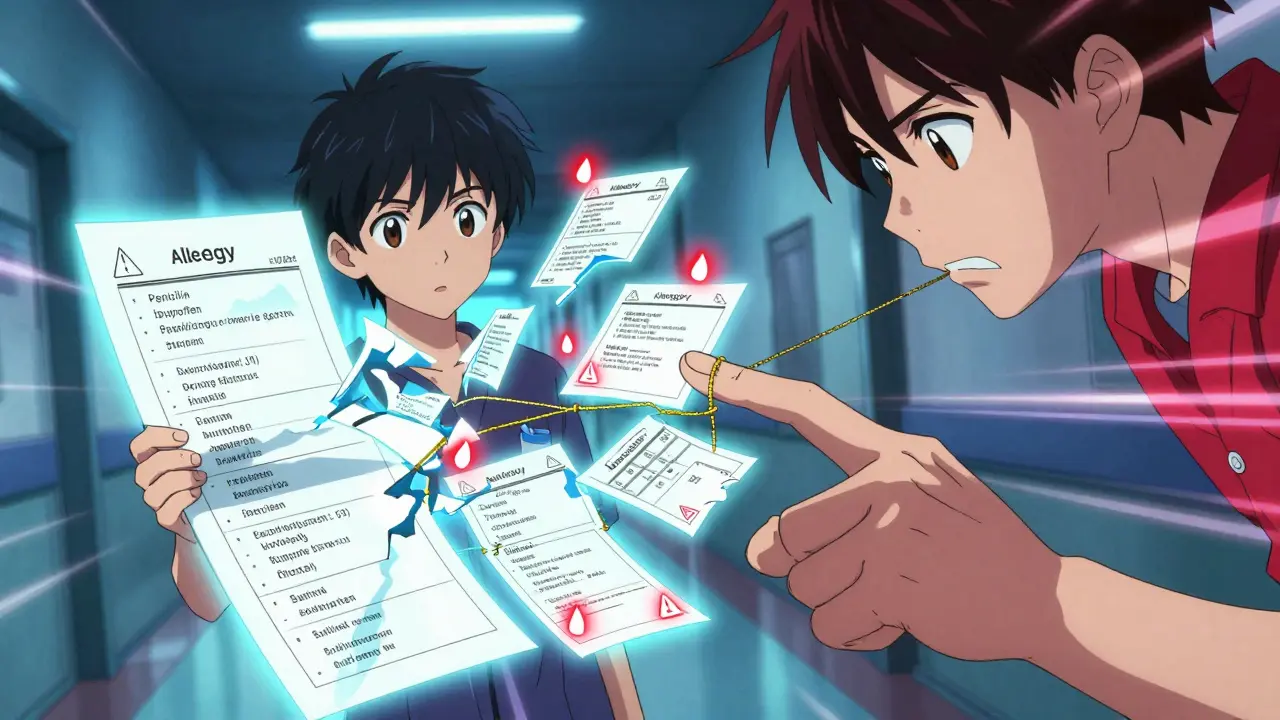
Every time you walk into a new doctor’s office, hospital, or pharmacy, your allergy list should be accurate - because one wrong entry could mean a life-threatening reaction. Yet, studies show that up to 12.9% of allergy records in electronic health systems are wrong, outdated, or incomplete. That’s not a small risk. It’s a silent threat that happens in clinics, emergency rooms, and even your regular GP’s office. The good news? You can fix this. And you don’t need to wait for your provider to catch up.
Why Your Allergy List Is Probably Wrong
Most people think their allergy list is just a note in their file. It’s not. It’s a live safety signal that tells every clinician: “Don’t give this drug.” But here’s the problem: allergies get mislabeled all the time. A rash after taking amoxicillin at age 8? That’s often not a true allergy - it’s a side effect. Yet, it sticks in your record for decades. By the time you’re 40, you’re being given stronger, more expensive antibiotics because your old “penicillin allergy” hasn’t been reviewed. The real issue isn’t just about drugs. Allergy lists often miss food reactions, environmental triggers, or even latex. And worse - they rarely get updated across systems. If you saw a specialist in Sydney, then moved to Brisbane and saw a new GP, chances are your Brisbane provider doesn’t know about the severe reaction you had to ibuprofen last year. Why? Because most EHR systems still just show your allergies from other clinics - they don’t compare them to your actual medical history.What Your Allergy List Should Include (The New Standard)
As of January 1, 2025, every certified electronic health record in the U.S. and Australia must follow the USCDI v3 standard for allergy documentation. That means your allergy entry isn’t just “Penicillin - rash.” It needs to be:- Exact substance (e.g., “Amoxicillin,” not just “Penicillin”)
- Reaction description (e.g., “Hives within 30 minutes,” “Anaphylaxis with throat swelling”)
- Timing (e.g., “Occurred in 2018 after a single dose”)
- Severity (Mild, Moderate, Severe)
- Verification status (Patient-reported, Clinically verified, or Confirmed by challenge test)
Step-by-Step: How to Update Your Allergy List
You’re not powerless. You can take control - even if your provider doesn’t have the fancy tools. Here’s how:- Get a copy of your current allergy list - from every provider you’ve seen in the last 5 years. Use your patient portal, call the records department, or request a printed copy. Don’t assume your GP has the full picture.
- Compare them side by side - Look for mismatches. Did one provider list “NSAID allergy” while another says “Ibuprofen reaction”? Did one say “verified” and another say “patient-reported”? Write down every difference.
- Clarify what’s real - If you’re unsure about an allergy (e.g., “I had a rash once - is that still an allergy?”), ask for a drug challenge test. It’s safe, simple, and often done in an allergist’s office. Many people who think they’re allergic to penicillin turn out not to be - and that opens up better, cheaper treatment options.
- Update your records - Go to each provider’s office or portal and submit a formal request to update your allergy list. Don’t just say, “I think I’m not allergic anymore.” Say: “I had a penicillin challenge on [date] at [clinic], and the result was negative. Please remove ‘Penicillin allergy’ from my record and replace it with ‘No known penicillin allergy - verified by challenge test.’”
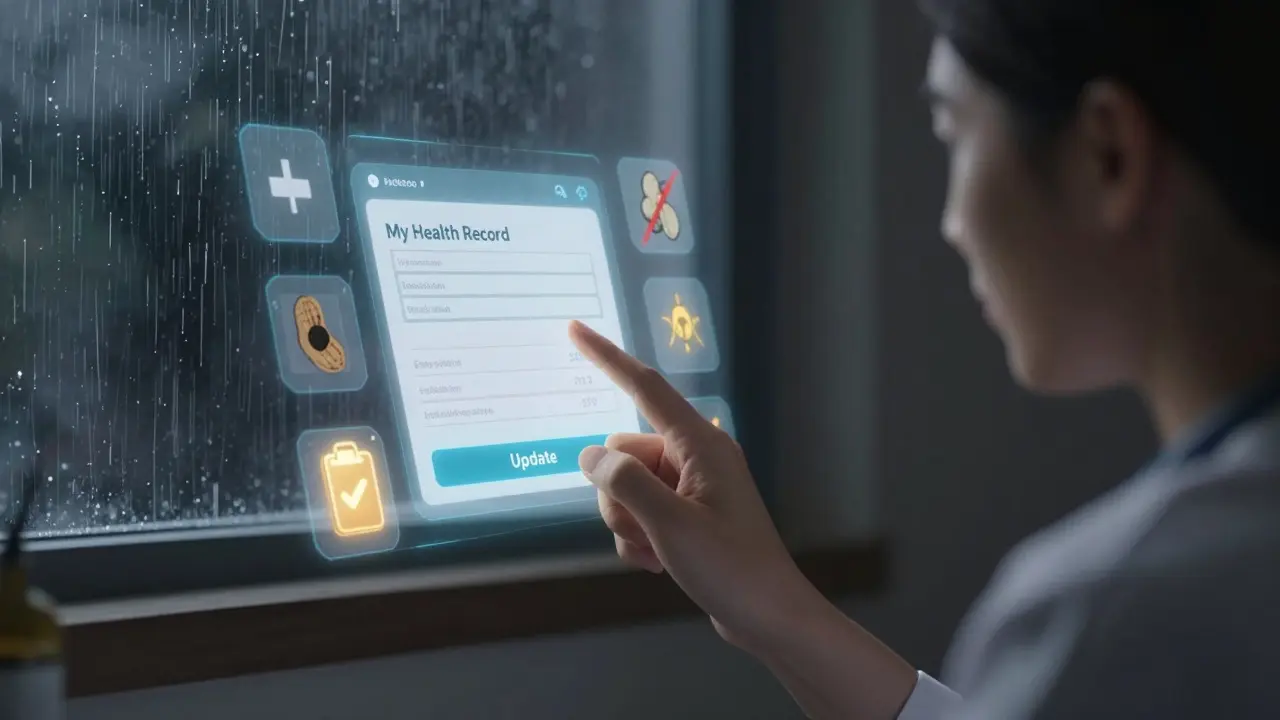
- Use your patient portal - Most portals now let you submit updates directly. In Australia, My Health Record allows patients to add or correct allergy entries. If yours doesn’t, ask why - and push for it.
What Your Provider Should Be Doing (But Probably Isn’t)
The best clinics use AI-powered tools to automatically spot discrepancies. Systems like those at Mass General Brigham scan your clinical notes, lab results, and medication history to flag mismatches - like when a patient has a “penicillin allergy” in their record but was prescribed amoxicillin three times last year with no reaction. These tools catch errors before they cause harm. But here’s the catch: only 28% of community hospitals have these advanced systems. Most still rely on manual checks. That means if your provider doesn’t use a reconciliation tool, they’re flying blind. That’s why your personal effort matters so much.What to Do If Your Provider Refuses to Update Your Record
Sometimes, providers are slow, busy, or don’t understand the risk. If they say, “We’ll update it when we get around to it,” or “We don’t change records based on patient requests,” here’s what to do:- Ask for a written explanation - get it in writing if they refuse.
- Request a formal “Patient Request for Record Amendment” form - this is your legal right under Australian Privacy Principles and HIPAA-equivalent laws.
- Take your records to another provider - if your current doctor won’t fix it, go elsewhere. Your health record belongs to you.
- Report persistent issues to your local health ombudsman - in Queensland, that’s the Office of the Health Ombudsman.

How to Keep It Updated Going Forward
Updating your list once isn’t enough. Allergies change. New reactions happen. Here’s how to stay ahead:- Review your list at every appointment - even if you think nothing’s changed.
- Ask your pharmacist to flag new medications against your allergy list - they’re trained to catch conflicts.
- Keep a personal health journal - note new reactions with dates and symptoms. Bring it to every visit.
- Use My Health Record (Australia) or equivalent - update it after every doctor’s visit. It’s your single source of truth.
- Teach your family - make sure someone else knows your allergies in case you can’t speak for yourself.
Why This Matters More Than You Think
Inaccurate allergy records cost the U.S. healthcare system $1.2 billion a year in unnecessary antibiotics, longer hospital stays, and avoidable reactions. But beyond the money - it’s about safety. A 2022 study found that 10% of patients who had an anaphylactic reaction due to a mislabeled allergy died. That’s not a statistic. That’s someone’s parent, sibling, or friend. You’re not just updating a file. You’re preventing a medical emergency.When you take control of your allergy list, you’re not being difficult. You’re being smart. You’re the only person who knows your body. No algorithm, no EHR, no doctor has that information better than you.
Can I remove an allergy from my record if I think it’s wrong?
Yes. If you believe an allergy was misdiagnosed or has resolved, you can request removal. The best way is to get a formal drug challenge test done by an allergist. Once confirmed, bring the results to your provider and ask them to update your record with the verification status: “Negative challenge - no longer allergic.” This is now standard practice under USCDI v3.
Do I need to update my allergy list with every provider?
Yes - unless your providers are using a fully interoperable system with advanced reconciliation. Most aren’t. Even if you’re in the same hospital network, different departments may use different EHRs. Always verify your allergy list at the start of every visit. Don’t assume it’s already updated.
What if I have food or environmental allergies, not drug allergies?
Include them. Many EHRs still treat food allergies as secondary, but they’re just as critical. A severe peanut allergy can trigger an emergency in a hospital kitchen or during a procedure using latex gloves. Document the exact allergen (e.g., “Peanuts - anaphylaxis”), severity, and reaction timing. Push to have these added to your primary allergy section - not buried in “Other Notes.”
Can I update my allergy list through My Health Record?
Yes. My Health Record allows patients to add, edit, or remove allergy entries. Log in, go to “Allergies and Adverse Reactions,” and click “Add.” You can upload documentation from your doctor or allergist. While providers can override your entries, your version becomes part of the official record and must be considered in clinical decisions.
How long does it take for an allergy update to appear across providers?
If you update your record in a system that uses FHIR-based interoperability (like Epic, Cerner, or My Health Record), changes should sync within 24-48 hours. But if your provider uses an older system, it may never sync automatically. Always confirm with each provider you see - don’t rely on automatic updates.
Are there tools or apps to help manage my allergy list?
Yes. Apps like Medisafe, MyTherapy, and even Apple Health allow you to store detailed allergy records. But these are personal tools - they don’t connect to your EHR. Use them to prepare for appointments, but always update your official medical record through your provider or My Health Record. A digital list on your phone won’t stop a nurse from giving you the wrong drug if the hospital system doesn’t know.





Comments
Gregory Clayton
January 10, 2026 AT 03:43This is why America’s healthcare is a dumpster fire. I had a doctor write 'allergic to penicillin' in my chart after I got a rash at 12. Now I’m 34 and they give me Cipro like it’s candy because they don’t bother checking. Meanwhile, my cousin died from anaphylaxis because her record said 'no allergies' - she had a latex reaction during surgery and they didn’t know. This isn’t advice - it’s a cry for help from people who are tired of being treated like data entry errors.
Catherine Scutt
January 10, 2026 AT 07:01Wow. So you’re saying we’re supposed to be our own medical admins now? Great. Just what we needed - another unpaid job on top of parenting, working, and paying taxes. And let’s not forget the 70-year-olds who don’t know how to use a patient portal. This system is broken, and now you want patients to fix it? No thanks.
Alicia Hasö
January 11, 2026 AT 07:24Let me tell you something - your health record isn’t just paperwork. It’s your lifeline. I used to think allergies were just 'meh, I get a rash sometimes.' Then my daughter went into anaphylaxis because her chart said 'mild reaction to peanuts' - but she’d had full-blown swelling three times before. We fought for two years to get it updated. Now she carries two epinephrine pens everywhere. If you’re not updating your allergy list, you’re not just being lazy - you’re gambling with your life. And your family’s. And your doctor’s. This isn’t a suggestion. It’s survival.
Jacob Paterson
January 13, 2026 AT 02:23Oh wow, you actually believe the government’s 'USCDI v3' nonsense? You think a checkbox on a portal is going to fix systemic incompetence? I’ve seen EHRs where 'allergy: penicillin' was entered as 'PCN' and the system auto-filled 'penicillin' as 'penicillin G' - which is a different drug. And now you want me to 'verify with a challenge test'? Cool. Let me just take a pill in front of my GP while they’re busy texting their kid’s soccer coach. This is like asking someone to fix a sinking ship by polishing the deck chairs.
Phil Kemling
January 13, 2026 AT 13:50It’s funny - we treat our phones like sacred objects. We update them weekly, back them up, encrypt them. But our medical records? Tossed into some server like last week’s takeout. We’ve outsourced our bodies to institutions that can’t even spell 'allergy' consistently. Maybe the real question isn’t how to update the list - it’s why we let systems this fragile control something so vital. We’re not patients. We’re liabilities in a database.
Diana Stoyanova
January 14, 2026 AT 01:29Okay, I just did this. I went through every provider I’ve ever had since 2018. Found six different versions of my 'allergy to ibuprofen.' One said 'mild rash,' another said 'anaphylaxis,' and one didn’t even list it. I called my allergist, got the challenge test done, and submitted the report to every portal. Took me three hours. I cried. But now? My record says 'Negative challenge test - no longer allergic.' And guess what? My pharmacist actually called me back to confirm. That’s the power of being annoying. Be annoying. Be loud. Be the person who won’t shut up until your chart is right. Because if you don’t, someone else will pay the price - and it won’t be them. It’ll be you.
Elisha Muwanga
January 15, 2026 AT 13:10Another woke healthcare fantasy. Next you’ll tell us to manually audit our insurance claims and recalibrate our insurance premiums. This isn’t patient empowerment - it’s institutional abandonment. If your EHR can’t sync across providers, that’s not your fault. It’s the fault of the $2 billion industry that built broken software and called it 'interoperability.' Stop blaming the patient. Start suing the vendors. This isn’t a checklist - it’s a corporate failure dressed up as a public service announcement.
Aron Veldhuizen
January 17, 2026 AT 08:18Actually, you’re wrong. The USCDI v3 standard doesn’t mandate 'verification status' - it mandates 'certainty.' There’s a difference. And 'patient-reported' is not a valid verification status under any clinical guideline. Also, you’re conflating 'allergy' with 'adverse reaction.' A rash isn’t an allergy. A GI upset isn’t an allergy. Only IgE-mediated responses are. So if you’re telling people to update their records with 'I had a stomach ache after penicillin' - you’re not helping. You’re creating noise. And noise kills. Precision matters. Stop misinforming people.
Meghan Hammack
January 19, 2026 AT 00:17You got this. Seriously. I was scared to ask my doctor to change my record too. But I printed out my whole history, highlighted the contradictions, and walked in with a coffee and a calm face. She said, 'You’re right - we missed this.' And now my record’s clean. Don’t wait for them to catch up. Be the one who shows up with the facts. You’re not being difficult - you’re being brave. And your future self will thank you.
Angela Stanton
January 20, 2026 AT 15:16TL;DR: Your EHR is a dumpster fire. Your allergies are likely misclassified. Your provider is probably using a 2010s legacy system. Your phone app doesn’t count. My Health Record? Only if you’re in Australia. HIPAA? Doesn’t enforce accuracy. You’re on your own. Pro tip: screenshot your record after every visit. If your provider refuses to update, file a complaint with OCR. And if you’re still alive after all this? Congrats. You’ve just completed the Healthcare Survivor Challenge™. 🎉🩺💥